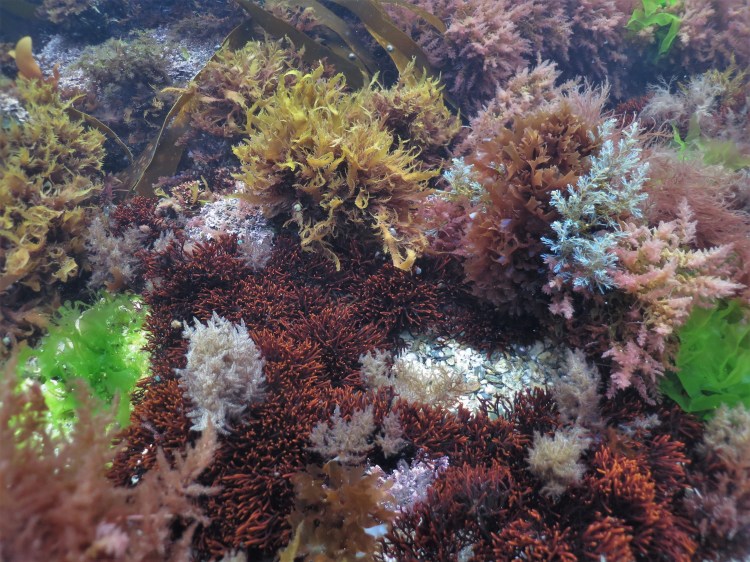
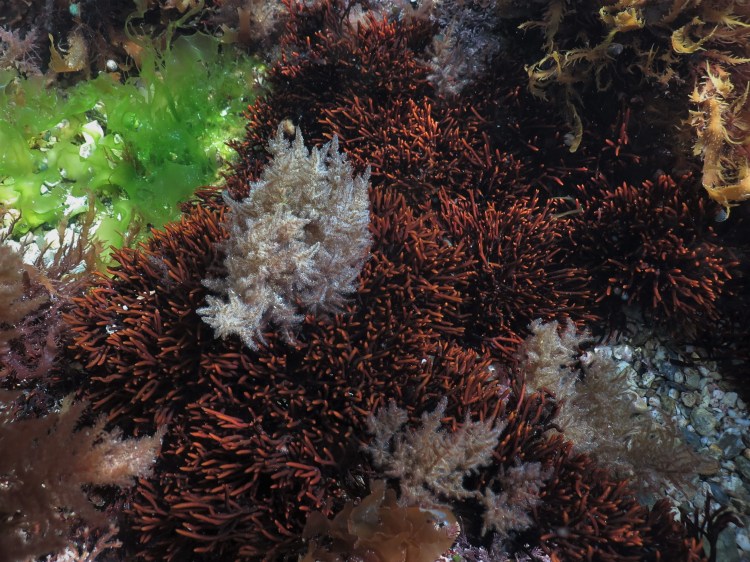
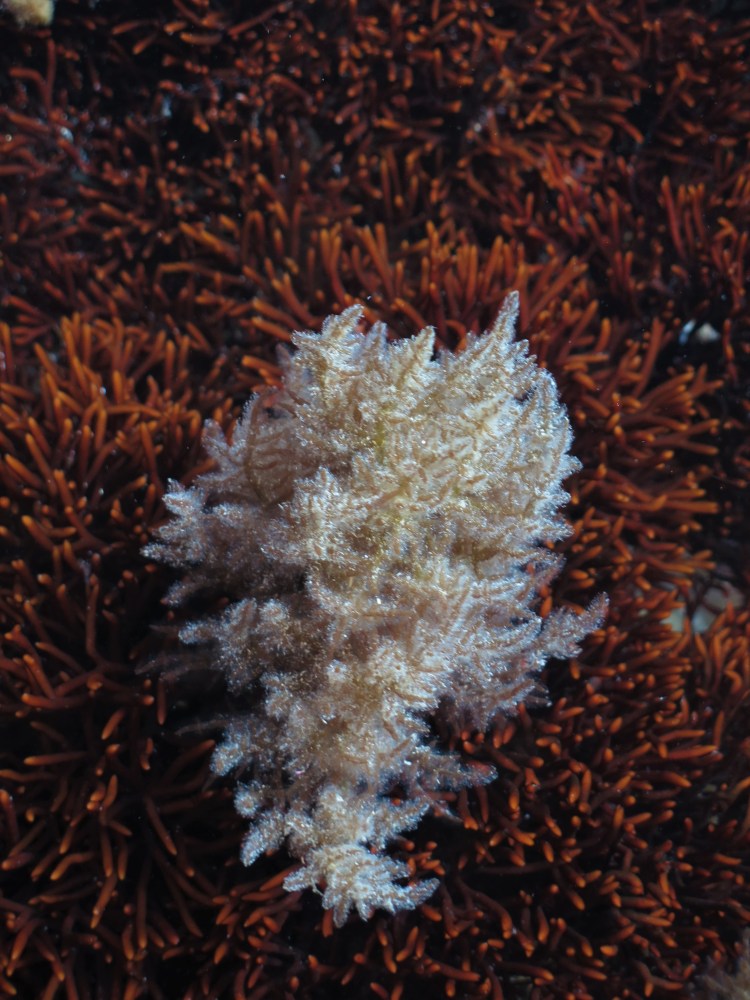
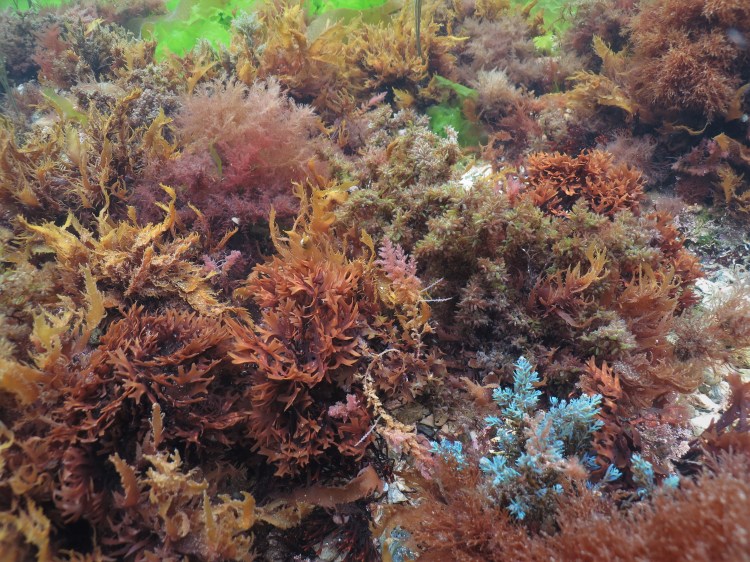
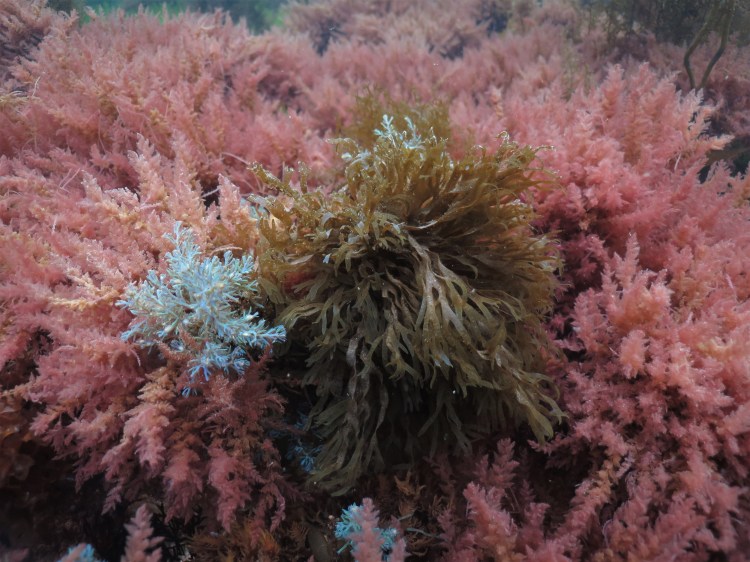
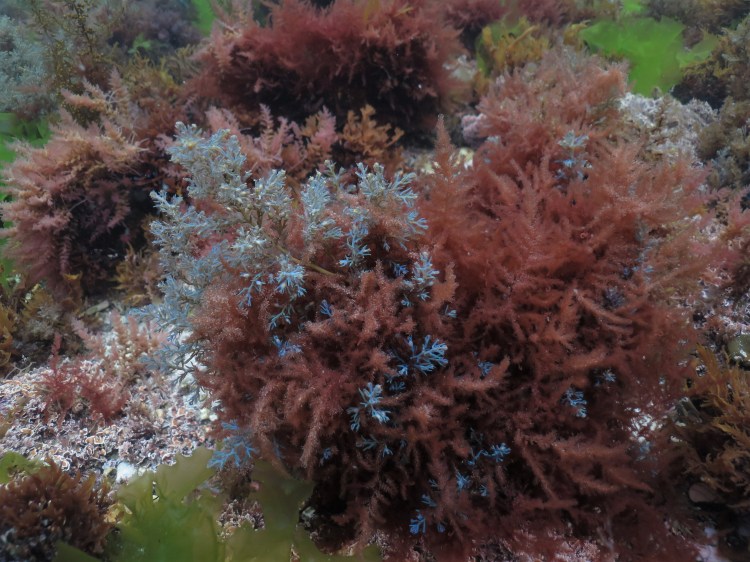
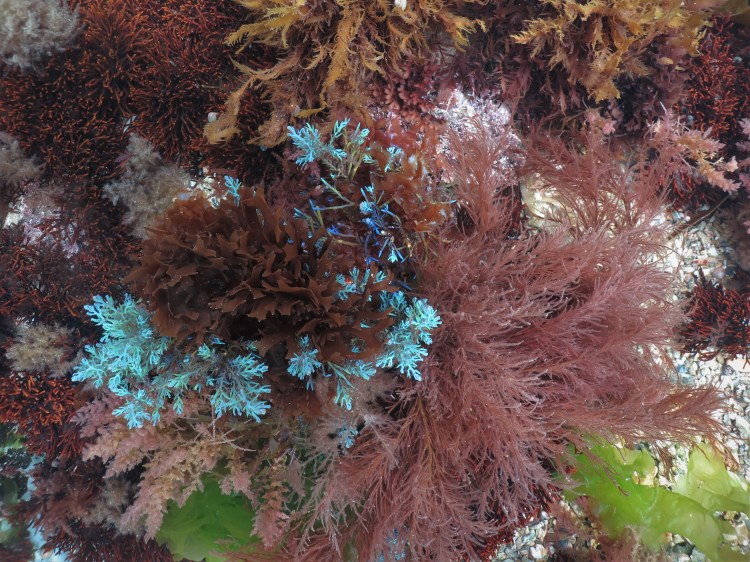
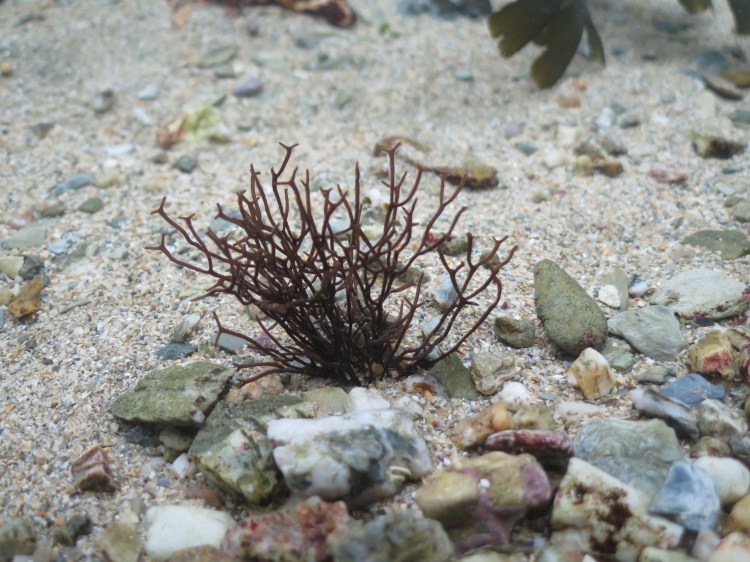
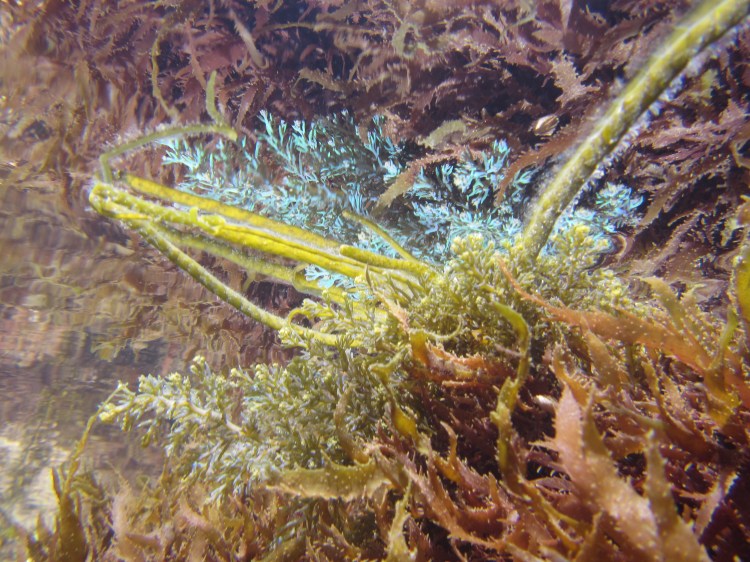
 Above an illustration of the decline of seaweeds: Juicy whorl weed Chylocladia verticillata all white and fuzzy (see for a more healthy looking plant this post from 2.5 months ago) on a bed of the common and pretty Discoid fork weed Polyides rotundus. There seem to be around 25 or so (larger) species that are common in these pools. Many of them can be seen in the two photos below (including a stray Bladder wrack, a species that dominates the shore just a meter higher):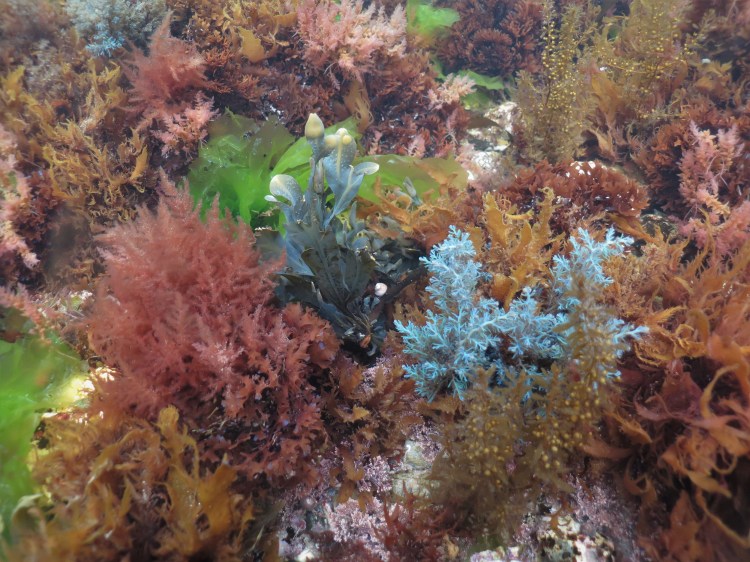
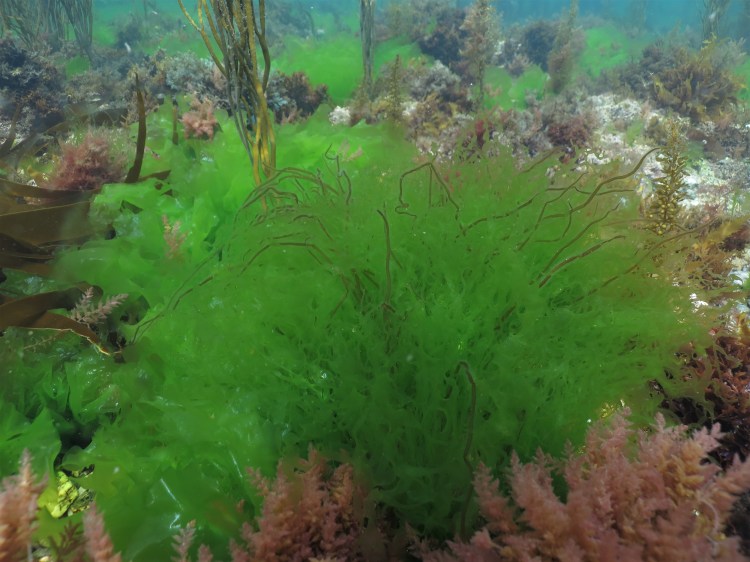
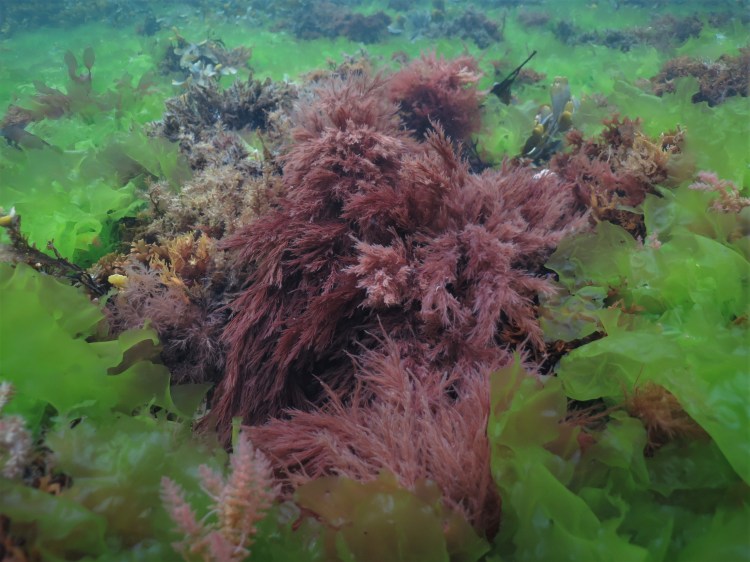
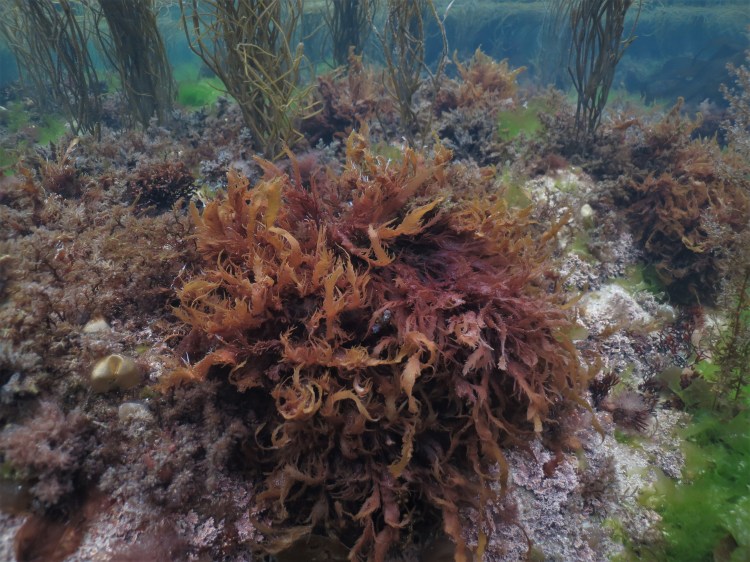
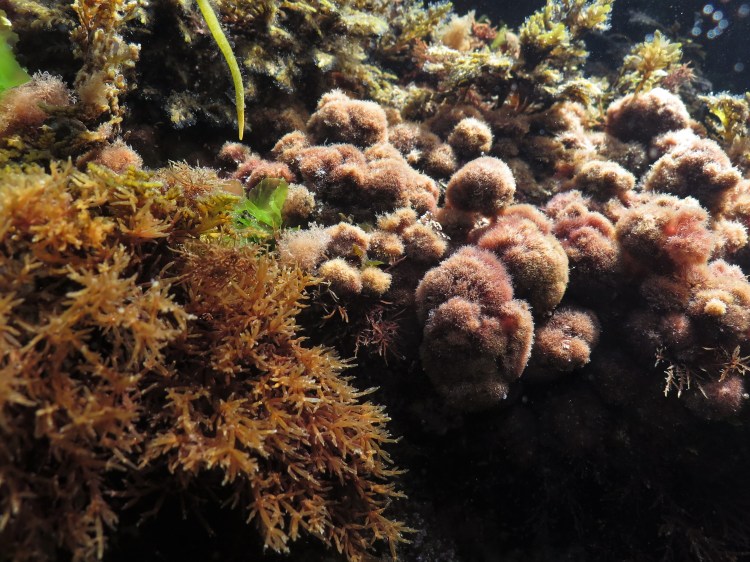
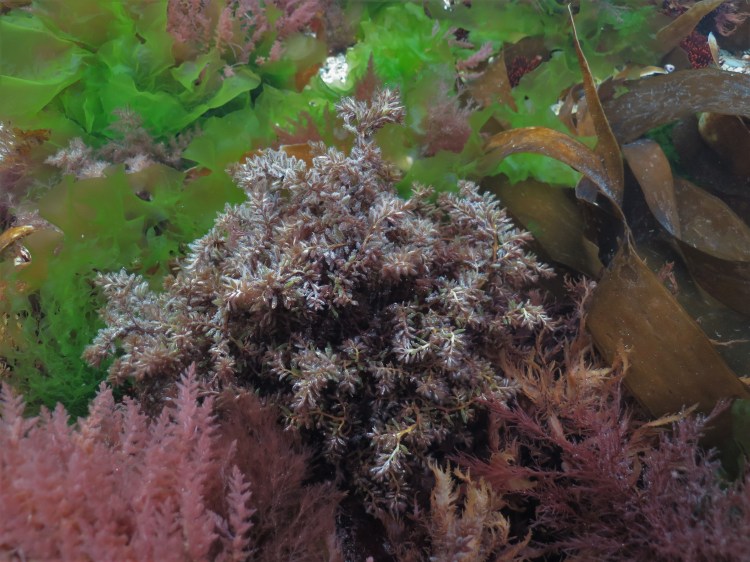
 Below, a whole bunch of individual species. First, Sea beech Delesseria sanguinea, which must have washed up from under the kelp beds (too bad I did not get the entire plant in frame…). Second, a photo of Ulva with Chipolata weed Scytosiphon lomentaria. Third, the brown Divided net weed Dictyota dichotoma. Fourth, Slender wart weed Gracilaria gracilis. Fifth, False eyelash weed Calliblepharis jubata; this plant has grown quite large and has turned from dark red/brown to a much lighter brown. Sixth, the Falkenbergia stage of Harpoon weed Asparagopsis armata (see the third photo) on the right. Seventh, Red grape weed Gastroclonium ovatum. Finally, two photos of my favourite species the blue Bushy rainbow wrack Cystoseira tamariscifolia.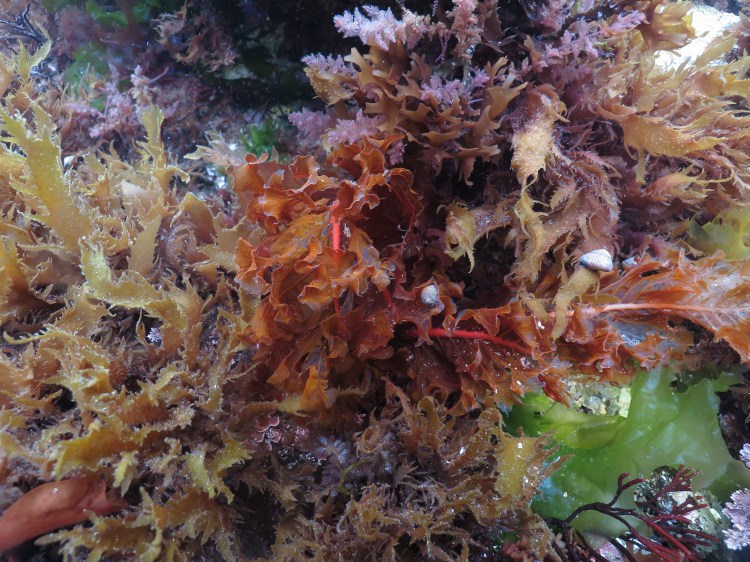
Tag Archives: Bushy rainbow wrack
Falmouth Seaweeds: Mid-March part 2
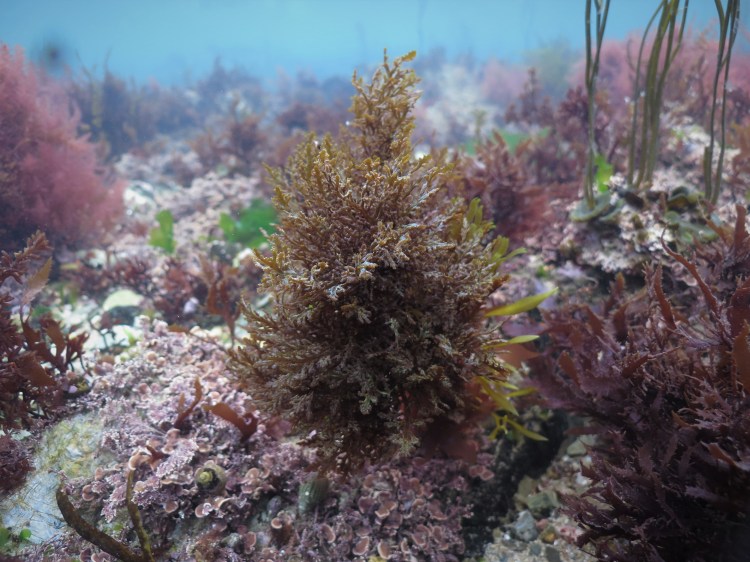 More seaweed photos, taken a couple of days after the ones in the previous post, when it was overcast and the water was less clear. The photos are not as good, but there are still a lot of interesting species to see. Below some photos showing the diversity of species next and on top of each other. In the last two months, most species have been growing quite a lot. There are quite large patches of Slender-beaded coral weed Jania rubens. Bushy rainbow wrack Cystoseira tamariscifolia plants are completely overgrown with all kinds of epiphytes, seaweeds, sponges and colonial tunicates, and often have a Nursehound egg case attached.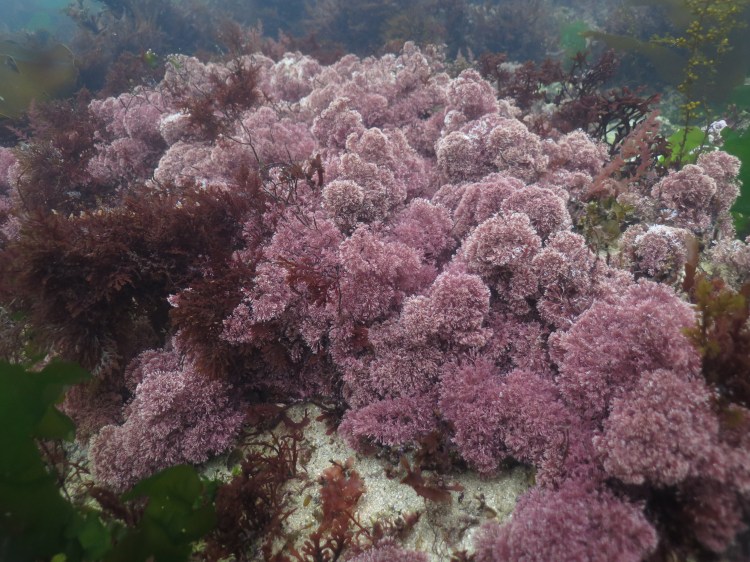
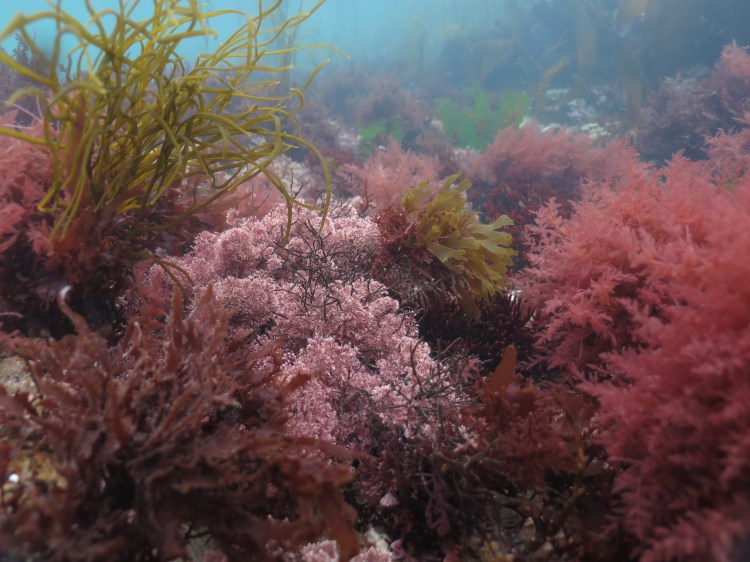
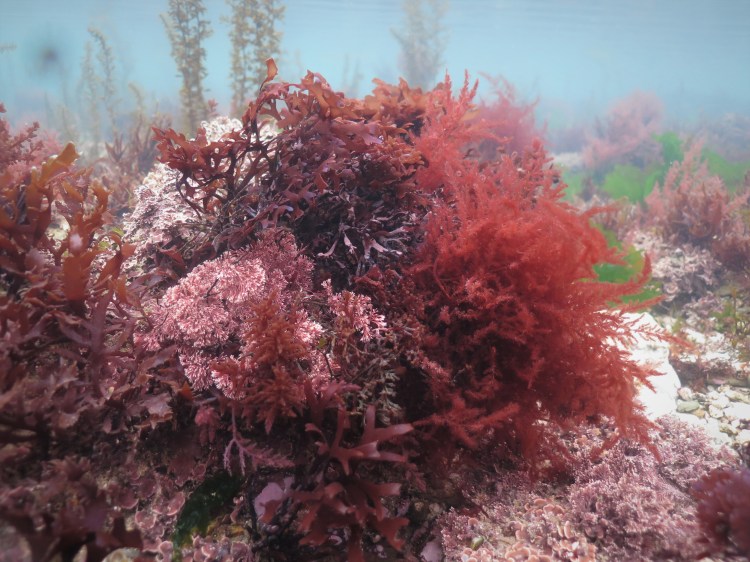


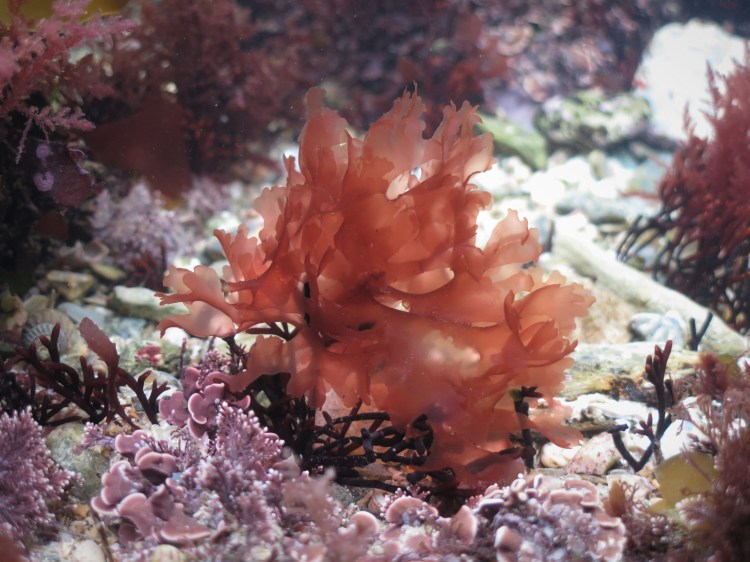
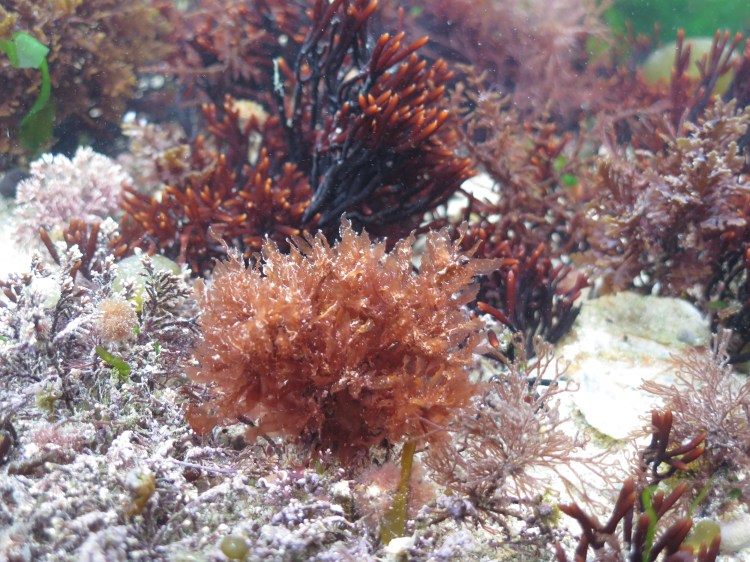
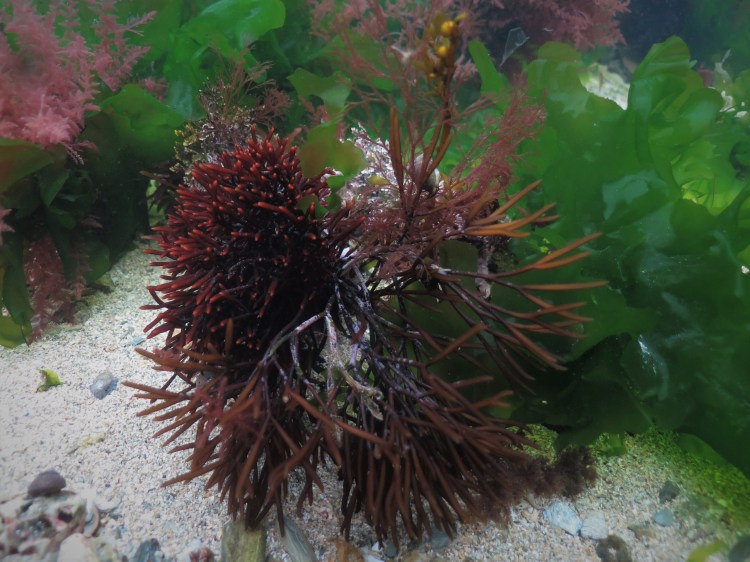
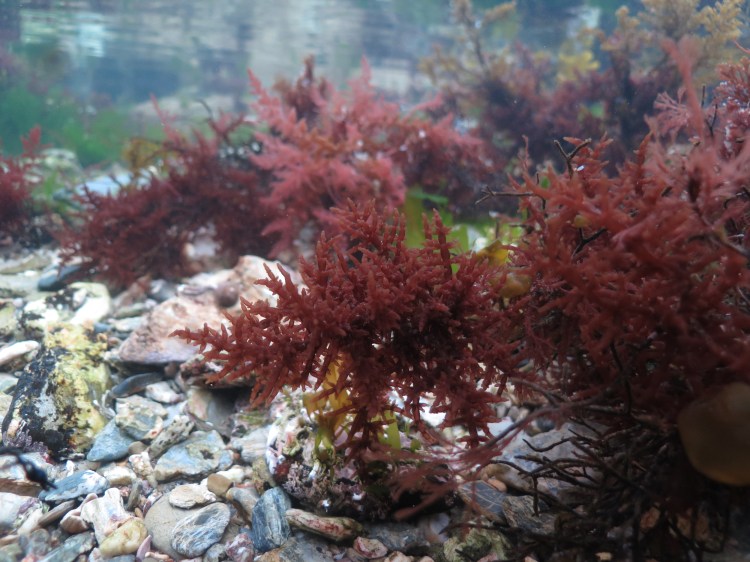
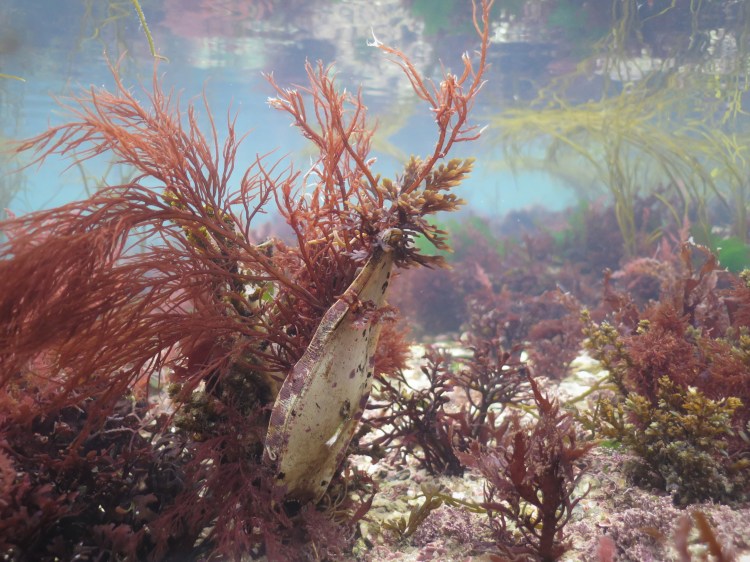 Next, photos of individual species. First some flat reds: Leafy rose weed Rhodophyllis divaricata, Beautiful fan weed Callophyllis laciniata, Branched hidden ribs Cryptopleura ramosa (probably), the invasive species Devil’s tongue weed Grateloupia turuturu and Under tongue weed Hypoglossum hypoglossoides. After that, two species that look a bit similar: left the reddish Discoid fork weed Polyides rotundus and right Clawed fork weed Furcellaria lumbricalis. The former is one of the most common species (also on the photo above it) but difficult to photograph as it usually sits on the white sand. After that, Juicy whorl weed Chylocladia verticillata. Last, two quite unassuming species: Black scour weed Ahnfeltia plicata and Sea flax weed Stypocaulon scoparium. Identifications made possible using the must-have Seasearch Guide to Seaweeds of Britain and Ireland, David Fenwick’s excellent aphotomarine website (and personal communication) and the good people of the Seaweeds of the NE Atlantic facebook group (any mistakes are my own).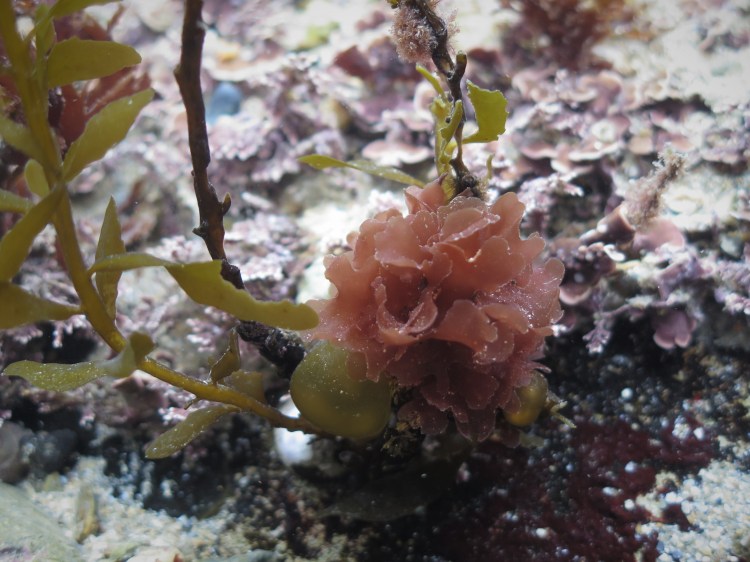



Falmouth Seaweeds: (early) March
 OK, it was the plan to post a general Falmouth seaweed/rock pool photo post every month but I am faltering the second month in… It is not for lack of trying, because I have been sneaking out of the office quite a bit, but the weather has been pretty awful. Lots of wind, choppy waves, rain, cold and bad viz. I had one good day this week and I am posting some of the better pics from that session. Again a photo of Nursehound mermaid’s purses attached to Bushy rainbow wrack, pretty much the only seaweed species these sharks use to attach their egg cases to. This must be because this seaweed species is very sturdy, and especially because it is a perennial: the eggs can take up to twelve months to hatch! Below three more Bushy rainbow wrack Cystoseira tamariscifolia photos. The first photo shows a short plant with few epiphytes but the following photo shows that this species is an especially great substrate for all kinds of other seaweeds, including Harpoon weed, Fern weeds and Juicy whorl weed. The plant in the third photo (unfortunately out of focus) is completely covered by a beautiful flat red species: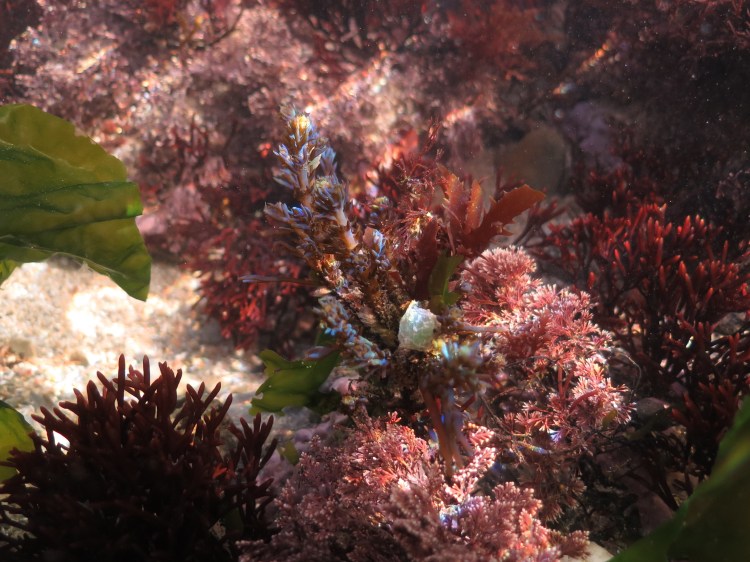

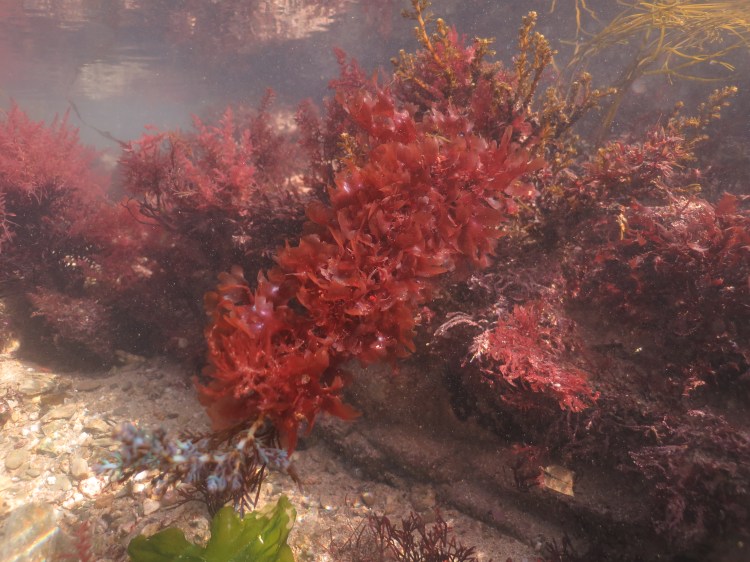
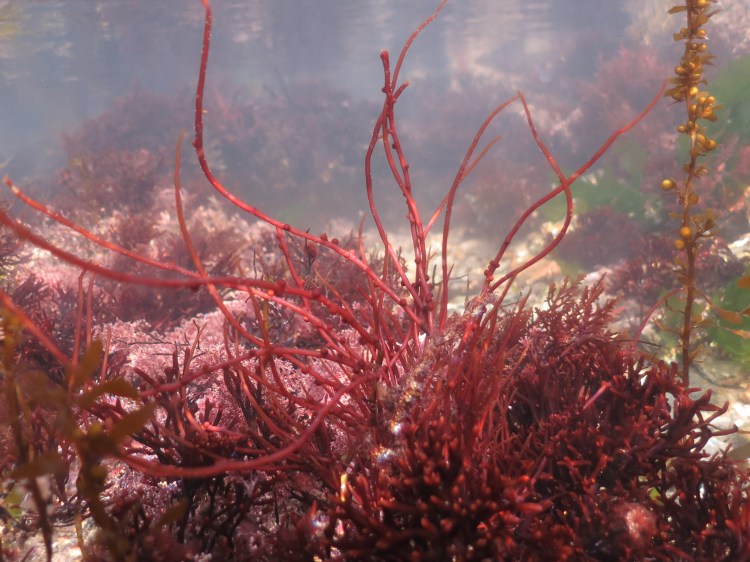
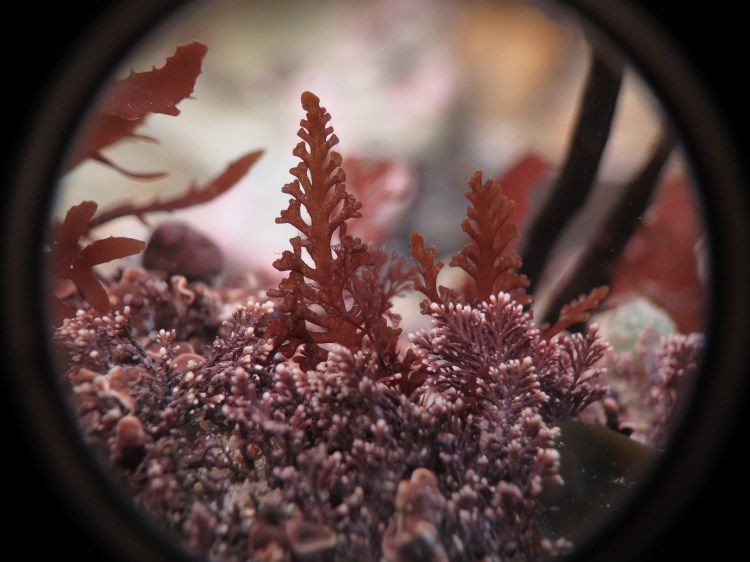
 Above a general impression of the scene before the sun reappeared. Btw, most of the photo’s have not been post-processed but some I have tweaked a little using the standard photo editor that comes with Windows 10, which is actually really good. The seaweeds have been growing quite a bit since January. A few have become more prominent, such as Slender wart weed Gracilaria gracilis (first two photos) and (I am not 100% sure) Purple claw weed Cystoclonium purpureum in the two photos after that. I have a bunch more photos that show different seaweed species, but I hope that I can take better pictures of these later this month for a follow-up post (I am trying to find a balance between showing what I have seen and posting ‘good’ photo’s, which is a bit tricky!). I have a macro lens now as well, which I will mainly use for animals but also can be used for the smaller seaweeds; the last photo is a first attempt.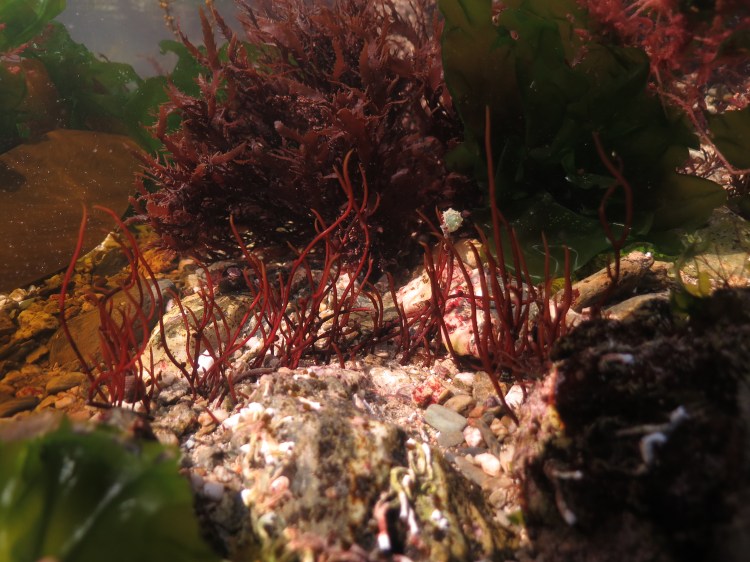


photographing seaweeds with a Canon Powershot part V
I have been a bit busy and so the photos below are some weeks old. The seaweeds are in decline already it seems. Actually, that is not true, there are plenty of seaweeds growing, but some of the prettier ones are dying off and some of the uglier ones are taking over. The window to take the nicest rock pool shots is quite short, pretty much early spring only. The ubiquitous False eyelash weed Calliblepharis jubata is yellowing, the green Sea lettuce Ulva lactuca is starting to cover everything and the Red grape weed is getting ‘fluffy’. Not the best session photo quality-wise and probably the last of the year. The Bushy rainbow wrack Cystoseira tamariscifolia is abundant and looking good (on the photo with Discoid forkweed Polyides rotundus) and I managed I nice shot of young Thong (or Spaghetti) weed Himanthalia elongata. I have done some more research into ‘proper’ underwater cameras and was tipped of about the Canon G16 (thanks Thomas from HydroMotion Media), maybe something for next year….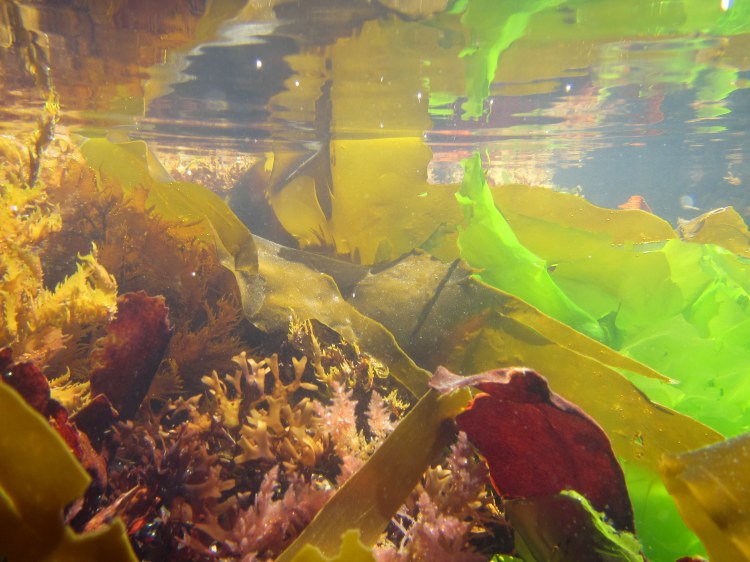


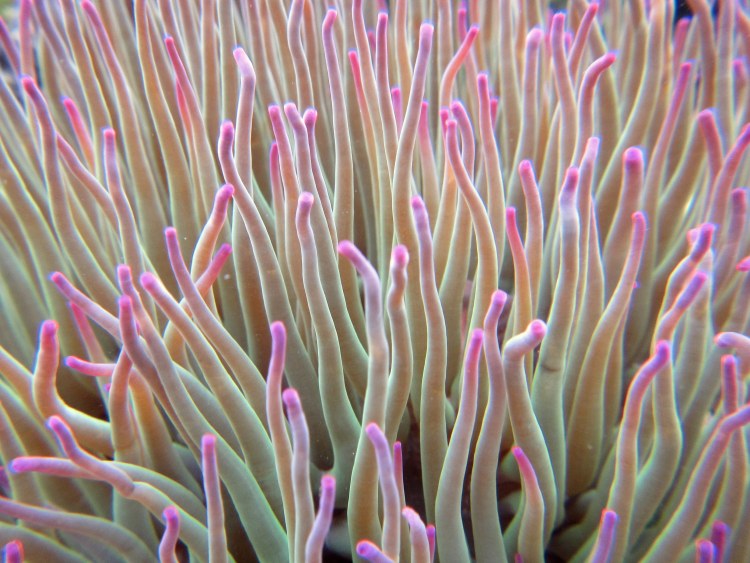
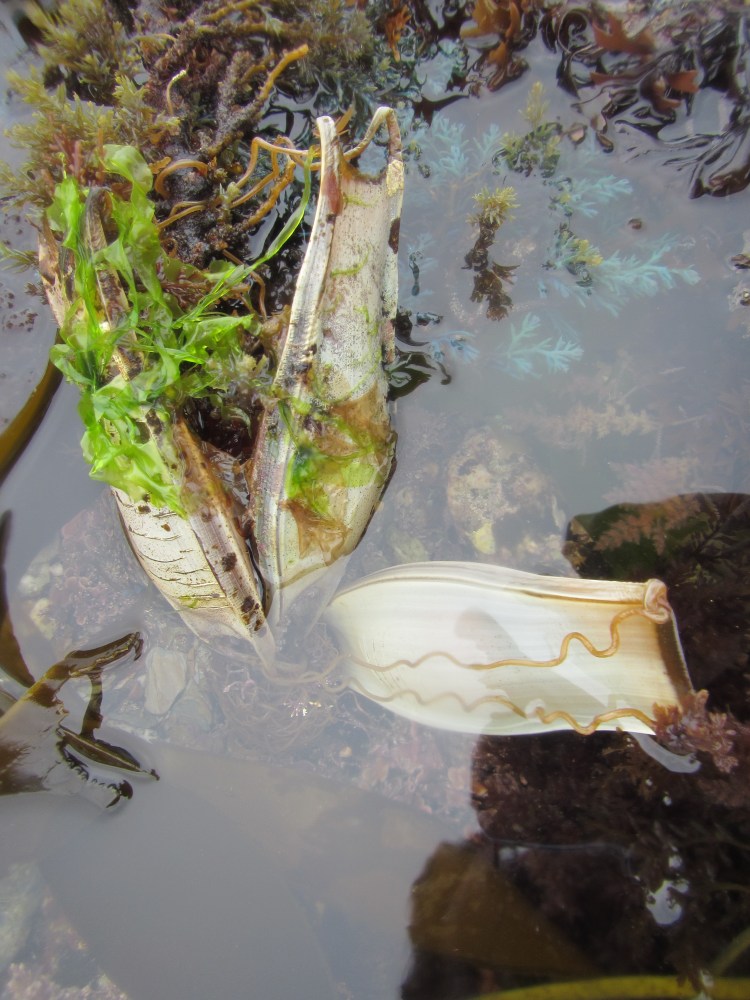
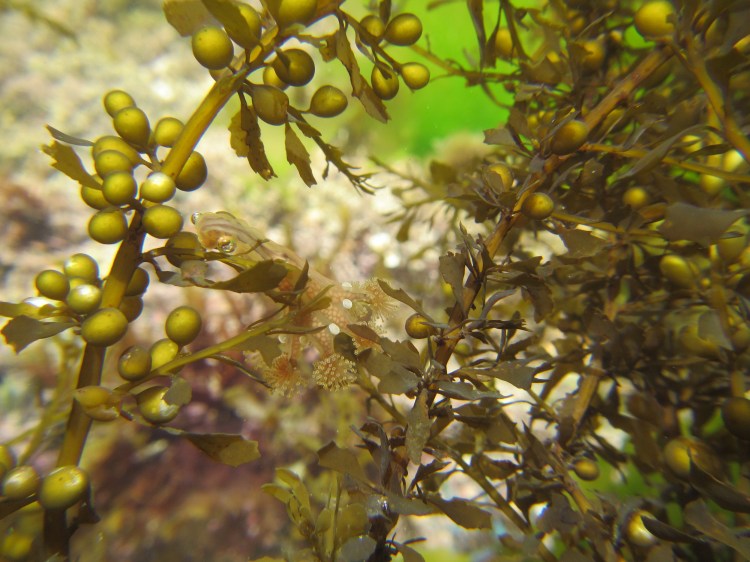
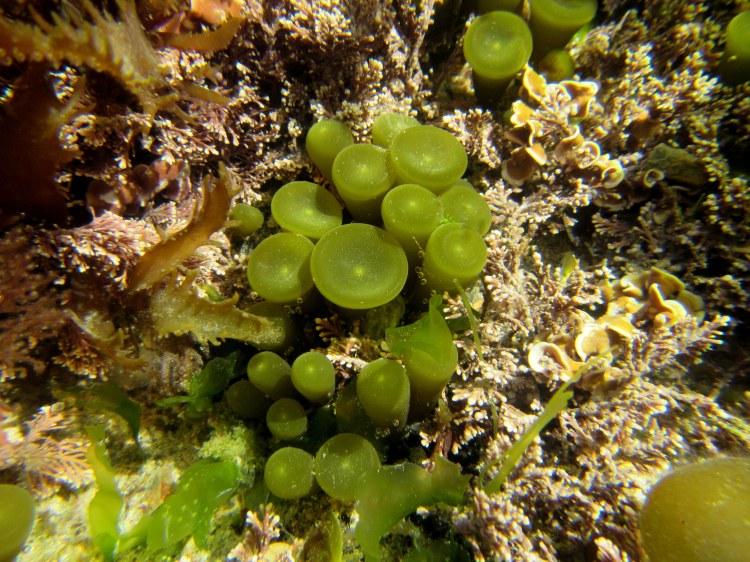 The past couple of times when focusing on the seaweeds I also encountered some animals (it is hard not to). Many Snakelocks anemones Anemonia viridis, with some having very short tentacles. Next, a Decorator crab Macropodia rostrata covered in Banded pincer weed Ceramium. Mermaid’s purses (egg cases) of the Bull huss/Greater-spotted Dogfish/Large-spotted Catshark/Nursehound Scyliorhinus stellaris seem to be exclusively attached to Bushy rainbow wrack. Finally, a Stalked jellyfish Haliclystus octoradiatus on Wireweed Sargassum muticum.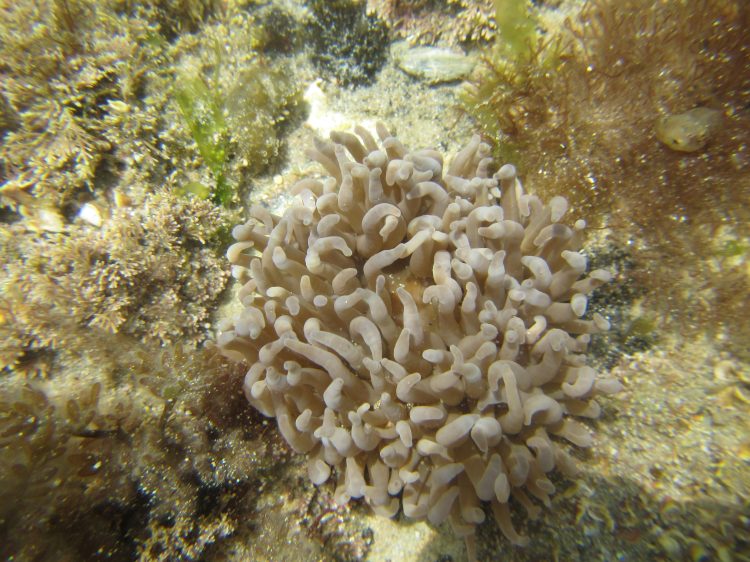



photographing seaweeds with a Canon Powershot part IV
All right then, another post with me fiddling around photographing seaweeds. Composition remains difficult; the next four photographs illustrate this. The diversity of colours and shapes compensate somewhat for it though. I think that a wide-angle lens is crucial to get better pictures: you can get close to the subject (important, as the water is not always crystal clear) whilst still getting a ‘panoramic’ view. Cameras such as the Sony RX100 in an underwater housing can be combined with such lenses (‘wet lenses’ which go on the housing rather than in). Camera, housing and a macro and wide-angle lens will set me back £1000 or so though, so maybe not. In any case there is still plenty room for improvement with the simple Canon Powershot, preventing overexposure for instance. I use Picasa to add some contrast, crop and straighten btw.

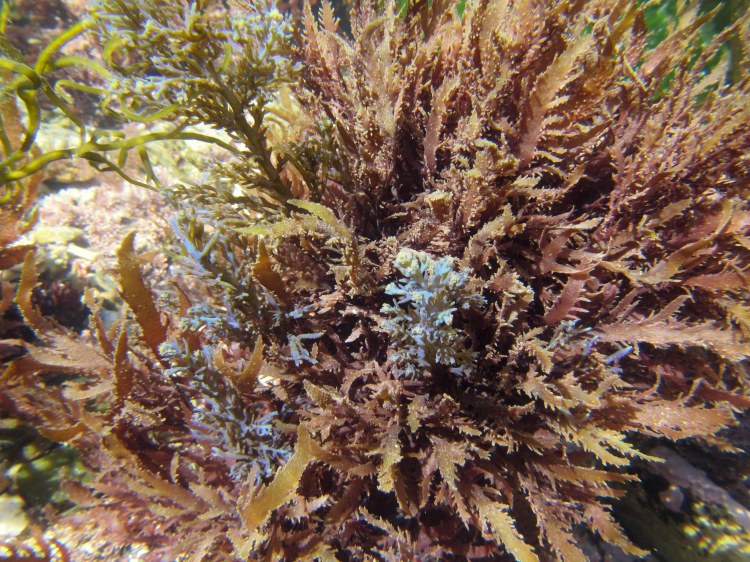
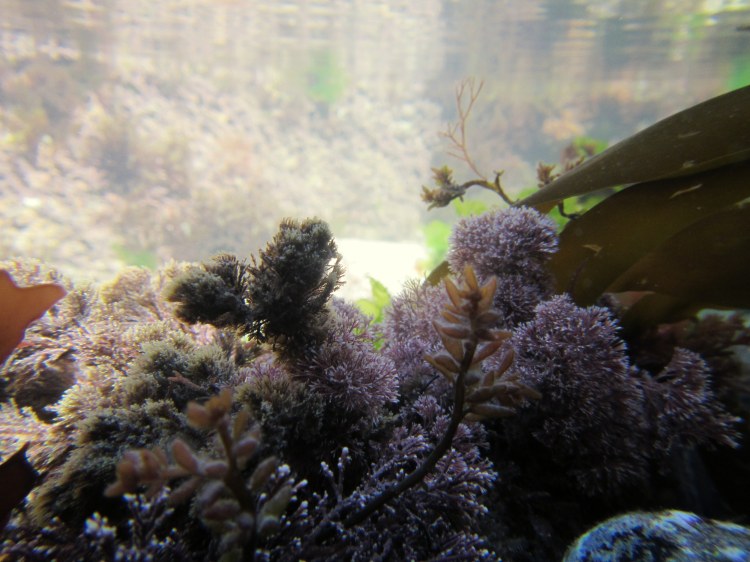
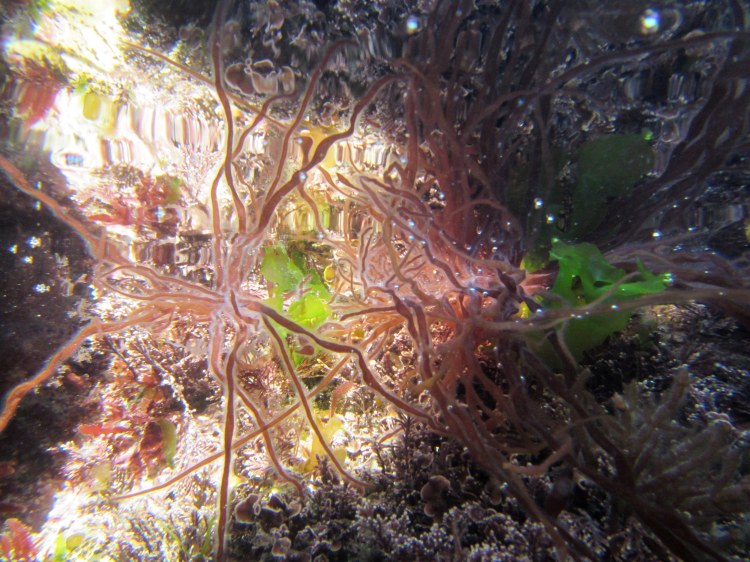
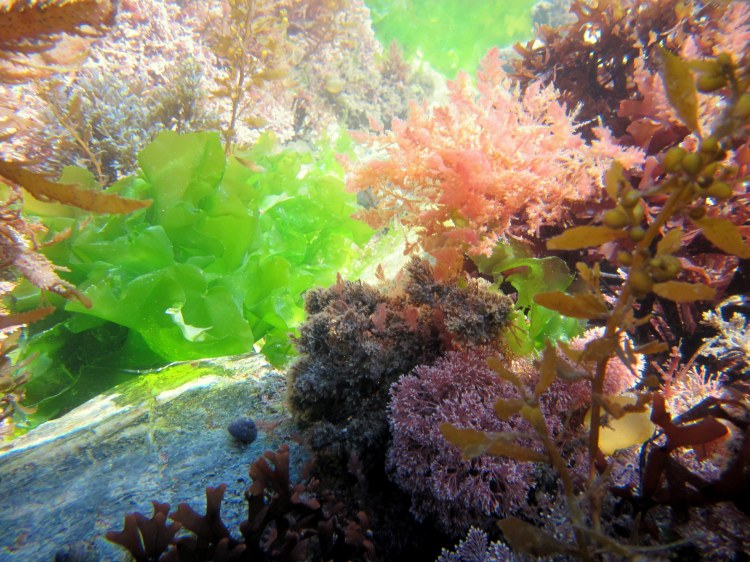
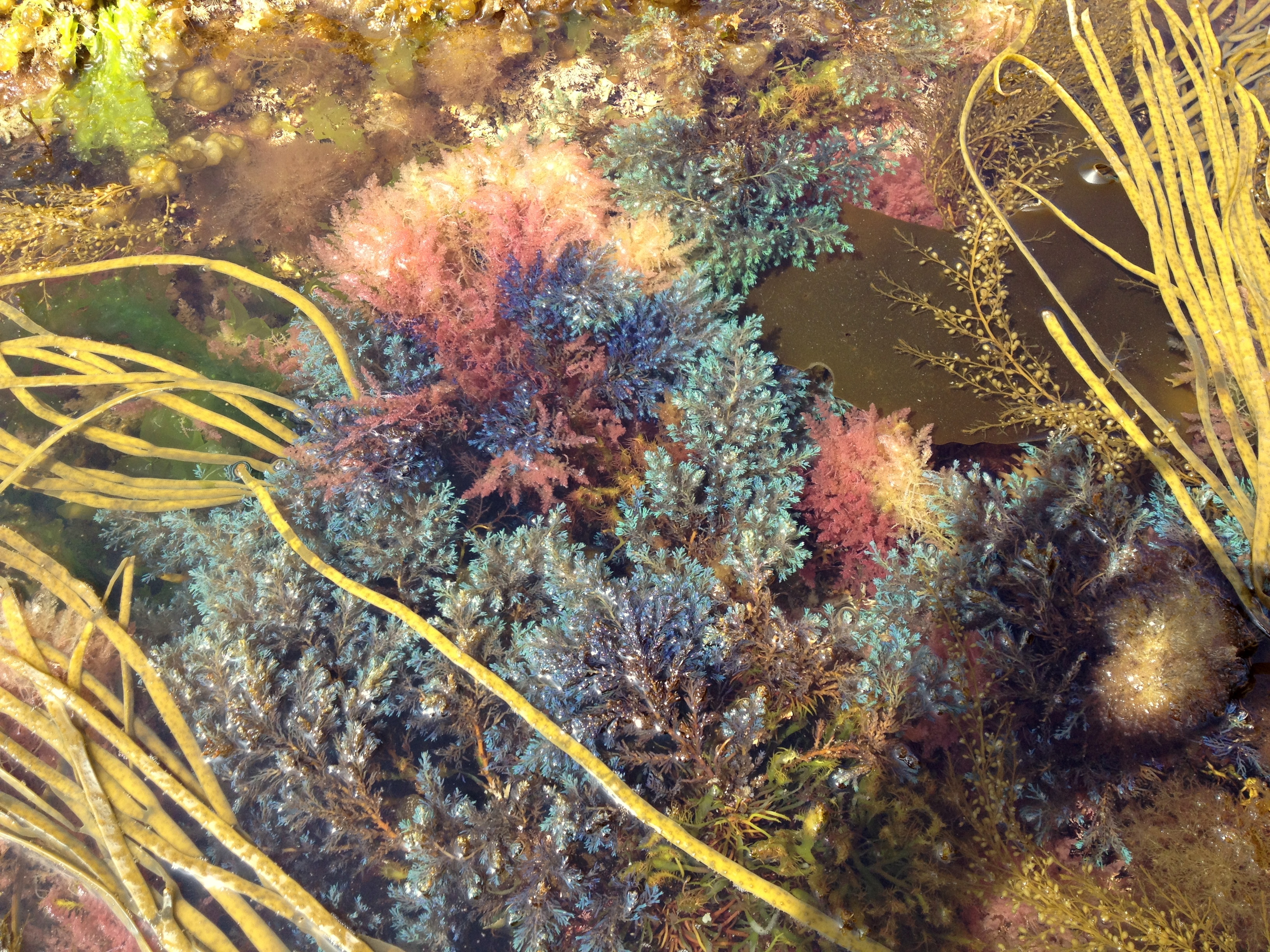
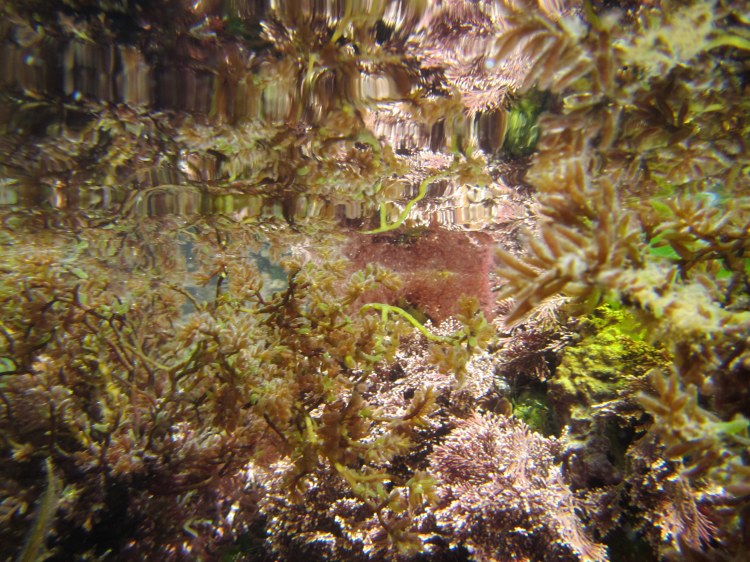 Photographing through gulleys to create some depth makes things a bit more interesting (first picture). The second picture shows an overexposed background and a dark foreground but if properly exposed and in focus this sort of shot could be nice. Shots that are half reflection make things psychedelic and quite cool. This effect works well for Dumont’s tubular weed Dumontia contorta which is common highest up the shore (third picture). It is challenging to capture the beautiful blue-green colour of the Bushy rainbow wrack Cystoseira tamariscifolia as it is caused by iridescence, i.e. physical surface properties (see this old blog post from my work blog for some more info). It thus depends on the angle of view whether these beautiful colours can be seen. In the fourth picture you can see that the seaweed is a dull brown, but its reflection underneath the water surface does reveal the blue colour. The last picture demonstartes the different colours and textures well, but it is overexposed unfortunately.
photographing seaweeds with a Canon Powershot part III
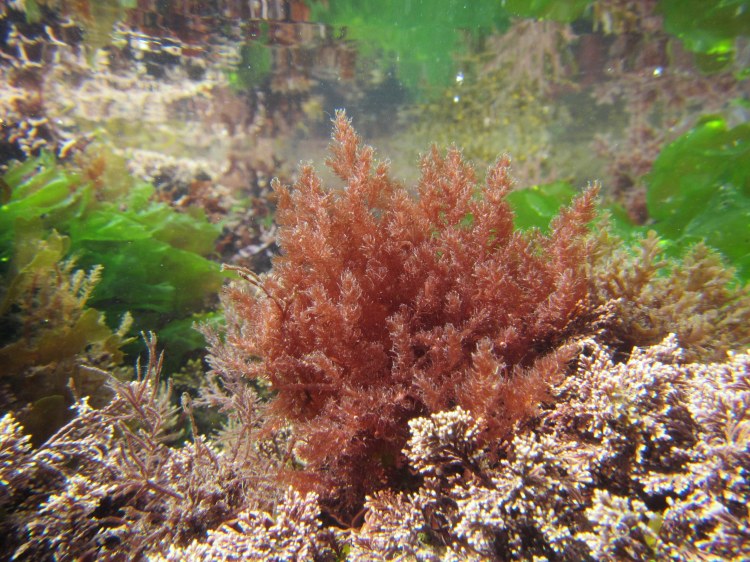
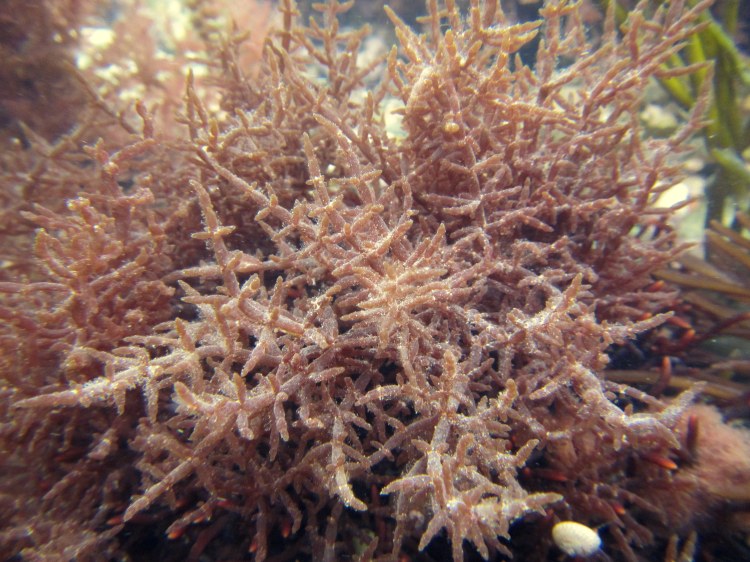
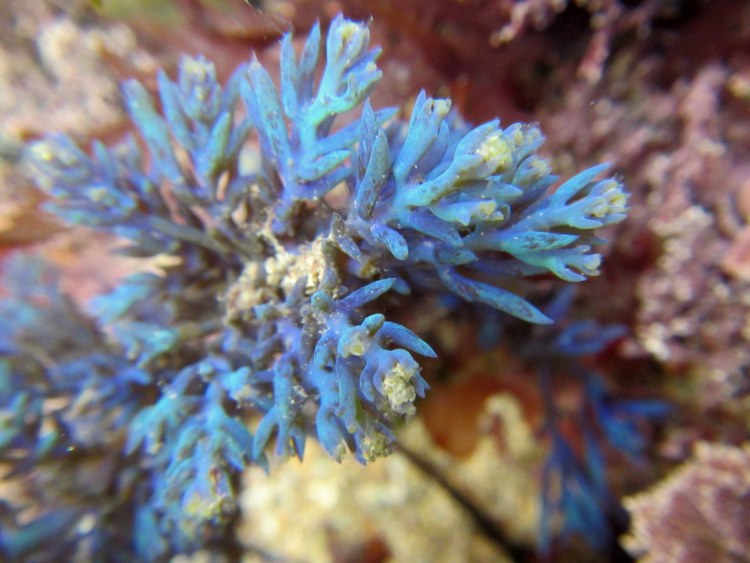
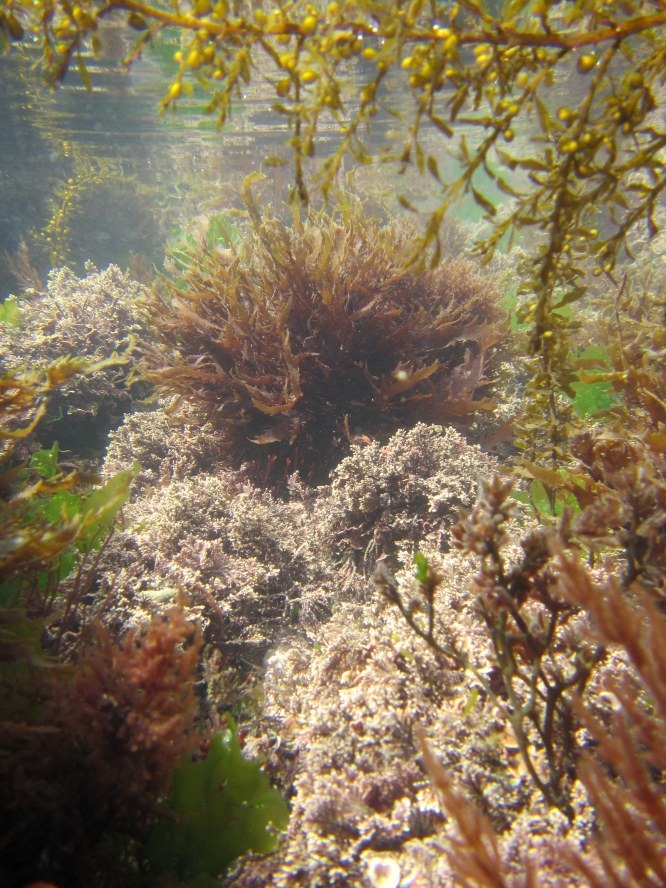 Another couple of sessions trying to take seaweed photo’s. A couple of seaweed species are really thriving at the moment, one is False eyelash weed Calliblepharis jubata in the middle of the picture above. In the picture below a couple of other species, Irish moss Chondrus crispus in the foreground, Discoid forkweed Polyides rotundus on the left, Black scourweed Ahnfeltia plicata on the right, with some Red grape weed Gastroclonium ovatum at the top. Below that two ‘miscellanious’ pictures and after that some photos of individual species: the photo that turned out best was of Bonnemaison’s hook weed Bonnemaisonia hamifera, an invasive species from the Pacific. After that Juicy whorl weed Chylocladia verticilliata, a Plocamium species and my favourite, the Bushy rainbow wrack Cystoseira tamariscifolia.


Leftover Pics
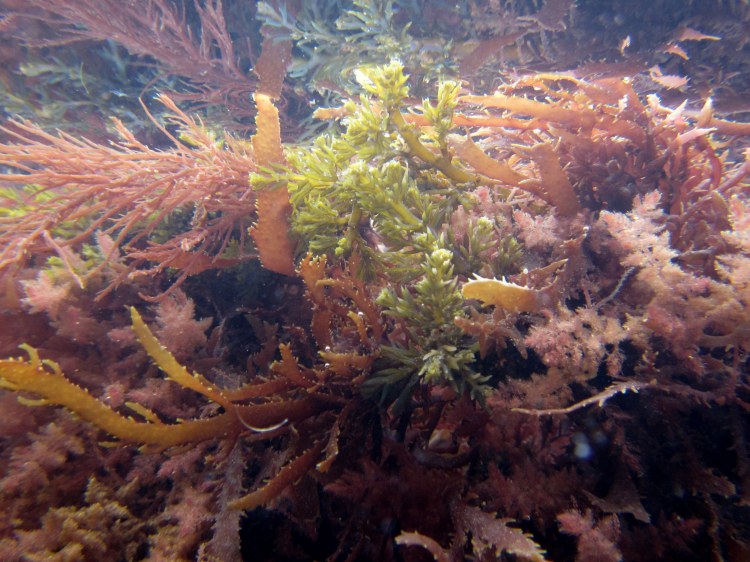
When going out rock pooling, I always take my iPhone and Canon Powershot (for underwater use) and take at least a couple of photos. Because of a lack of time, or because a single good photo is not enough for a new post, not everything ends up on the blog. Now I have some free time, I picked a couple of unused photos made this year that seem blog-worthy. First up, In realized only what I had found on the beach at St. Ives when leafing through the The Essential Guide to Beachcombing and the Strandline: a Seabeard! This hydroid, Nemertesia antennina, grows as stiff colonies protruding from a matted base and occasionally washes up on shore. It looks a bit plant-like; at the time I did not have the opportunity to have a closer look and just snapped a quick photo. Next a Lesser sandeel Ammodytes tobianus found at Gylly beach. I always see them when snorkeling or diving (see here) but this was a good opportunity to see one up close (I get excited when I spot a dead fish on the beach (see also here) and I am not afraid to admit it!). 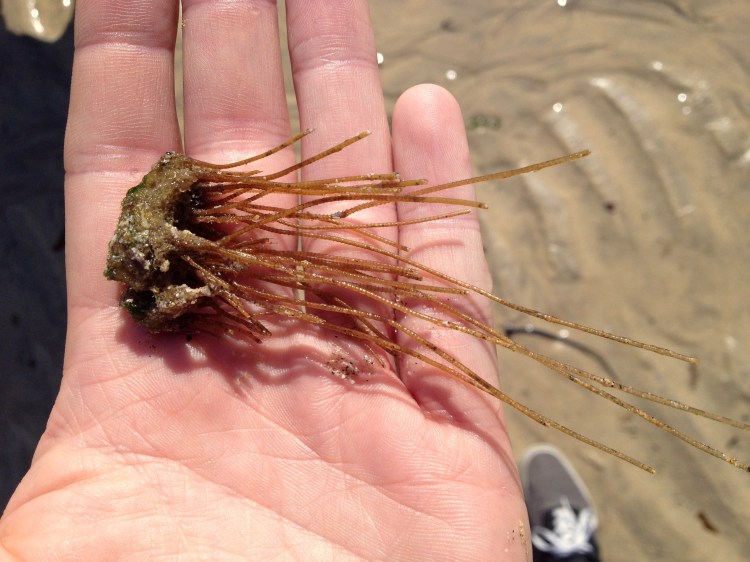

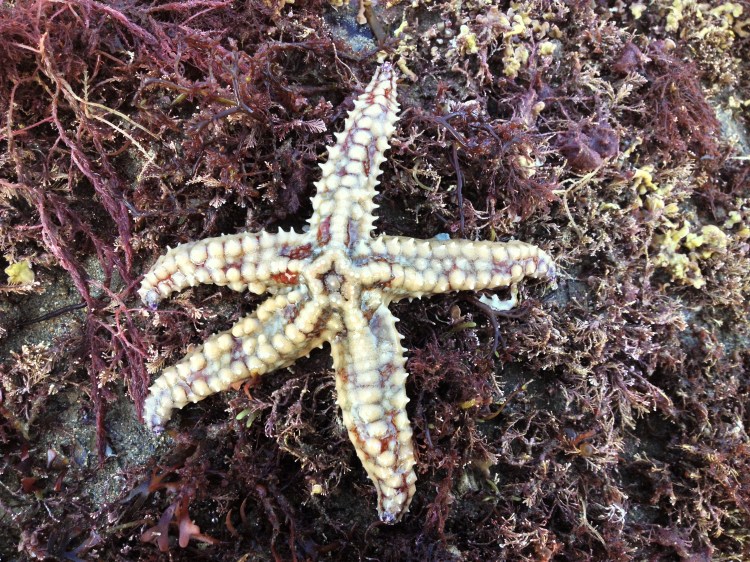
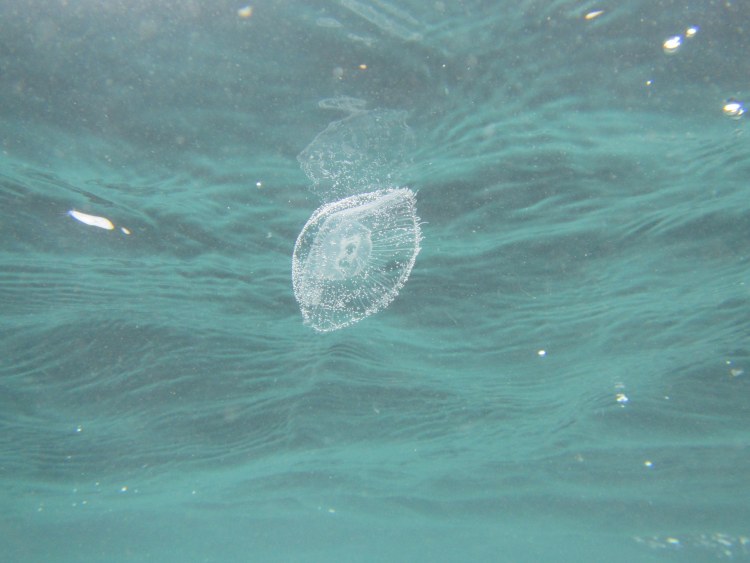
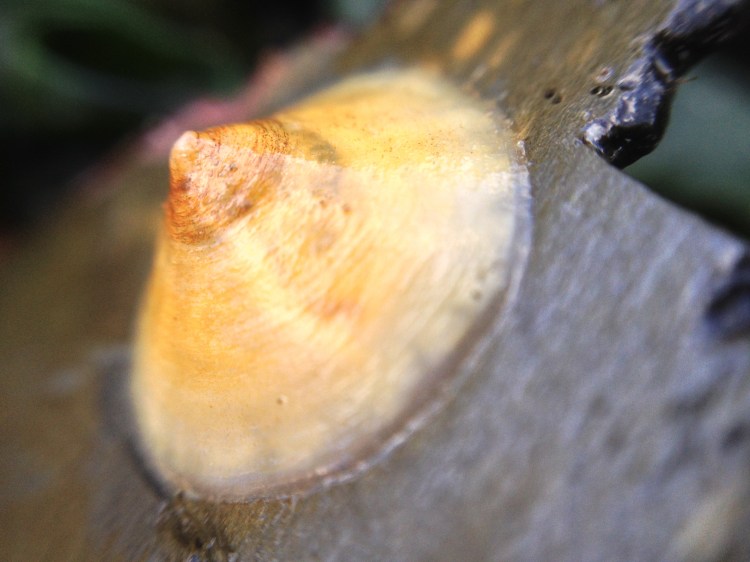
 Following are two colour varieties of the Spiny starfish Marthasterias glacialis, a Common brittlestar Ophiothrix fragilis and a shot of an Aequorea forskalea (or maybe A. vitrina) jellyfish. Next the gastropod mollusc Chinaman’s hat Calyptraea chinensis. I went back to Mylor marina for some pontooning recently but not much was growing; the only thing that stood out was the luxuriant sponge growth (I am not sure of the species, perhaps Halichondria).

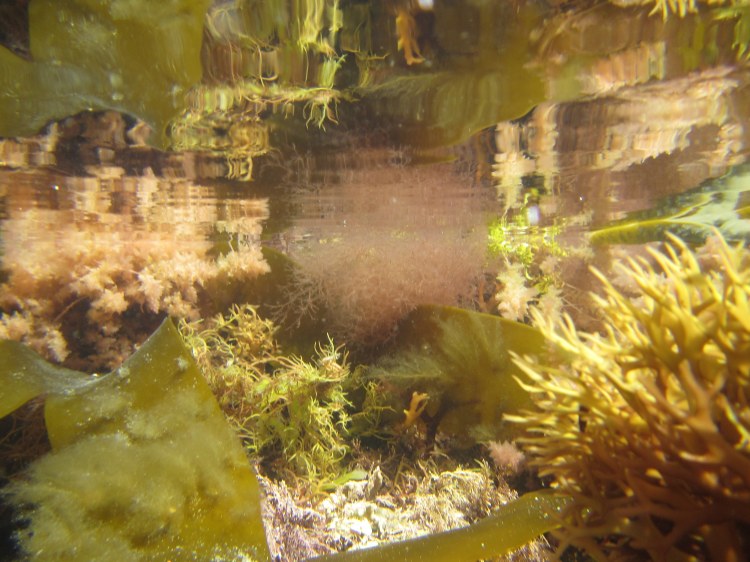
 And of course some seaweed pictures. By iPhone: Under tongue weed Hypoglossum hypoglossoides in Flushing, Black scour weed Ahnfeltia plicata in St. Agnes and a photo showing a variety of wracks all colonizing the same patch (Flushing): Serrated wrack Fucus serratus, Spiraled wrack Fucus spiralis, Bladderwrack Fucus vesiculosis and Egg wrack Ascophylum nodosum. Next some Canon Powershot underwater pics (see also this post and this one): a random rock pool picture of mostly decaying seaweed, a closeup of my favourite the Bushy rainbow wrack Cystoseira tamariscifolia and a shot of Wireweed Sargassum muticum that has completely taken over a pool. Finally an SLR photo of a rock pool at Gylly beach with large Cystoseira baccata plants (middle, Wireweed on the left).




A superlow tide at St. Michael’s Mount
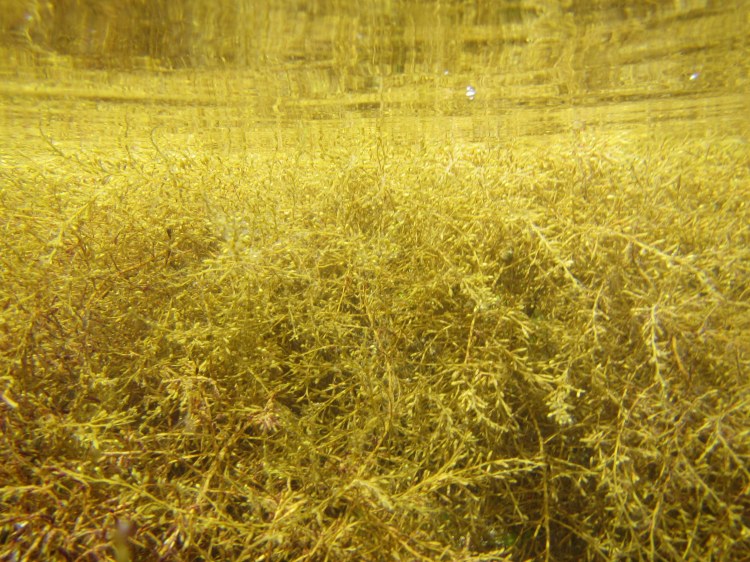
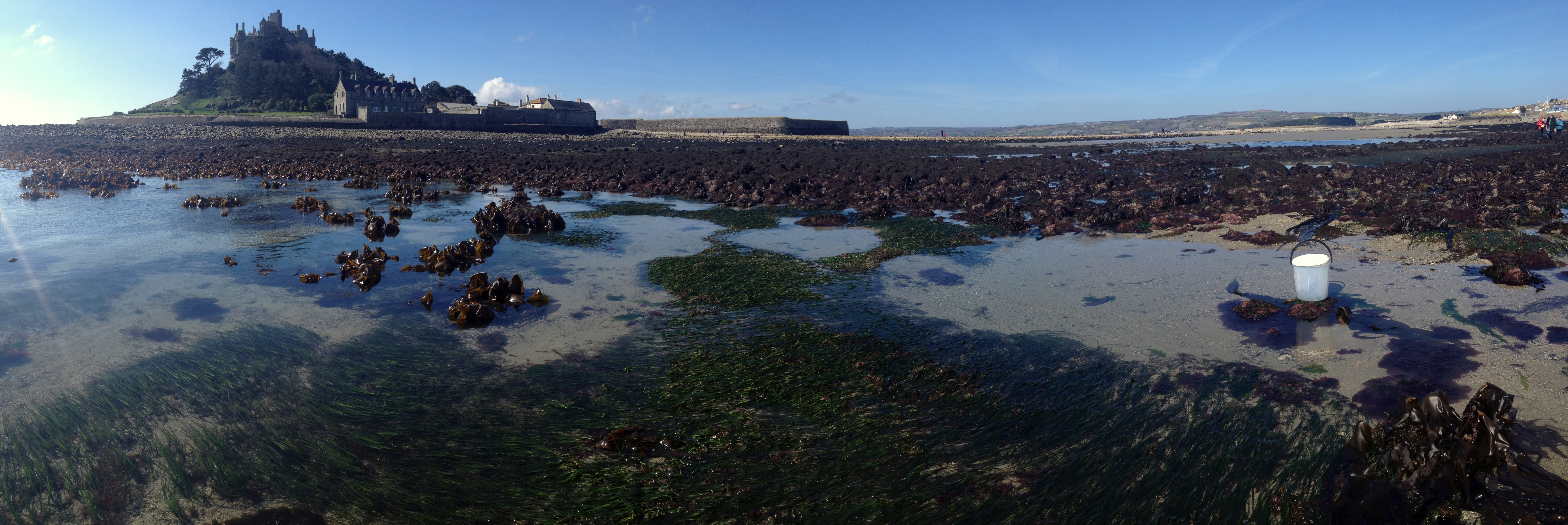 The lowest tide of the century so far, on a Saturday, with beautiful weather and on a stunning location: what could go wrong? Very little! St. Michael’s Mount, Marazion, Mount’s Bay is one of the most beautiful spots in Cornwall and an excellent site for rock pooling with a mixture of eelgrass beds, rocks and sandy expanses. I felt like a kid in a candy shop: wanting to turn every stone, photograph every seaweed and inspect every gully before the tide would come back in. I needed to collect some more Clawed fork weed Furcellaria lumbricalis for a cool student project. That was abundant so easy to sort. Chock full of Pheasant shells Tricolia pullus. One other amazing thing was that the place was littered with Bull huss Scyliorhinus stellaris (a.k.a. Nursehound, a.k.a. Large-spotted dogfish) mermaids purses. Mount’s bay is an important breeding ground for these sharks. The yolk was easy to spot, but the embryo’s still to small to be seen. There were loads of pretty seaweeds gently waving among the eelgrass in the crystal clear water. I saw a bright green Chameleon prawn swimming about, but the picture I took was a bit underwhelming.
I had met up with David Fenwick, so could get all species identified on the spot. Very striking was a great amount of small, fuzzy pink seaweed balls: Falkenbergia, the tetrasporophyte stage of the Harpoon weed Asparagopsis armata (it looks so different from the gametophyte stage, see some old posts, that it was long considered a separate species). Also, a picture of Bushy rainbow wrack Cystoseira tamariscifolia, simply because one cannot post too many pictures of Bushy rainbow wrack….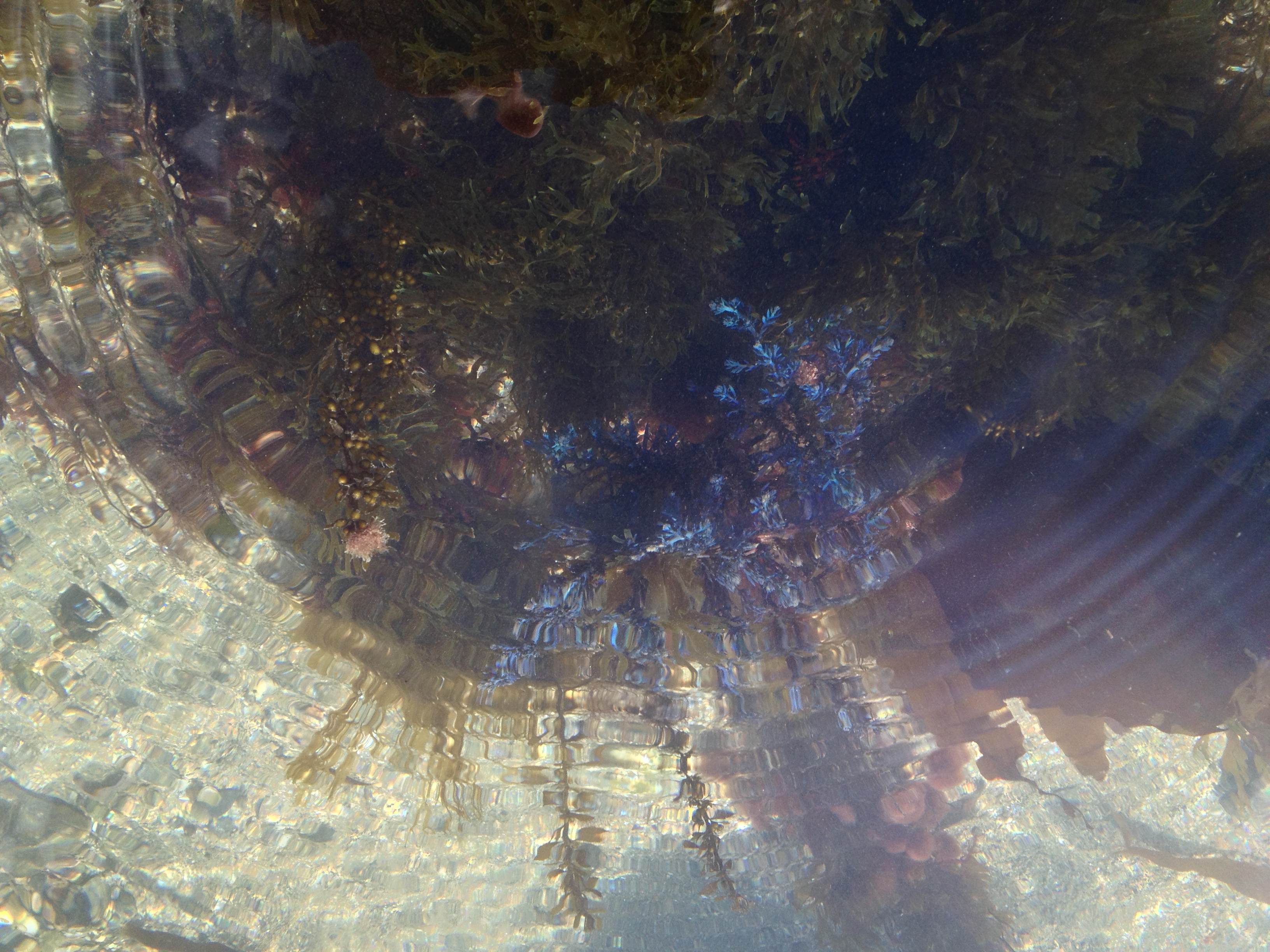
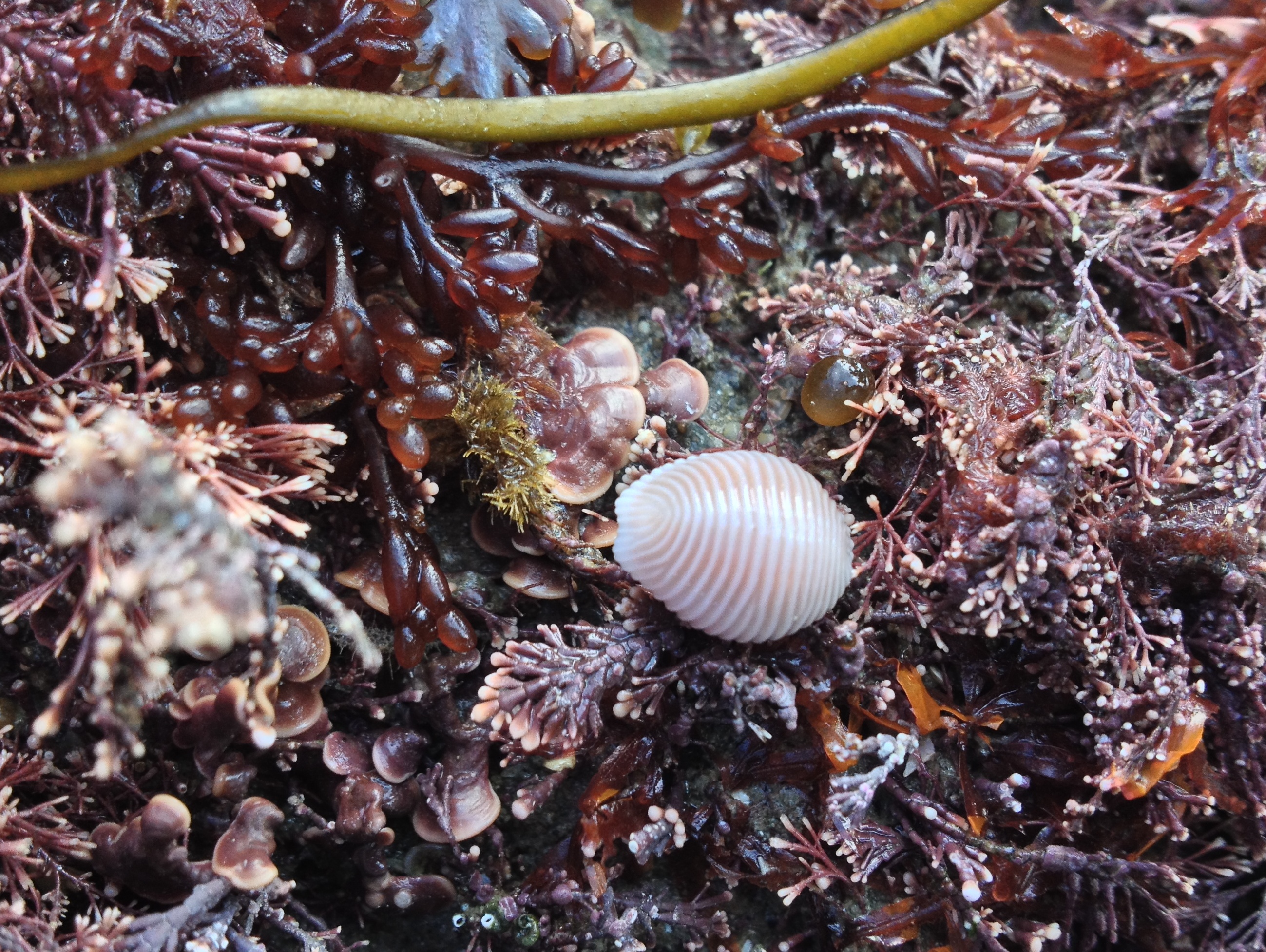
Some invertebrates: the large scale worm Alentia gelatinosa, a Strawberry worm Eupolymnia nebulosa larger still, a tiny hermit crab Anapagurus hyndmanni and the Arctic cowrie Trivia arctica: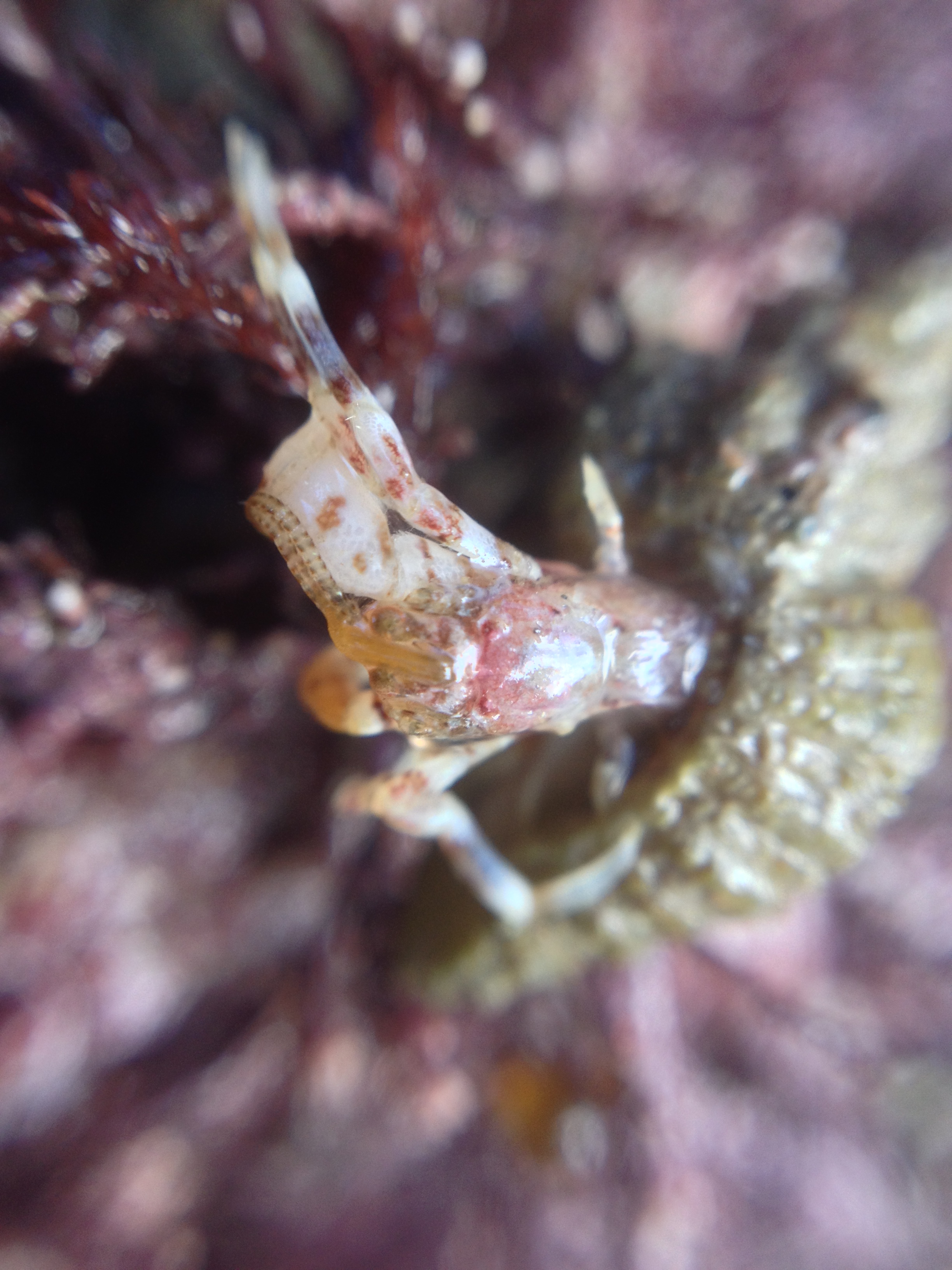
The find of the day (the month probably) was a Little cuttlefish Sepiola atlantica. This picture is crap, but David has made some stunning photos back in his lab and they will appear sometime soon on his aphotomarine site I am sure.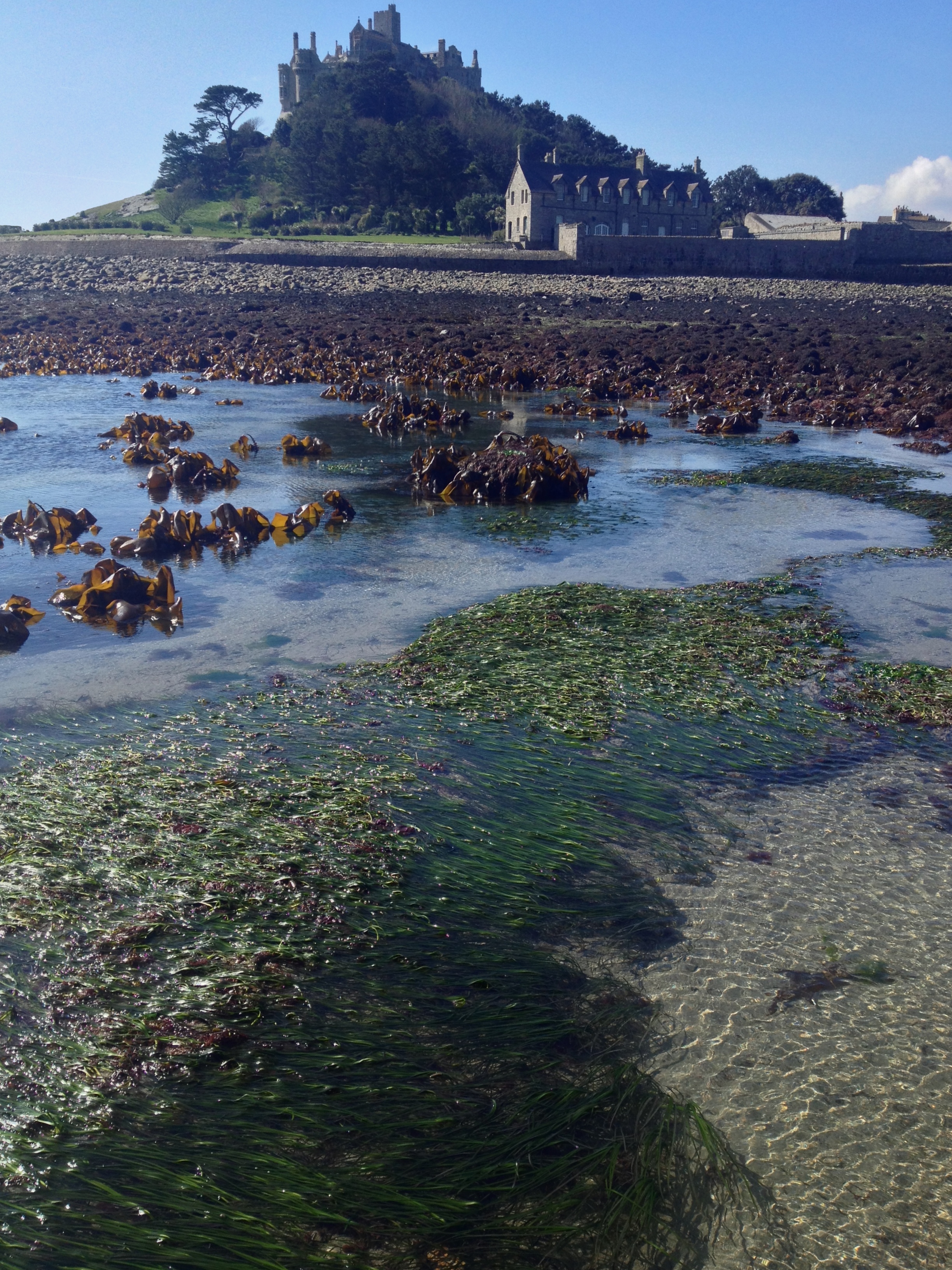
the aquarium: an unveiling of the wonders of the deep sea
I just received an interesting facsimile ordered from Amazon: ‘The Aquarium: an Unveiling of the Wonders of the Deep Sea’ by Philip Henry Gosse, first published in 1854. In it, Gosse describes his rock pooling and dredging trips around the Devonshire coast and his experiences with keeping animals and seaweeds in his marine aquarium. I actually do not know of any other book on temperate marine aquariums, so although it is a century-and-a-half old, it might still be the most current source available (not counting writings on the internet of course). It’s a very interesting read; in the early Victorian era, scientists had only just began to realize that plants and seaweeds produced oxygen for instance.
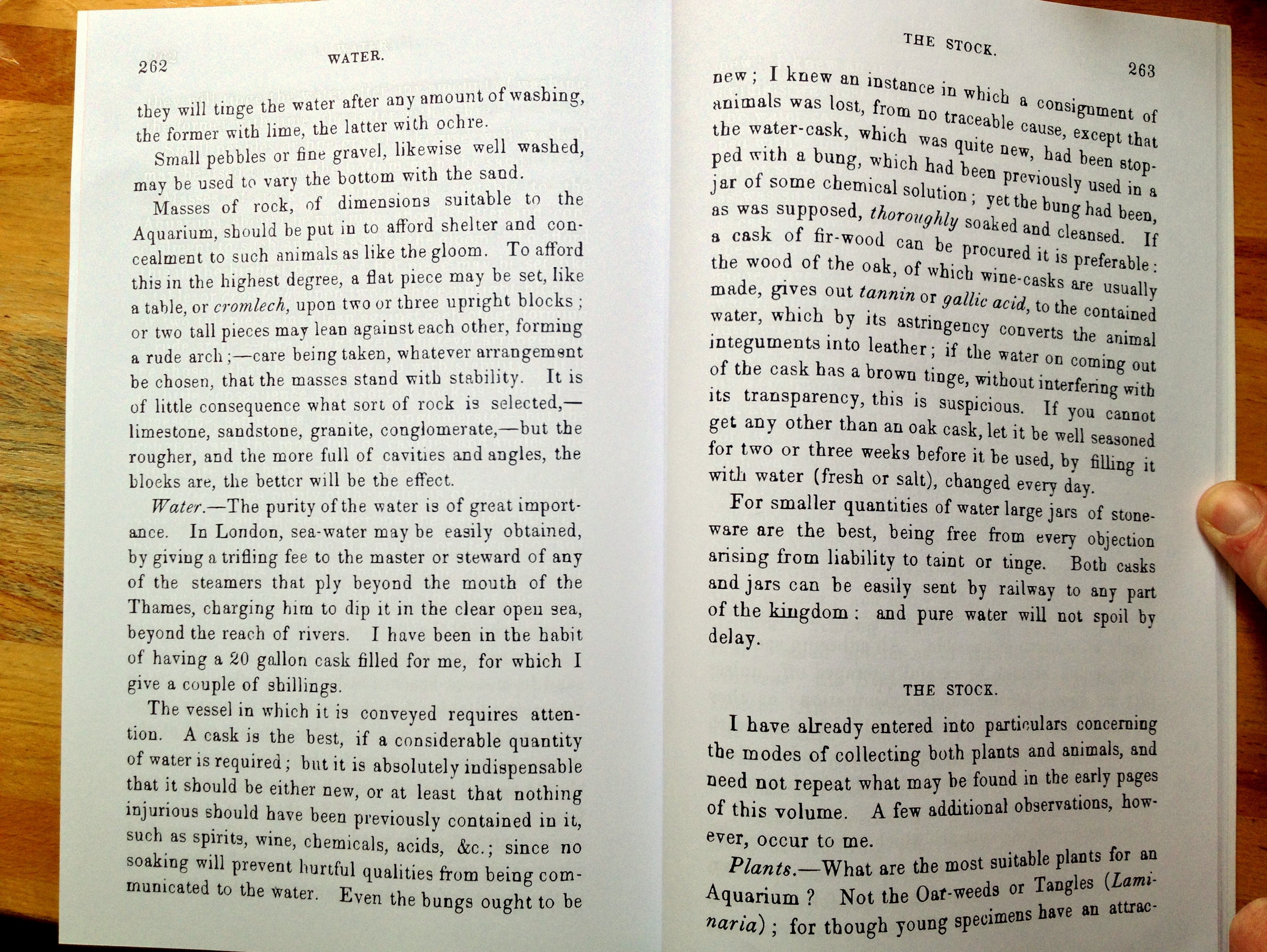
Of course I first looked up his description of my favourite, the Bushy rainbow wrack Cystoseira tamariscifolia. He was able to have this seaweed survive ‘for some time’ in the aquarium, tying branches of dredged up individuals to pieces of rock. He describes how submerged ‘their pale olive branches become invested with a most brilliant flush of iridescent light hue varying in intensity according to the play of light that falls upon it’, but that this remarkable gorgeousness of colour is not visible out of water (although it kind of is):
“Thus, it may be compared to some Christians, who are dull and profitless in prosperity, but whose graces shine out gloriously when they are plunged into the deep floods of affliction.”
They sure don’t write like that anymore! Gosse’s aquarium was small (2*1.5*1.5 feet), with glass plates set in grooves in a slate bottom and corners of birch-wood. He used ‘white-lead putty’ to fasten the glass, which meant that when he first started up his aquarium, everything died within the first day (except for the mullet fry and beadlet anemones). Lucklily, after proper rinsing, lead poisoning could be prevented in the remainign attempts. Of course he had no pump, filter, chiller or lighting. He however had deviced a means to ‘purify’ the water: a ‘drip-glass’ hung above the aquarium, dripping down two or three gallons a day thus aerating the water. All in all his experiences of which organisms do well in the aquarium and which do not, descriptions of rock pooling adventures and animal behaviour and even musings on the spiritual use of natural history make for a very interesting read.
seaweeds in the aquarium Part II
Time for the second post on the topic of seaweeds in the aquarium and I will write a part III as well.
4. What conditions are right for seaweeds?
The short answer is: I don’t know yet (and they will vary for different species). I have some clues that add up to a longer answer though. Obviously light is an important factor. Most tanks come with actinic (blueish) light representative of deeper waters. The seaweeds I collect are from shallow water (rock pools) and so are adapted to whiter daylight (as in freshwater planted tanks). I have played around with lighting (see this post) but not in a very systematic way and so am not too sure about what wavelength and intensity is best. Another factor that is important is sufficient wave action. Before I used a Tunze nanostream to create extra flow, I noticed that detritus and algae could settle on seaweeds, see this picture of Serrated wrack Fucus serratus taken from an older post:

High nutrient levels could benefit some microalgae more than they benefit macroalgae (seaweeds) as is the case for plants in fresh water aquariums and could lead to problems. Another factor that must be very important is temperature. I do not have a chiller and my tank is around 25C (higher than room temperature because of the lighting). Seaweeds from rock pools must have not much problems tolerating this temperature for hours on end, but many might have a problem with it for months on end. I therefore will probably buy a chiller next year… One very interesting parameter that I have not yet seriously considered is CO2. CO2 can be a limiting factor in photosynthesis, that is why many fresh water aquarium keepers add it (in gas or liquid form) to promote plant growth. I found a very interesting article on the role of CO2 in reef aquariums by a very clever chemist named Randy Holmes-Farley. It could be that CO2 is limiting for seaweeds in my aquarium as well and I’ll definitely need to do some pH tests to find out whether this could be the case. The article lists a table with relative rates of photosynthesis at pH 8.7 compared to pH 8.1 for a number of seaweeds. This is 57% for my favorite seaweed Bushy rainbow wrack Cystoseira tamariscifolia. Very interesting stuff indeed and I shall investigate!
 An Bollenessor