What is a seaslug?

A nudibranch, a snail and a seaslug crawl into a bar…no seriously, what actually is the difference between these three types of molluscs? According to Kerney and Cameron (1979), those animals that cannot fit into their shell are called slugs, and those that can are called snails (definition brought under my attention by Ian Smith, see his amazing species accounts of British molluscs on flickr: Morddyn). Seaslugs either have an outer shell in which they cannot retract, an internal shell or no shell at all. The Solar-powered seaslug (Elysia viridis) pictured above is a species without a shell that is an example of a seaslug. Nudibranchs are a type of seaslug with ‘naked’ (nudi) gills (branchs) on their back. Nudibranchs never have a shell (although many have one when they are a larva). Books on nudibranchs often include seaslugs and sometimes they even feature snails! This happens when these species are related to seaslugs (the ‘lathe acteon’ or ‘beer barrel’ Acteon tornatilis is an example of that – a goal of this year is to take a good photo of that species). I have posted a range of photos on here as an illustrations of seaslugs (or not!); read the captions for species info.

Rainbow Seaslug

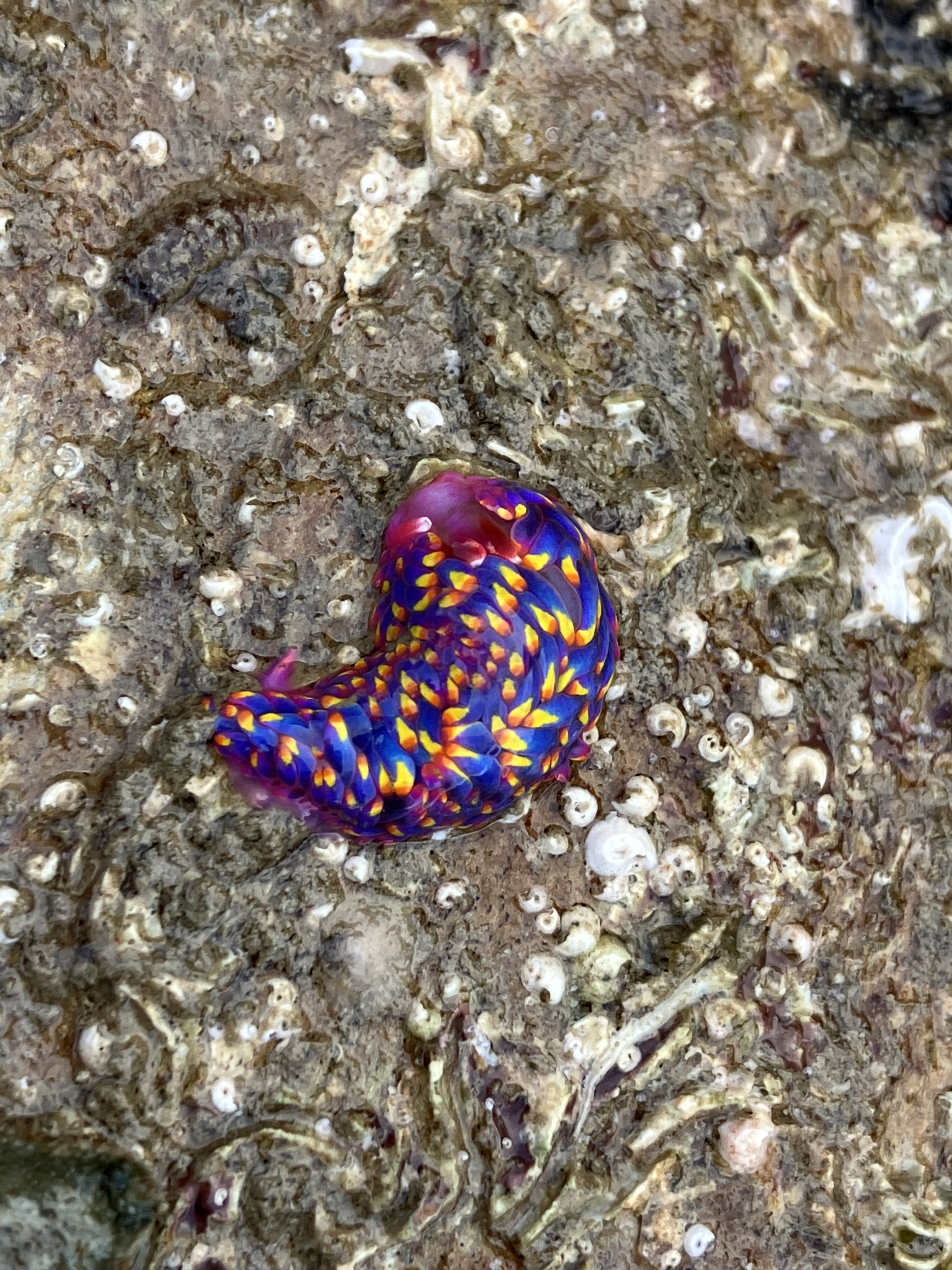
See here the find I alluded to in the last post: a Rainbow Seaslug! When turning rocks last Monday, on a cold but sunny (and rainy) afternoon, a multi-coloured blob (see below) immediately caught my attention. This is only the second time I found one (the first time I did not have my camera to hand) so I was very excited. This species (Babakina anadoni) is not only over-the-top in its colouration but also a newcomer to British shores, having only been reported for the first time in the Scillies in 2022 and on mainland Britain in 2023 (on the very same shore here in Falmouth). It now is sighted regularly so seems to be establishing itself.

Because it was only a few degrees I had opted for rockpooling instead of snorkeling, but as this was my chance, I left the overturned rock to walk back to the carch, ange into my wetsuit and run back. By gently lowering the rock in a pool I was able to take underwater photos. (Some people manage to submerge their camera only when they are out in waders but that approach just does not work for me.) Seaslugs are fairly slow but small (this one was maybe 15 mm) so it is not easy to photograph them. I always go through many aperture/ISO/shutterspeed/strobe output combinations before shots become acceptable. One way of shooting nudis is to use a very small aperture to get as much of the animal in focus, another is to use a larger aperture to only have (parts of) the head in focus, leaving behind the often cluttered background. I am still figuring out what works best for me!

Blue-rayed Limpets

Some snaps of Blue-rayed Limpets (Patella pellucida) from last year. I do not think I can improve much on an earlier photo of this species (see here) but I quite like the subtle colour patterns of the kelp on these photos. I have a whole bunch of images still to put on the blog however, I saw something very special the one time I went out this year and will probably post about that first! Btw, some photos see the light of day on instagram first, check: @an_bollenessor.

Macro Rockpooling

I realised I had not posted (much) about this year’s rockpool snorkels so I am taking the opportunity to post a ‘picdump’ with a whole array of tiny species. These photos were taken with a macrolens, and for most a wetlens was used for even greater magnification. Above the White Tortoiseshell Limpet Tectura virginea, a tiny species living on calcified red seaweed. I have added species names to the photos below.

Macro-Wide Angle (on land)

I really like macrophotography and I really like wide angle photography, but what I REALLY like is macro-wide angle photography! Examples of that underwater can be seen in previous posts (e.g. here and here) but this year I also bought a normal ‘topside’ lens for this purpose: the kuangren k42. It is a difficult lens to use: it is manual focus and it is very (VERY) dark. The first few times trying it out I was almost ready to give it up – that is how hard it was to get a usable photo out of it. With a lot of perseverance I narrowed down the combination of camera and lens settings but there is a lot of practice to be done next year. (Ideally I’d also have two flashes on bendy arms instead one mounted on top of the camera to properly light the subject.) Anyway, above a White Italian Snail which has a bunch of other common names so the Latin one is always best: Theba pisana. It is not all in focus (the eyestalks are not a friend of DoF) but the perspective does manage to show both the (small) animal and its habitat which is otherwise impossible to do. I have also tried the lens a bit closer to the water, some examples below. I have since purchased another kuangren lens and hope to also experiment with – and blog about – that next year!

Some Silver Steps Molluscs

After posting about the fish and crustaceans of my local dive site Silver Steps in Falmouth, it is time to give molluscs some love! The photos in this post were all taken at 5-10 meter depth at a gravelly bottom this year. Above (and at the end) the Turban Topshell (Gibbula magus) which is common subtidally. However, this was the first time I noticed that they have pretty sky-blue eyes! It is one of my challenges to take a pic of it with both eyes in the frame next year. Below, another favourite species of mine: the Pheasant Shell (Tricolia picta, previously P. pullus). This was a large individual (close to a centimetre?) with a candy cane striped pattern that I’d never seen before.
Next up a juvenile European Stingwinkle (Ocenebra erinaceus) on top of a Saddle Oyster and the Common Keyhole Limpet (Diodora graeca). The latter might be called ‘common’ but I do not see it very often. Going from the Gastropods to the Bivalves: a King Scallop (Pecten maximus) with its many eyes. Moving to yet another Mollusc Class: meet the Cephalopod Common Cuttlefish (Sepia officinalis). This was a very large individual covered in many small white lesions, probably near the end of its life. It was fine in my presence and let me take some photos. It is sometimes strange to think that these intelligent creatures are more closely related to a clam than to a fish! Some bonus photos at the end.

Seagrass Macro

Polycera quadrilineata

I had a couple of good snorkels at the end of summer in the seagrass beds off my local beach in Flushing. The water at the end of summer is warm enough to go without wetsuit – I just had a weightbelt to let me sink down on the sand at low tide, no fins needed. I managed to do what I normally find very difficult: spot nudibranchs! Mainly one of the more common species, Polycera quadrilineata, but that was fine by me, as they are very beautiful, especially the black colour morph pictured above. I spotted one other species, the egg-eating Favorinus branchialis (with its own eggs also visible). Not great photos, but in my defense they are very small!

Shelled molluscs are easier to find. Below 1) the ubiquitous Grey Topshell Steromphala cinerarea, 2) the Grooved Topshell Jujubinus striatus and 3) the tiny Rissoa membranacea (faecal pellets on show, even within the shell). The latter two species are strongly associated with seagrass.

Some assorted macro photos below and at the end a view at a very low tide of the Flushing seagrass site this October.

The Crack pt. 1

At my local shoredive site Silver Steps here in Falmouth, there is a crack in the rocks, maybe three meters long and not very deep, that is home to an array of interesting species. I have posted pics from this spot before, for instance that of a big conger eel (which has since left it’s hidey-hole, perhaps it swam off to reproduce and die in the Mid-Atlantic?). Anyway, I visited again this week and tried close-up shots with my macrowide angle probe lens. The prawns are much bigger here in the rock pools, but I am not sure if they are Paleamon serratus or P. elegans, as this requires a closer look at the serrations on the rostrum. Regardless of species name, they are stunningly beautiful animals with their blue and yellow legs and black-striped carapace.

Some more pics below (notice that in some another animal is lurking in the background!). Some species are easier to photograph than others, clingfish are very shy for instance. Anyway, there are some more ideas I have, for instance trying to capture multiple species in one frame and post about them in ‘The Crack pt2.’!

Moody Macro

A quick post with some finds from a recent walk on the shores of Flushing, specifically above-water (‘topside’) macro shots with a diffuser. This always leads to my subjects turning out with subdued grey and brown tones, but that is OK. A velvet crab, the amphipod Cymodoce truncata (looks a bit like a trilobite!), a worm pipefish covered in a film of water with some more shots (with descriptions) at the end.

life on a chain

The rain has been hammering down and I am in accute underwater withdrawal… Just a bit of the ole bloggin then! These are some pictures from April, when the phytoplankton had not kicked in and the water was still quite blue. Out of curiousity I swam out to the marker buoys off Castle Beach in Falmouth to see if there was anything interesting growing on them. There was! Lots of mussels, including on the chain going down to the bottom (10ish meters deep). I took my fisheye lens and after much adjusting of strobes (holding the housing sideways for portrait mode, and also up, meaning that the lower strobe needed to be pulled back) I got the nice shot above. Mussels are not a favourite of underwaterphotographers (this is an understatement!) but they are beautiful upclose, the white mantle contrasting with the blueish black shell.

A few days later I returned with my probe lens, as i thought this would offer an original perspective. It was a tricky thing to do as this lens lets in very little light. The difference between foreground and background seems slightly off as well! These photos show that the mussels were crawling with the tubedwelling amphipod Jassa marmorata, a prominent fouling species. I planned to return to try again a few days later, but the chains had been replaced by ‘fresh’ ones, bad luck! I will go back to have a look at them as soon as the weather allows it.

P.S. there are two older posts tagged with ‘buoys‘.