Seagrass Macro

Polycera quadrilineata

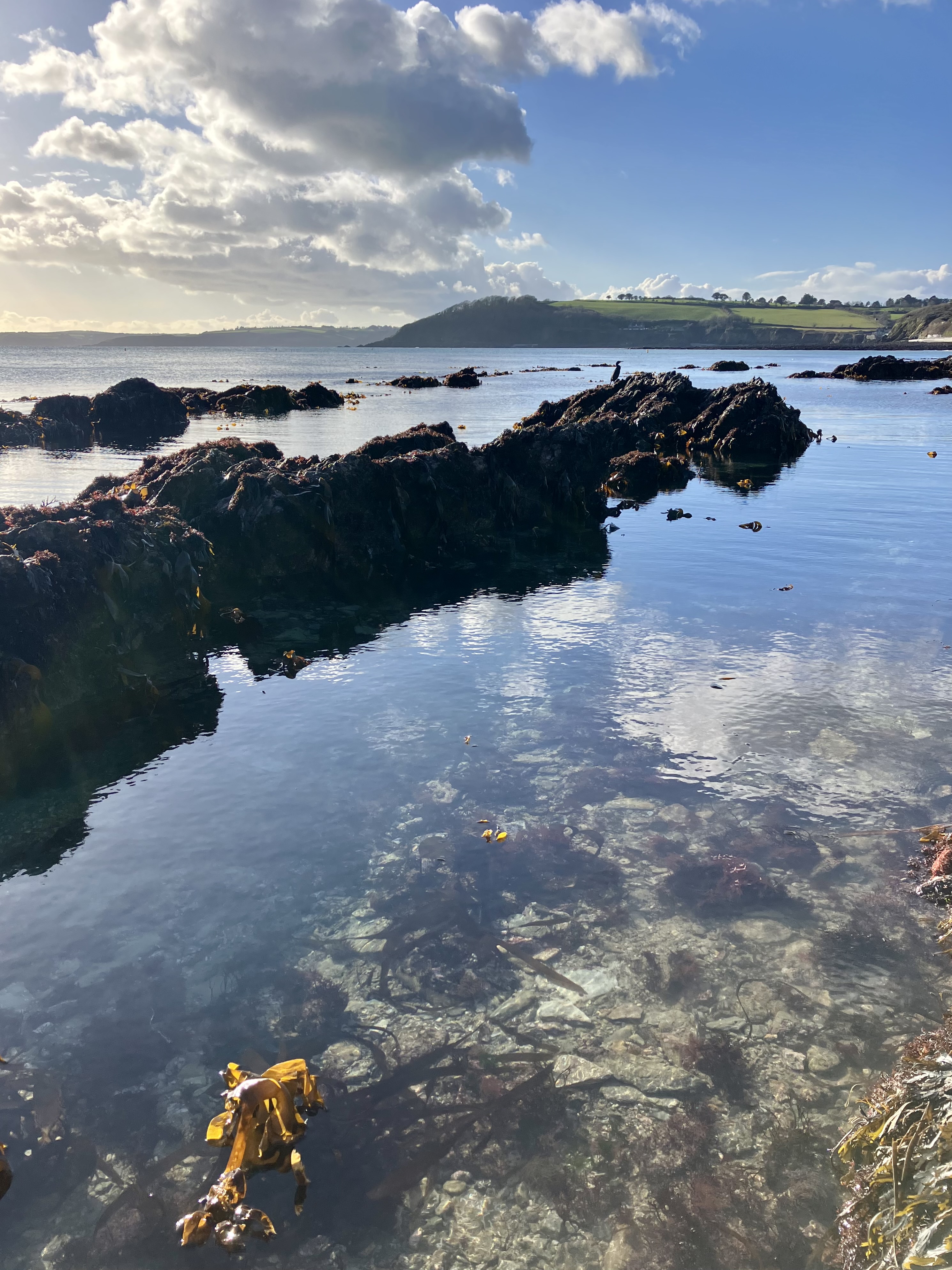
I had a couple of good snorkels at the end of summer in the seagrass beds off my local beach in Flushing. The water at the end of summer is warm enough to go without wetsuit – I just had a weightbelt to let me sink down on the sand at low tide, no fins needed. I managed to do what I normally find very difficult: spot nudibranchs! Mainly one of the more common species, Polycera quadrilineata, but that was fine by me, as they are very beautiful, especially the black colour morph pictured above. I spotted one other species, the egg-eating Favorinus branchialis (with its own eggs also visible). Not great photos, but in my defense they are very small!

Shelled molluscs are easier to find. Below 1) the ubiquitous Grey Topshell Steromphala cinerarea, 2) the Grooved Topshell Jujubinus striatus and 3) the tiny Rissoa membranacea (faecal pellets on show, even within the shell). The latter two species are strongly associated with seagrass.

Some assorted macro photos below and at the end a view at a very low tide of the Flushing seagrass site this October.

Back to Silver Steps

With the camera housing back, I have been in the water again lately, taking quite a few photos. I am lagging behind with posting quite a bit (this will allow me to post when I cannot get in the water later in the year) but should occasionally maintain the blog over summer, so here is! My local haunt Silver Steps provided during two dives with the macro lens. Above a Twin Fan Worm (Bispira volutacornis). These are quite shy (i.e. they retract into their parchment-like tube when their composite eyes detect a curious diver) but also are attached to cluttered rock walls. To blur this unappealing background, I used a very shallow depth of field (f 2.8); this also has the advantage of letting a lot of light in so ISO can be decreased to 100 – sorry non-photographers!). Below a collage of other ‘usual suspects’ (names under the photos) but ALSO I SPOTTED AN OCTOPUS! Crouched in a crevice and with only a macro lens I could not do it justice but it was still a very nice encounter.

A Gray Seaslug

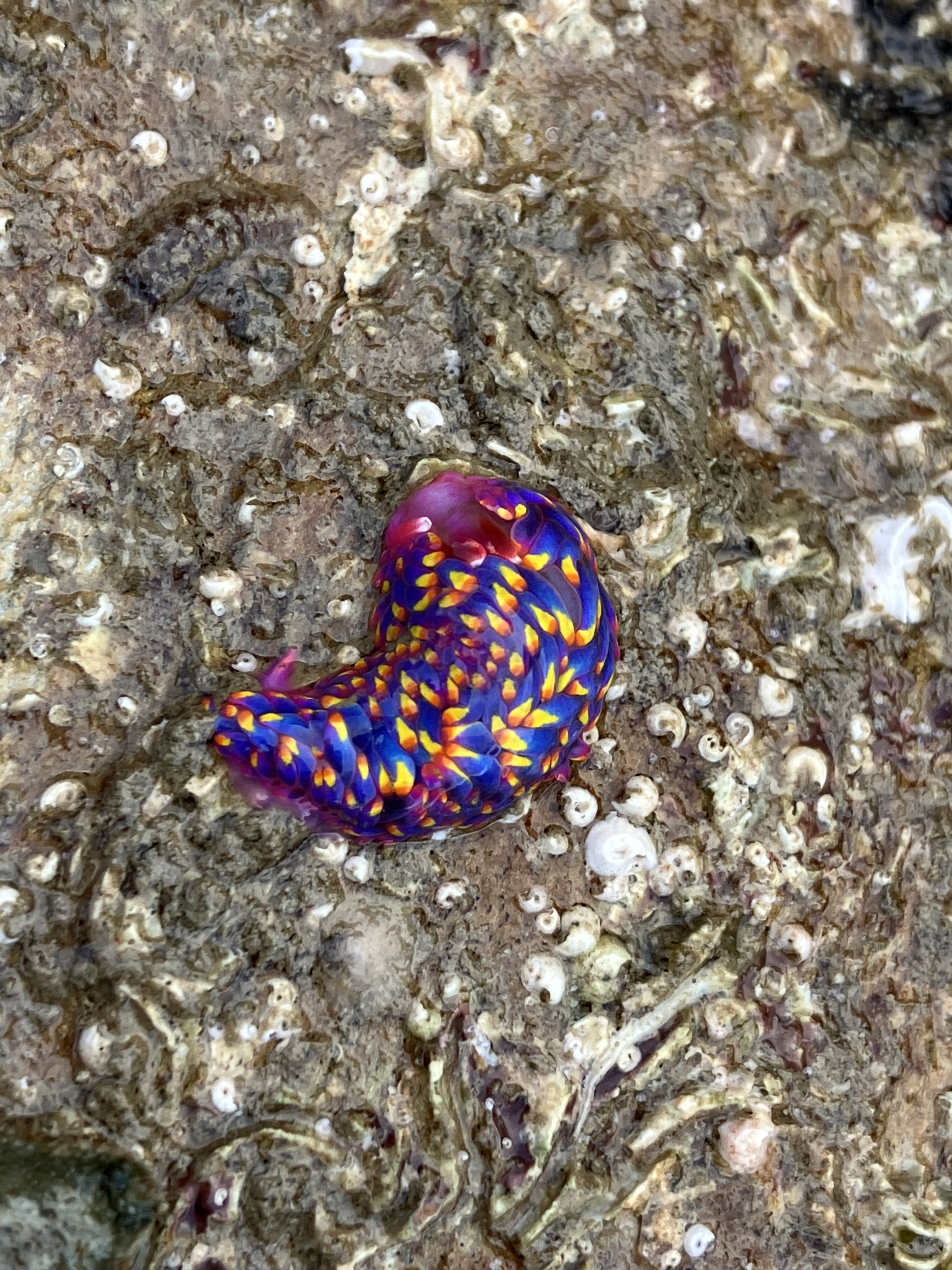
There have been a few finds lately at my local spot in Falmouth (and in other places in Cornwall) of the fantastically coloured Rainbow Slug Babakina anadoni. I have tried in vain so far to find it, but I did manage to find another species of Seaslug last Friday: Aeolidia filomenae. It is the opposite of the Rainbow Slug; large, not small, drab, not extravagant, and common instead of rare. More of an understated beauty I guess, and still a nice find! This species feeds on anemones (mainly Beadlet Anemones but also Snakelocks Anemones) rather than the Candelabrum hydroids the Rainbow Slug prefers. I am not very good at spottting nudibranchs so the plan is to keep looking this spring and find more species!

Rockpools from the top

I tried my hand today at taking photos of rock pools above water – tricky! I used my Leica wide angle lens with a polarizing filter and a handheld strobe in a diffuser. It was fun playing around, although felt my back after an hour or so trying! It is difficult to keep the reflection of the flash out of the shot. The tide was not low so these are small, mid-shore pools dominated by coralline algae and some (fine) red seaweeds. Beadlet and snakelocks anemones, limpets, periwinkles, thick- and purple topshells are the most common animals. Some sunshine and blue sky – let’s see when I can try my hand at underwater photos again!

P.S. two extra pics taken a day later (without flash) near Bream Cove featuring an anemone-eating Aeolidia nudibranch.

Back to Silver Steps

I recently bought (2ndhand) scuba gear and did a refresher dive; with the nice weather this week it was high time to get back under the waves and take some photos! I dived Thu/Fri/Sat at the main local shoredive site ‘Silver Steps‘. I went in by myself, but with a maximum depth of around 10 meters and good conditions this is not risky. The dives did not disappoint, the viz was excellent! Although I spotted cuttlefish every dive, I still opted for the macro lens, as I suspected I could not get great shots of them with my fisheye lens at 1.5 meter distance (I might have been wrong!). Instead of heading out to sea as some divers do, I always stick to the gullies by the rocks, diving below the kelp to see what happens beneath the rocky overhangs. There are three usual suspects hiding there, each with a very different personality. First, Leopard Spotted Gobies (Thorogobius ephippiatus) inhabit cracks in the rocks and are quite shy:

Second, Tompot Blennies (Parablennius gattorugine) are extremely inquisitive, often coming very close to check out what is going on in front of their domain:

Third, Black-face Blennies (which are not true blennies but triple fins) that only ever live under overhangs, usually head-down. I did not see males in breeding colours (black face, yellow body) but this colour form is even prettier I think:

When inspecting the rock walls carpeted in sponges, seasquirts, algae, worms and other things, I kept my eyes out for nudibranchs. Apart from a tiny crested aeolis, I spotted a good number of Discodoris rosi, busy mating and laying eggs. This species has only been observed in the UK for a decade or so but the population now is booming, with many reports coming in from all over Cornwall:

All in all a great enjoyable three dives! Silvery schools of sandeels and sprat/herring, many wrasse, cuttlefish, small and very big lobsters and a greater pipefish were also spotted. Unfortunately the weather has made a turn for the worse this week, however, there are still a few diveable months left this year…

New Nudibranch Book

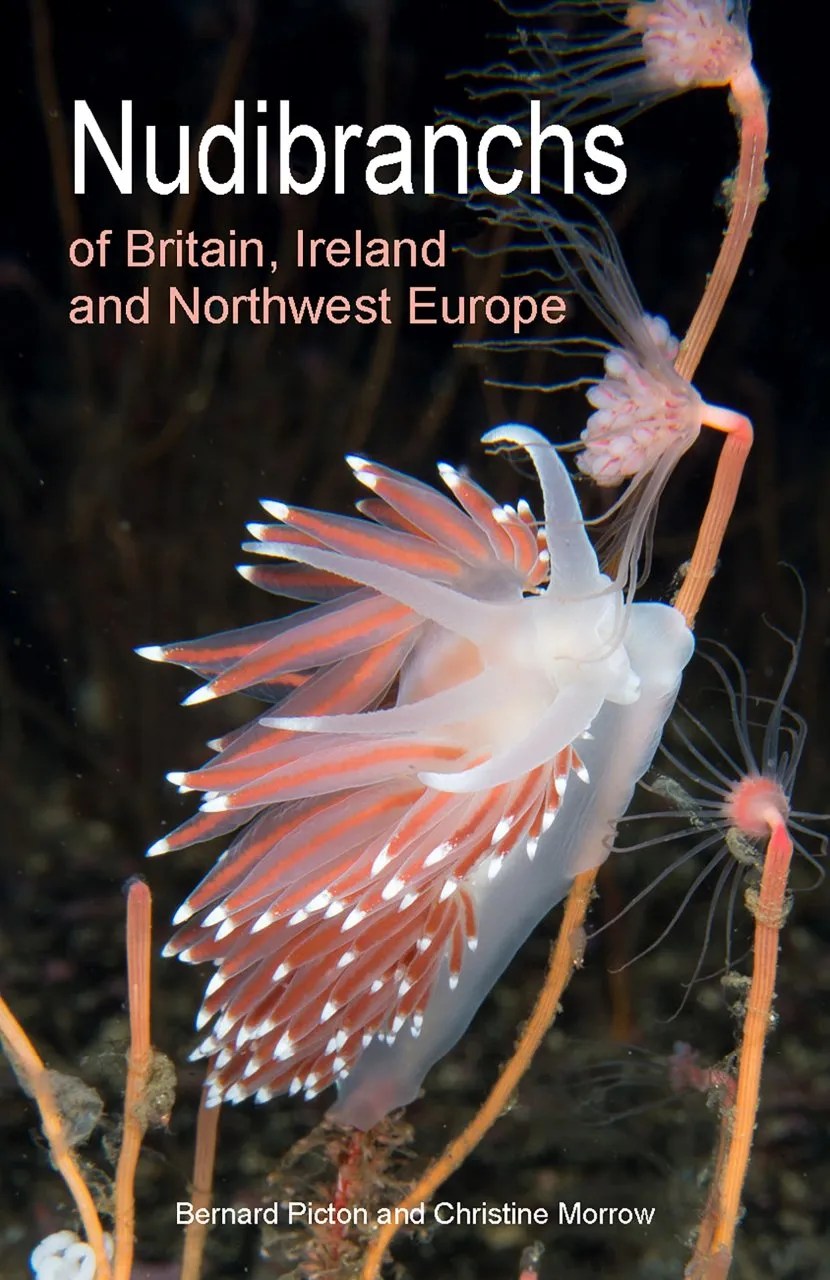
Last week I had a very special delivery in the post: the second edition of Nudibranchs of Britain, Ireland and Northwest Europe by Picton and Morrow (available HERE amongst other (web)shops). I received a free copy because I contributed photos for two not so commonly encountered egg-eating seaslugs: Calma glaucoides and Calma gobioophaga. I was really chuffed with this, as apart from the authors, many real experts contributed photos (including Cornwall’s very own David ‘aphotomarine‘ Fenwick). Although sea slugs might seem ‘niche’ to some, they are among the prettiest and most diverse marine creatures and I am sure many divers, snorkelers and rockpoolers (and readers of this blog) will really enjoy this book (see also this review)!

The funny thing is that I have actually not taken many photos of nudibranchs at all…. I have only been serious about macro (and in the possession of strobes that actually work…) for a few years but moreover, I am not very good at finding them! This publication has really spurred me on to go look for nudibranchs and learn more about them though. What is also exciting is that I bought (secondhand) scuba kit a few weeks ago, so i will be able to go back to diving and see a wider range of things. Now if only the wind dies down!

Nudibranch

Two entries back I posted photos of the Goby egg-eating seaslug Calma gobioophaga. Last week I was lucky enough to spot its cousin, Calma glaucoides, who is a bit less fussy and eats different types of fish eggs, as well as cephalopod eggs. I found it by turning over a rock whilst snorkeling in a very shallow (<50 cm!) pool. Next to a depleted patch of clingfish eggs, it was circling around, busily depositing eggs of its own. A fantastic surprise, and I really need to get on with recording such findings.


new strobe

Long time no post! Due to a combination of not-so-good weather and work I have not been in the water much the last few months. I attempted some seaweed photography but most times the viz was bad; the one time the conditions were great, somehow all my photos turned out to be a bit meh and I could not be bothered to post them. (For some older shots on seaweed diversity see here, and many older posts as well.) Anyhow, my exciting news is that I finally bought a new strobe (an INON D-200 for those who are interested) because my old Sea&Sea strobes just proved to be too temperamental. Something I should have done a long time ago, but the thrifty Dutchman in me just never pulled the trigger. I have now taken it out twice this weekend and it works like a charm! Now I just need to practice, as it is actually still very hard to go from an OK photo to a truly good pic. Above a shot of a baby urchin Psammechinus miliaris. The true stars of the weekend however were nudibranchs.

A very special find (shown to me by fellow rockpool photography enthusiasts Martin and Greg) were two Goby egg-eating seaslugs Calma gobioophaga. This tiny species can only be found on the goby eggs it eats. With such a ‘niche niche’ and with very good camouflage it is no wonder that reports of this species are rare. A fun fact: its protein-rich diet means it does not have to poo and it therefore does not have an anus…The rock with the eggs and nudis was very shallow and so it was a challenge to get the port of the camera housing under water. Luckily Greg assisted with pointing out the nudi and holding my strobe in place. Freshly hatched goby fry could be seen hovering above the eggs (the fact that a predator was munching through their brothers and sisters might have triggered some of the hatching). The cerata (the fleshy lobes on the nudi’s back) seem to have two goby eyes in them to make them better blend in!

Finally, two other nudibranch species, neither very colourful. Both are predators of anemones: first the largish Grey sea slug Aeolidia papillosa and second the smaller species Aeolidiella alderi. Both adequate shots but I need to practice to make them truly good. I will probably buy a second INON strobe so I can practice wide angle shots as well when diving. I hope to go out a lot more during summer and will make sure to post here about my finds and progress!

Silver Steps Diving III

I will keep this post short, as my third Silver Steps shoredive of the year was a week ago. As you can see above, my dive was made by encountering the beautiful nudibranch Antiopella cristata (although I prefer the old name Janolus cristatus…). My camera battery strangely gave up straight after taking these pics (argh!), otherwise I would have bothered it for at least another ten minutes! The 60mm lens is great. Look at the European cowrie Trivia monacha below which is less than a centimeter in length. Not a great shot but it shows that it is possible. Finally, a common Phoronid worm Phoronis hippocrepia (Thanks Allison, please check out her great blog Notes from a California naturalist). I hope the wind will die down and I can go back soon.

Because of the plankton bloom (see the last post), I decided to try my hand again at some above-water macrophotography. Above and below a Flat periwinkle Littorina obtusata on bladder wrack. More subjects: a Red Doris Rostanga rubra, a Painted topshell Calliostoma zizyphinum, Cornish sucker (or Shore clingfish) Lepadogaster purpurea eggs (they must not be laid long ago and so the tiny fish are not yet visible, although if you zoom in you can see an outline forming) and some layers of Coral weed.