aquarium update 1

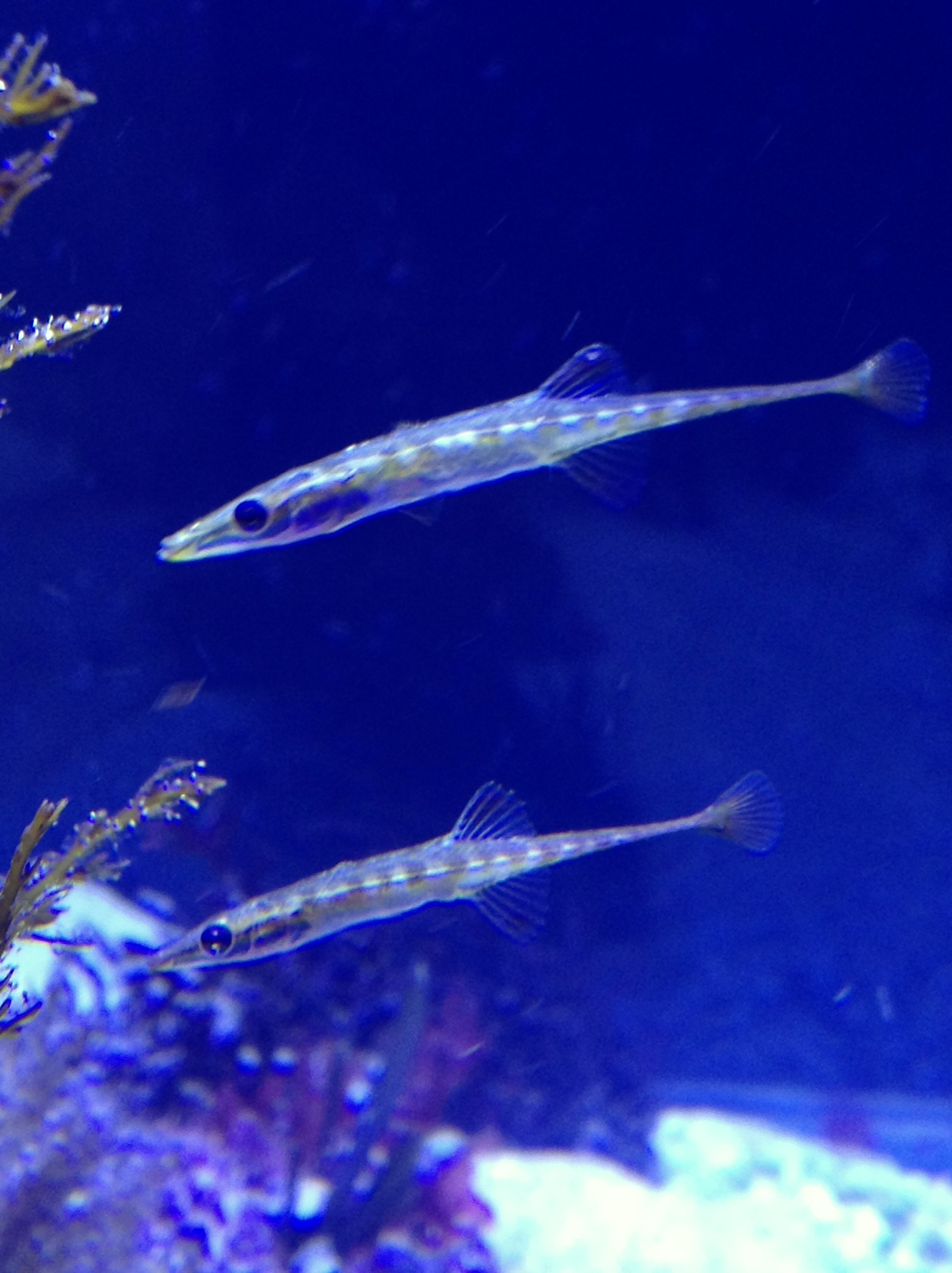
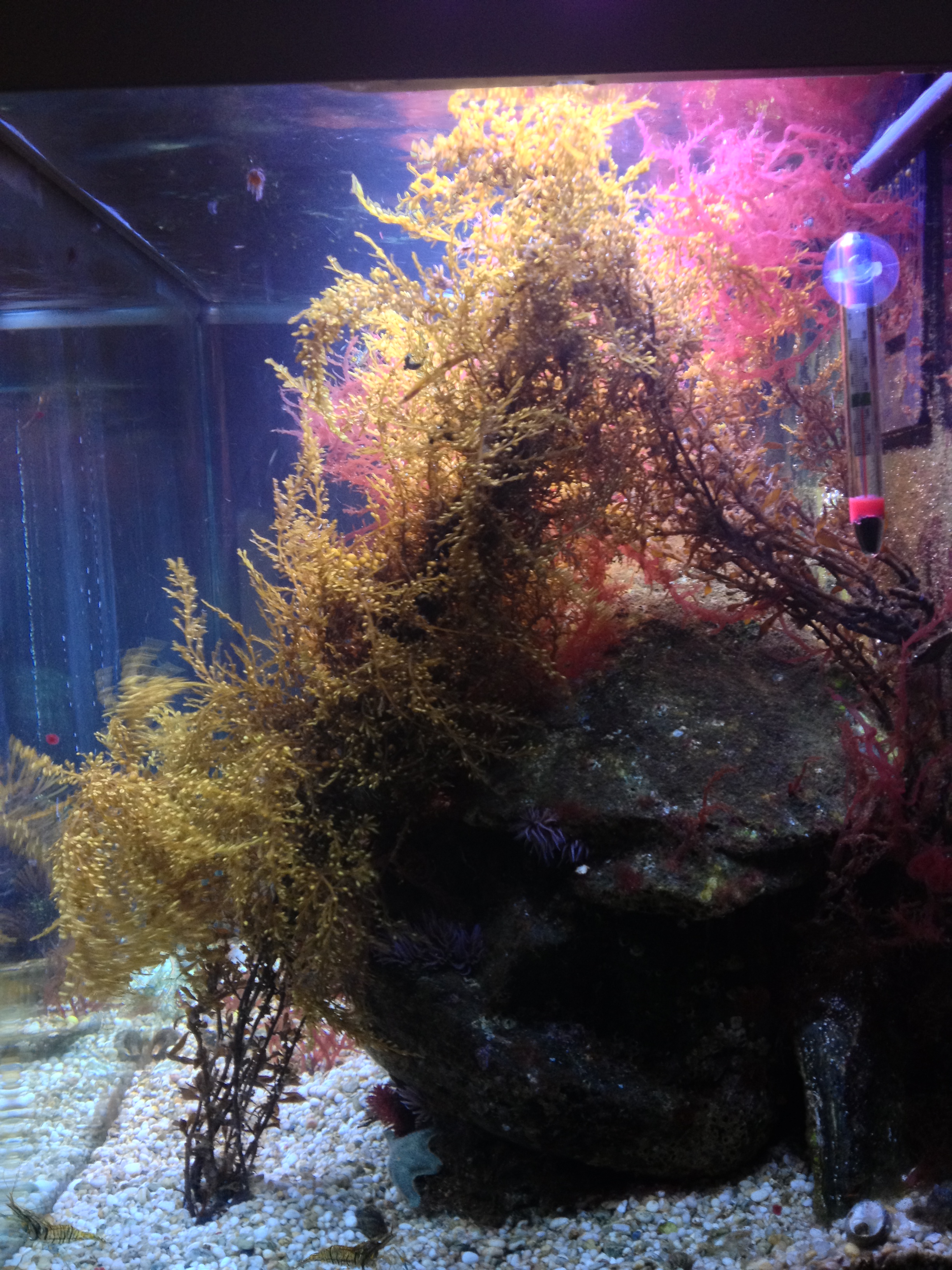
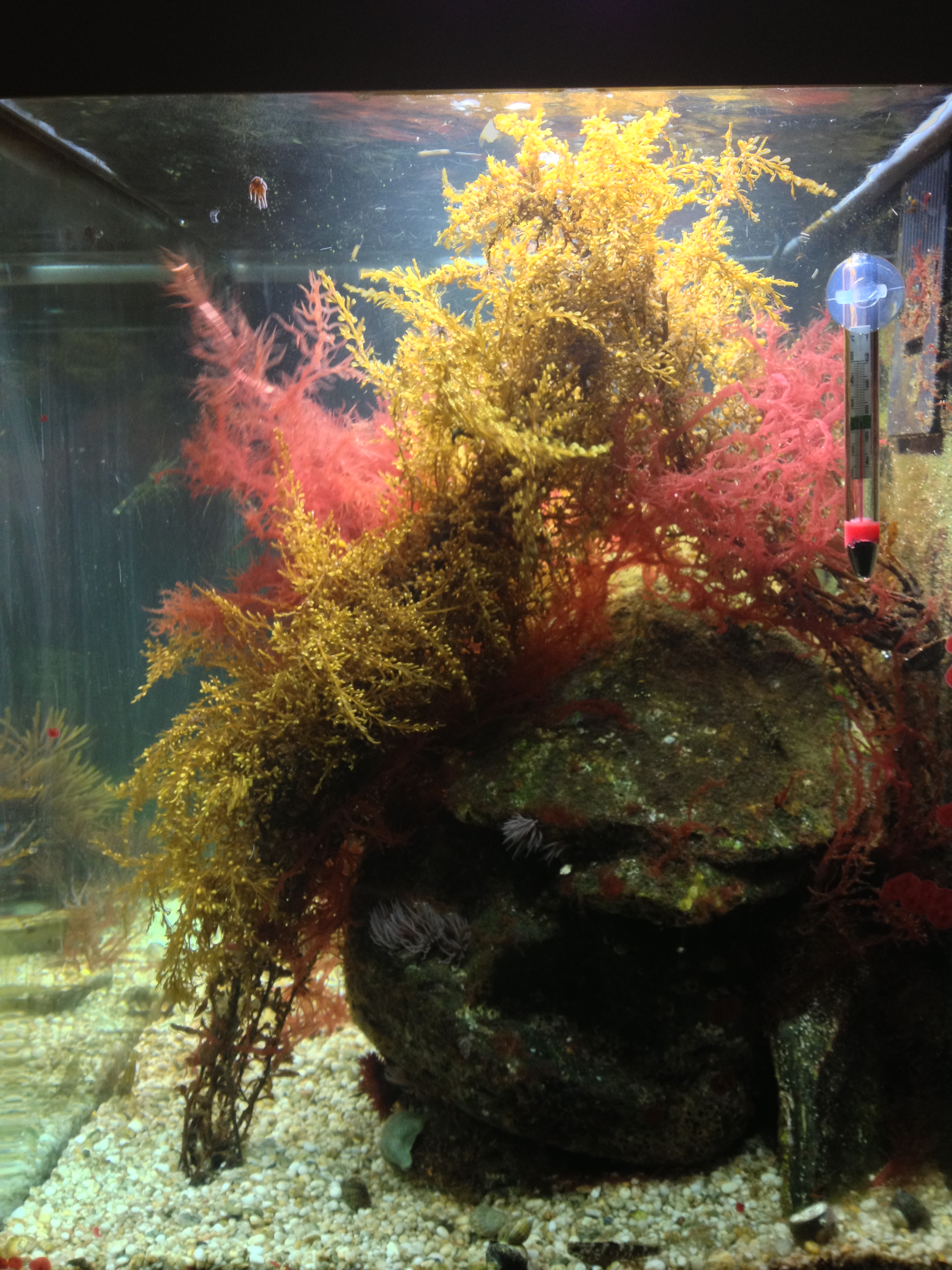
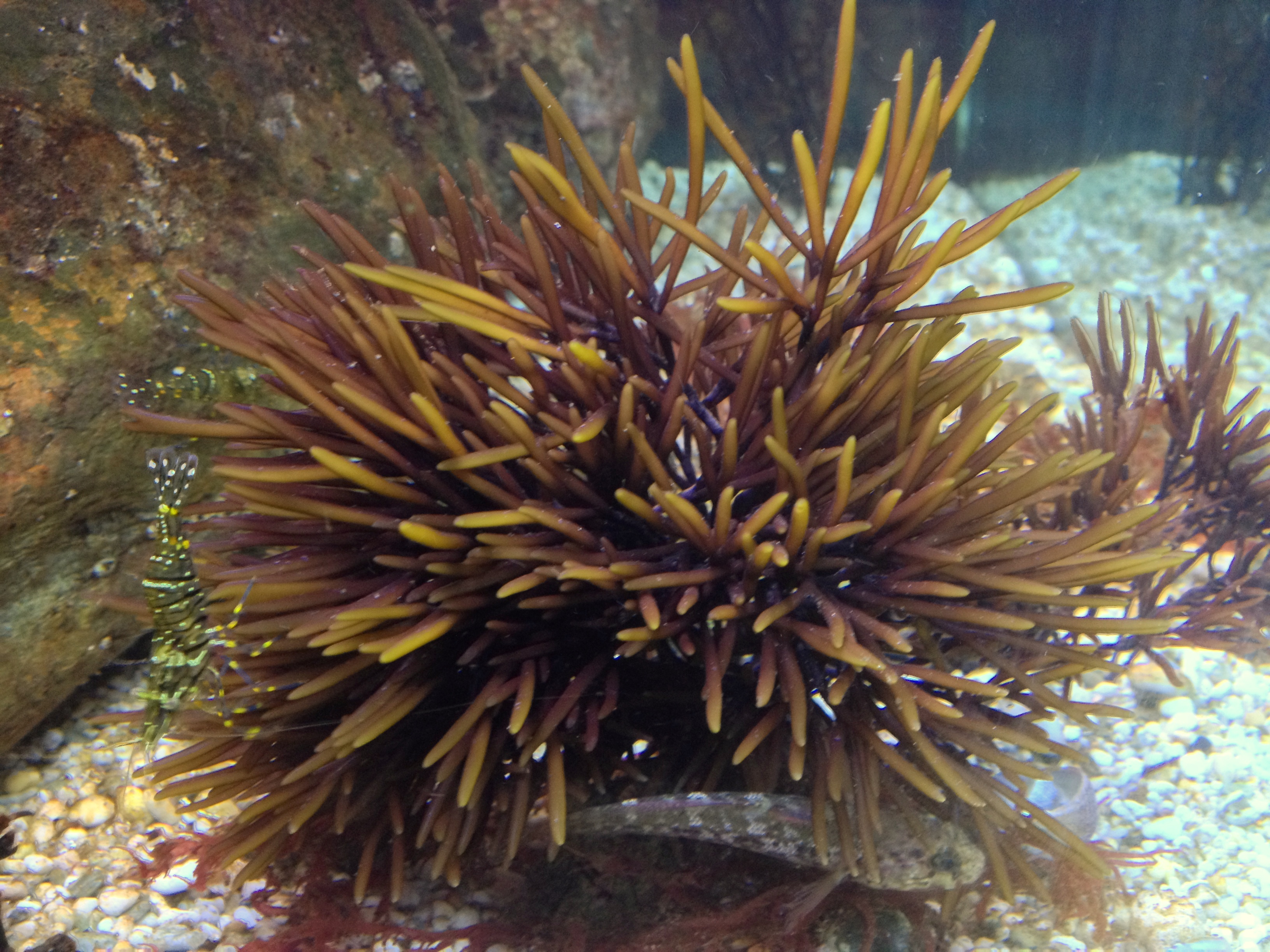
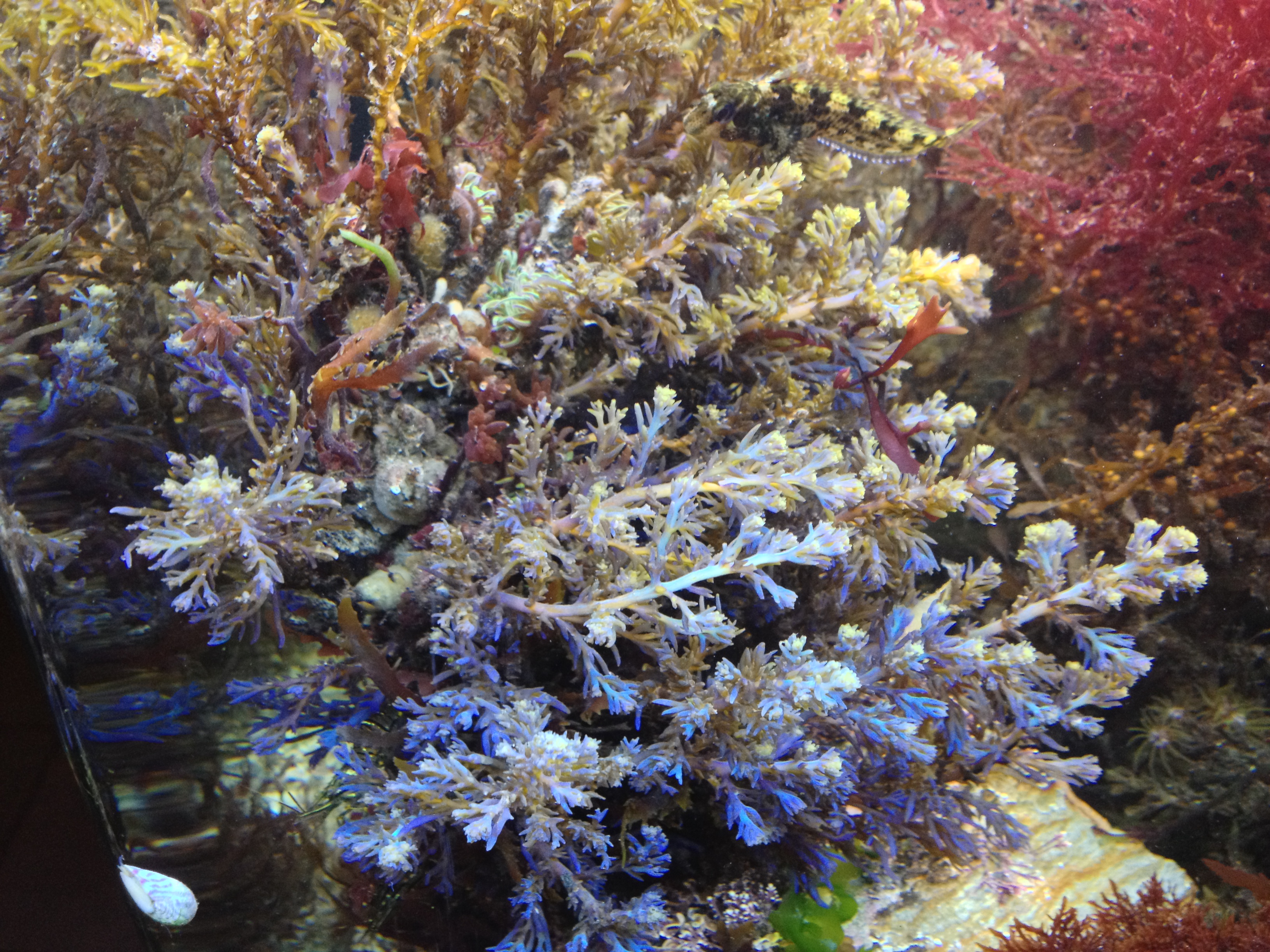
With the aquarium back on track, it is time for some more tank-related posts. I released one of the two Corkwing wrasse I caught, as the slightly bigger one was quite bullish. The Corkwing is very beautiful, although it has the nervous habit of chasing its reflection in the glass sometimes. I caught two small (4 cm) Fifteen-spined sticklebacks Spinachia spinachia as well that I wanted to observe. One disappeared without a trace and the other I did not see feeding on frozen artemia so I released it again. Most if the time these fish were facing the seaweed, probably to pick off any tiny crustacean that would appear. IM_0554
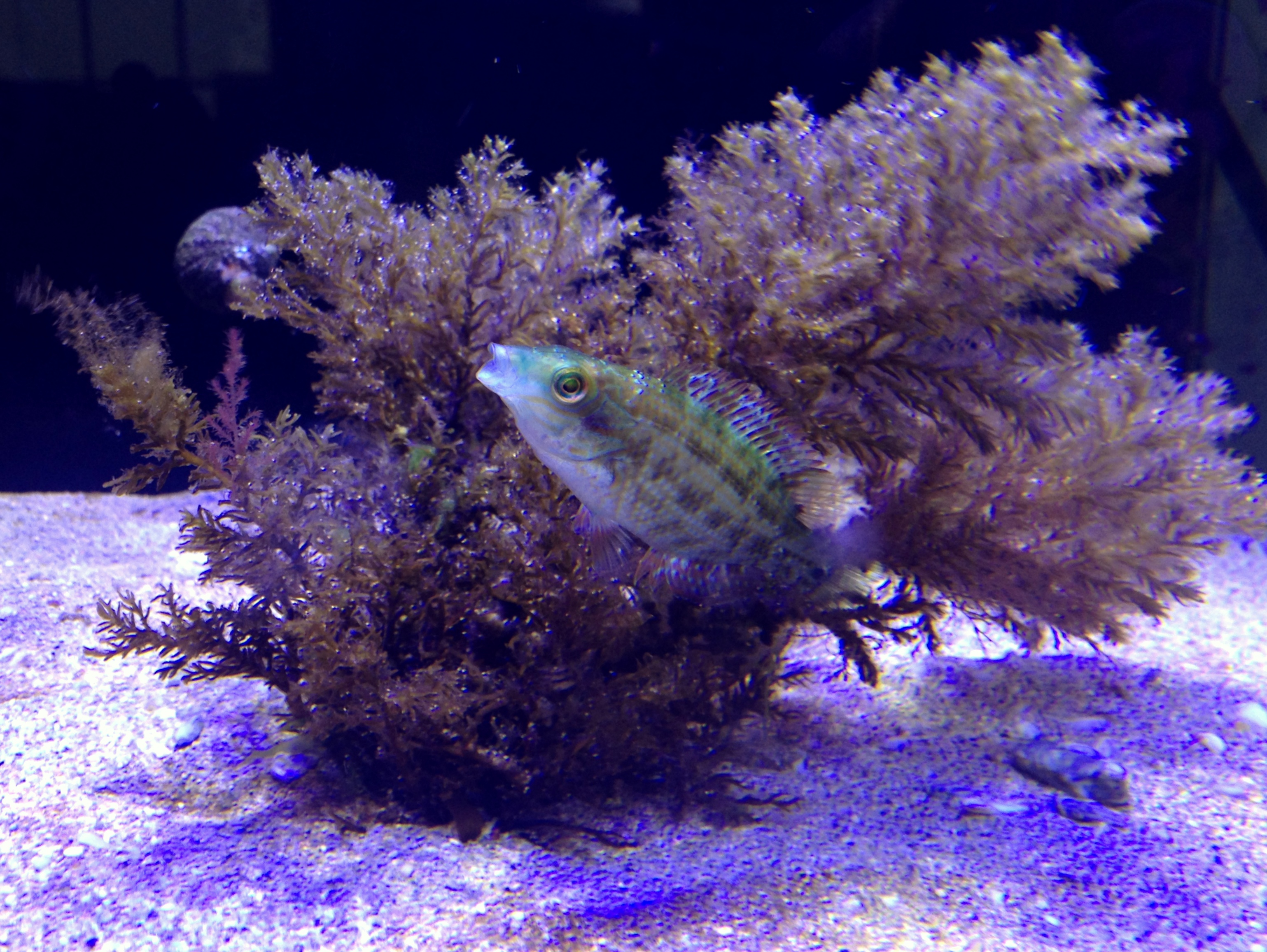
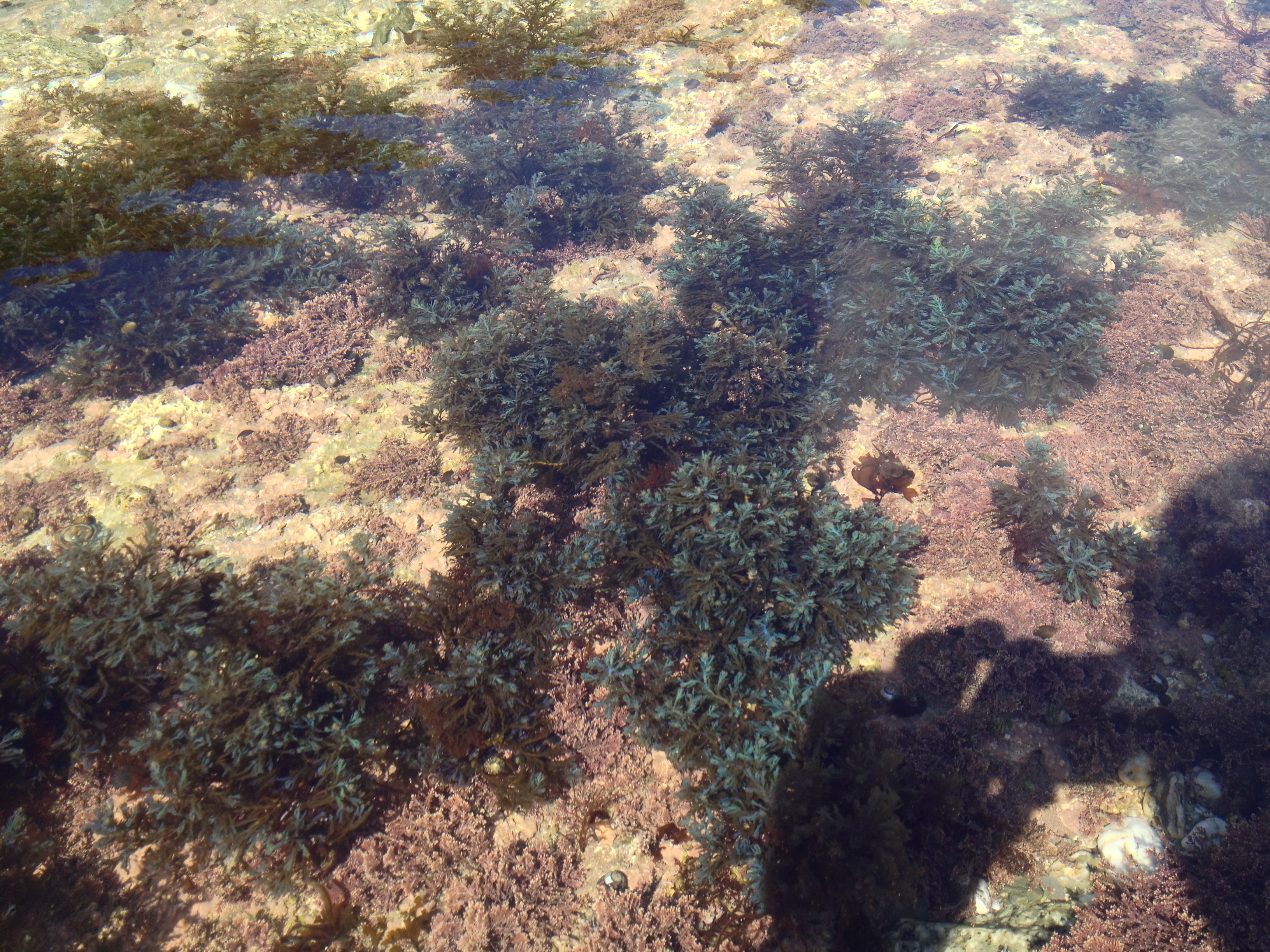
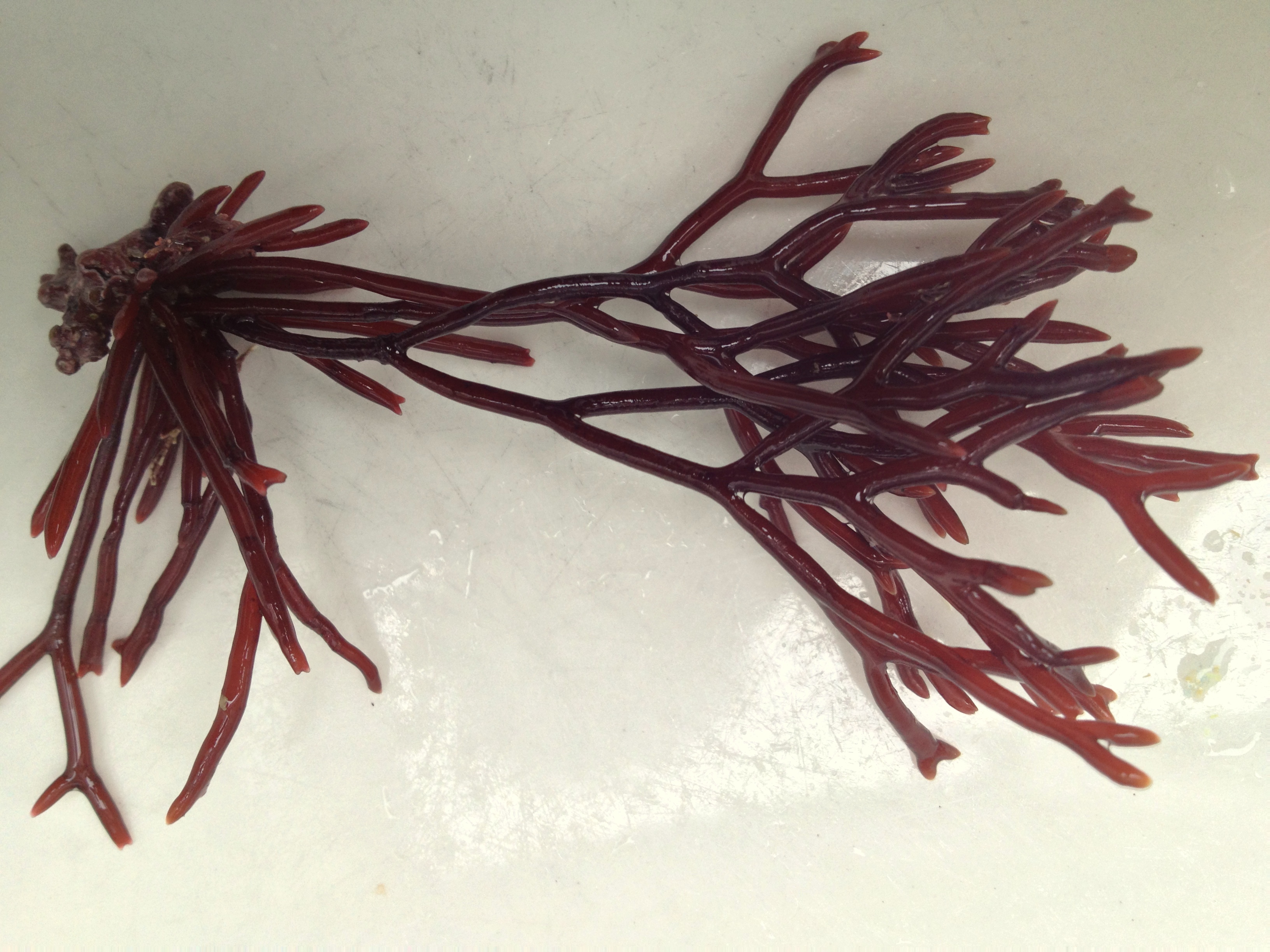
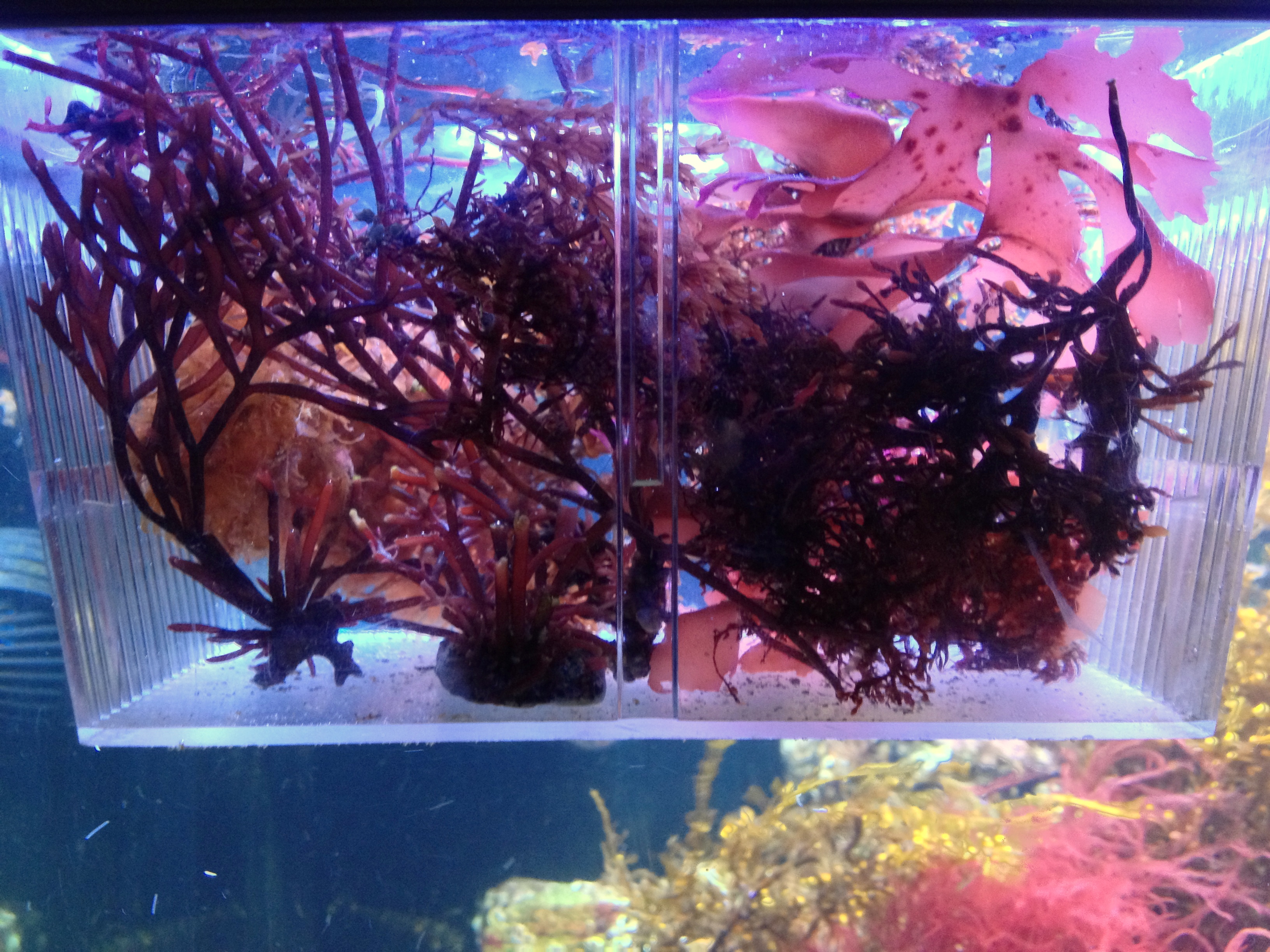
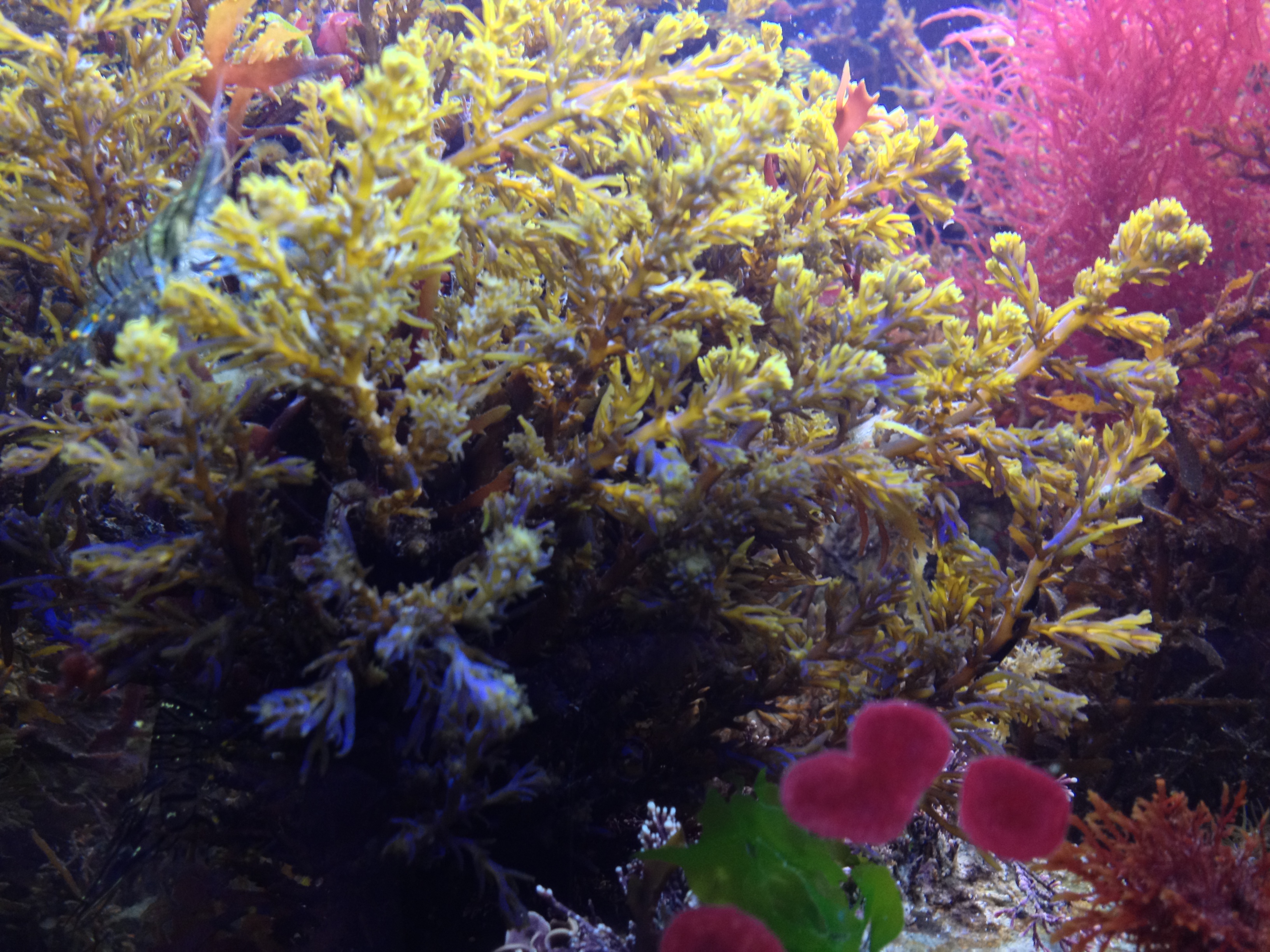
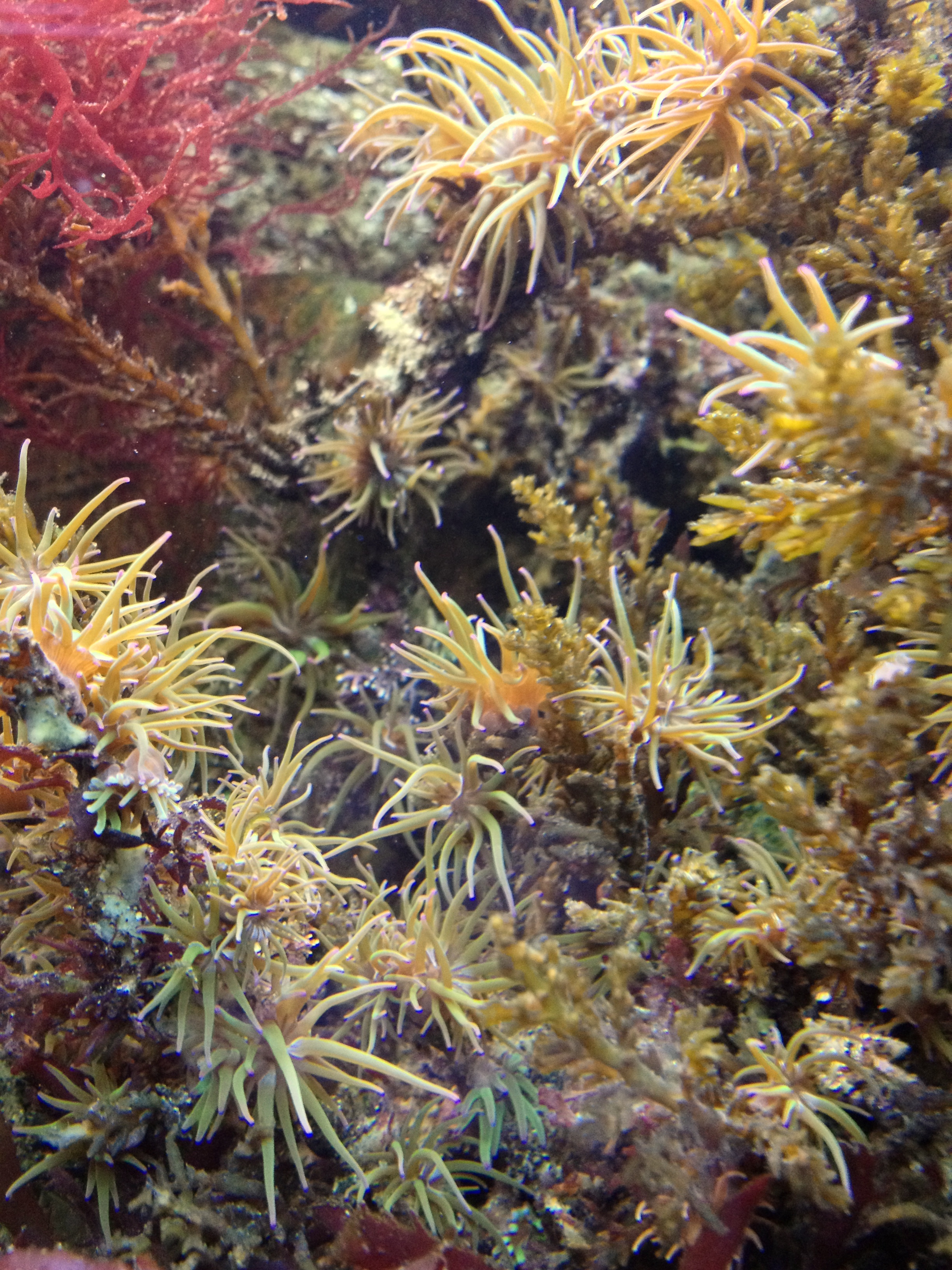
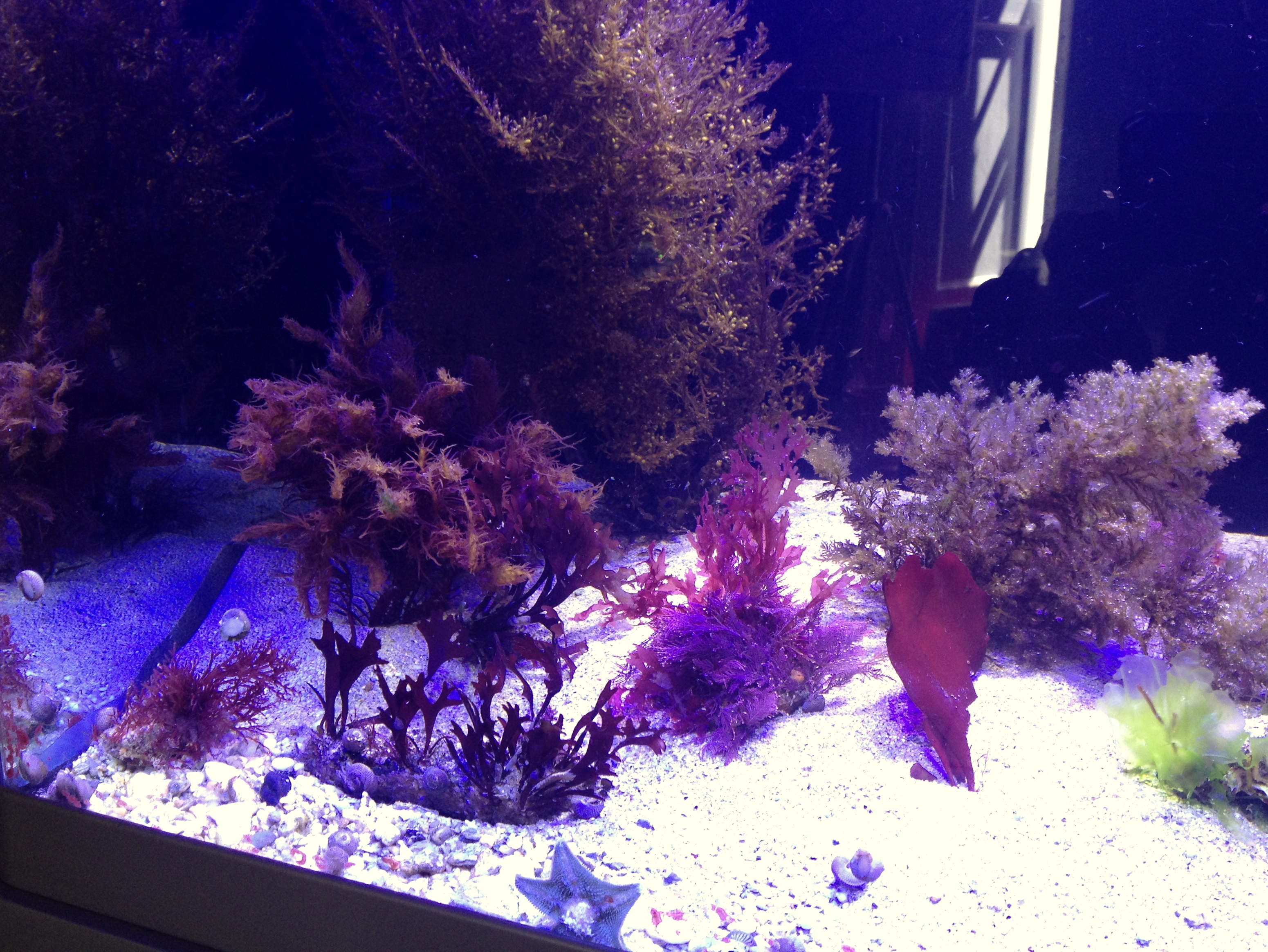
IMG_0660Very difficult to photograph these restless fish with a phone! I am not attempting to decorate the tank with rocks etc just yet, as I first want to experiment with trying to keep different kinds of seaweeds alive (I hope to have more luck now I have the LEDs and chiller). I plucked some of the seaweeds but for some I chiseled off small pieces of the bedrock they are attached to. (I might try to use superglue to attach small pieces of rocks to a rack, similar to frags in reef tanks.) I have a whole bunch of seaweed species, but it seems that the more I learn about them the less I know….False Eyelash weed or Beautiful Eyelash weed? Red rags or Starry liver weed? Irish moss or Grape pip weed? Of course I also collected a small Bushy rainbow wrack (see the first picture). It is very fuzzy, partly due to epiphytes, and hardly iridescent but it hasn’t seemed to die on me just yet. (Note that as this is a perennial, slow growing and usually not abundant species which harbours a lot of other life on it too, it is important to pick as little as possible.)IMG_0590
let there be light

All right, after a variety of issues, the LEDs and dimmer have been finally installed. Actually, only one of the two LED strings is now hooked up to the dimmer, as the other potentiometer caught fire when testing it out. Although RapidLed’s staff was very helpful responding to questions, it was a right pain to get this done and if you are thinking of starting a marine tank: go with a custom tank and buy off-the-shelf LEDs and do not bother with a ‘plug-and-play‘ aquarium with fluorescent bulbs or a LED retrofit kit! (I will post a list of recommendations based on my own experiences for starting a native tank some time …)

IMG_9850Anyway, it is all done now; one dimmable string with 12 white LEDs and one with 9 (if I remember correctly) white ones + 6 Royal Blues. The LEDs should have worked with the inbuilt timer but (at the moment) they don’t. This also means that the four inbuilt blue (moonlight) LEDs do not work at night, which is a shame. A very nice shimmer in the water; quite blueish, but I hope to get a replacement potentiometer soon so I can play around with the colour.

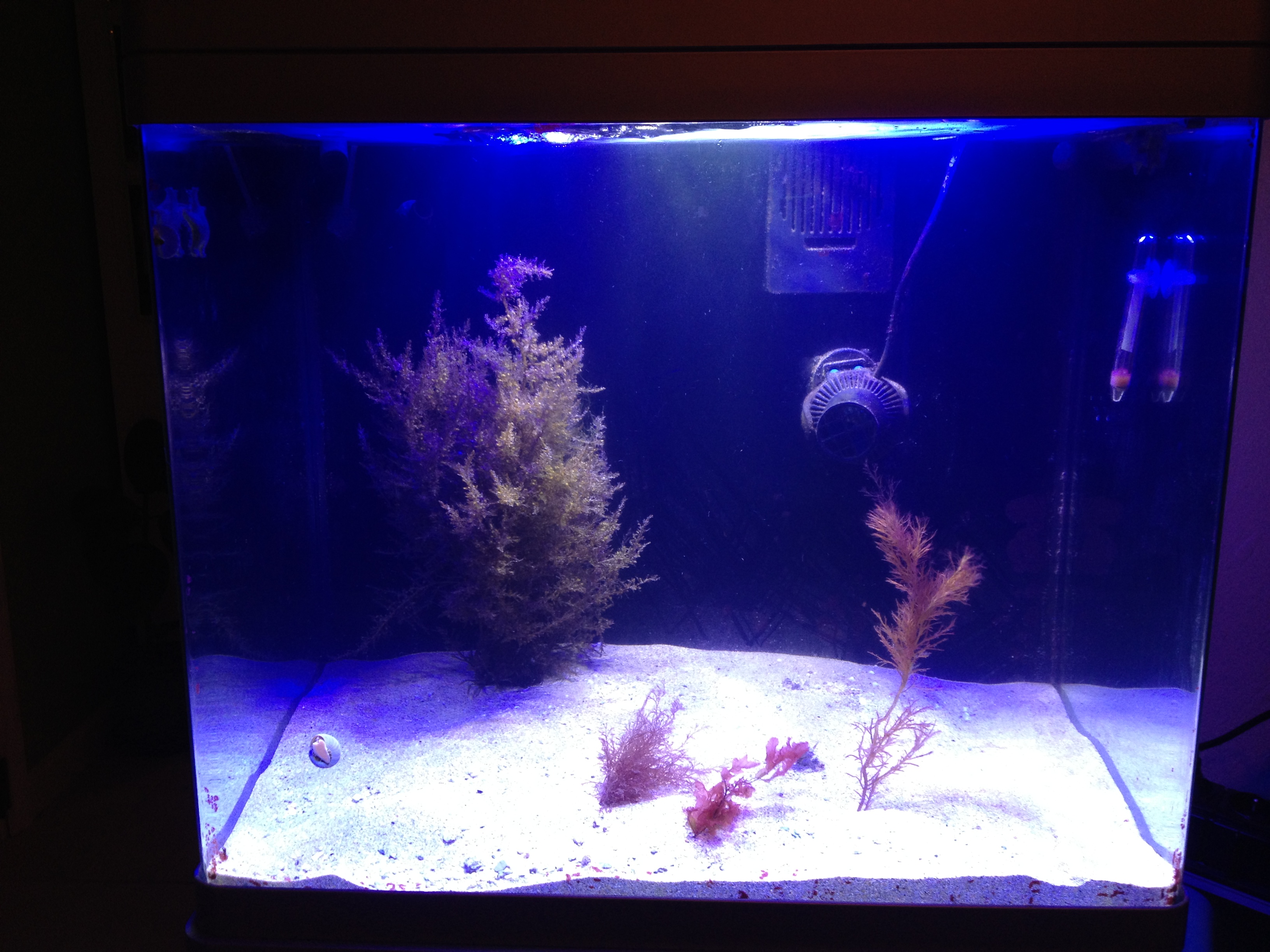
IMG_0430I have put in sand instead of gravel which looks nicer. I have put in some Wireweed to provide some competition for algae now the light are back on (I could not resist sticking in some red seaweeds I found). Some cushion starts and topshells were left, but with the chiller and LEDs in place it is time to get properly get back to collecting animals and seaweeds. Marius has raised the bar pretty high on his Irish Rockpool Aquarium blog, so let’s see how it goes!

Chiller

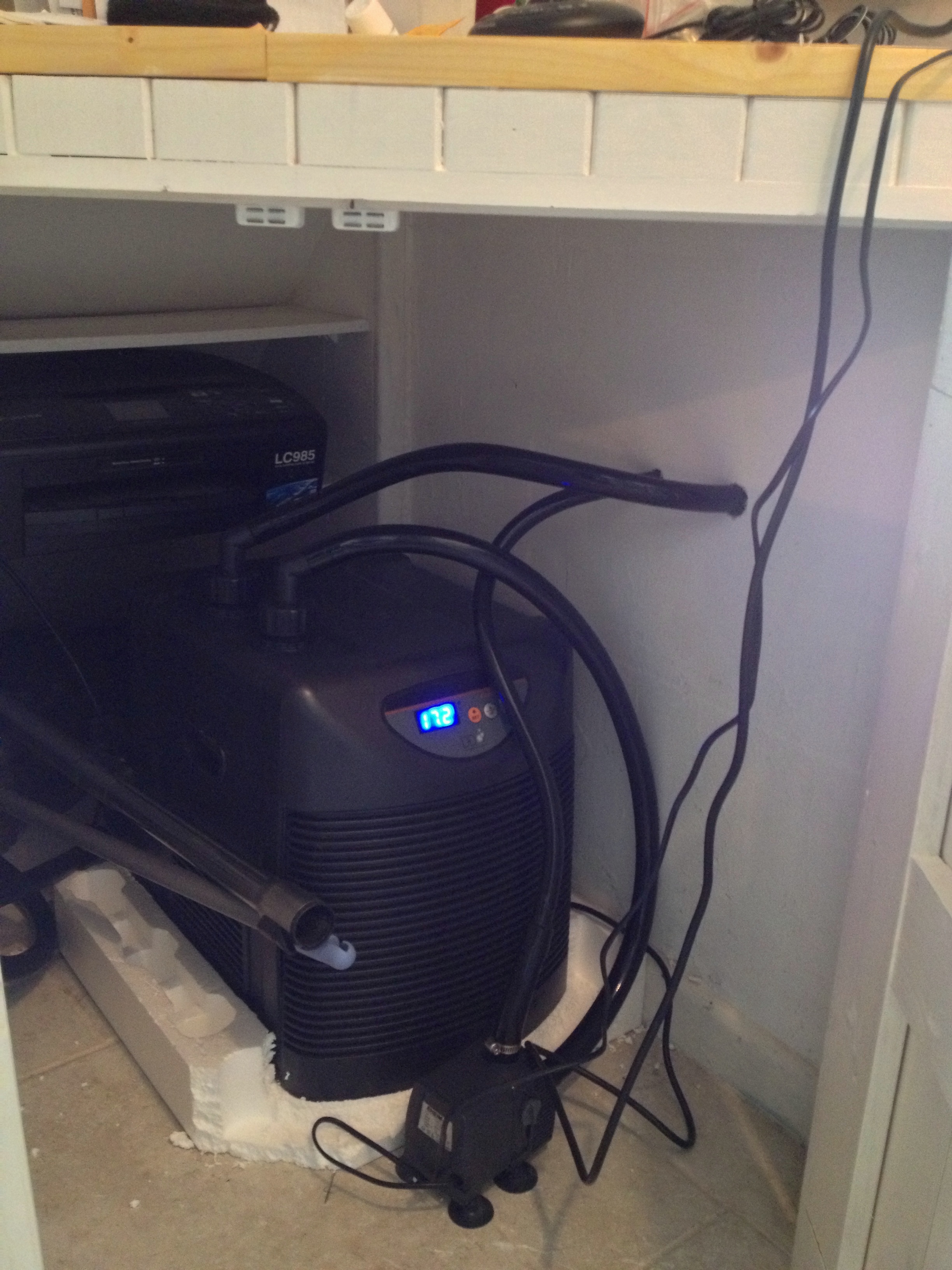
After a year and a half of running a supposedly cold water aquarium at room temperature (usually above 20C), I have finally bought a chiller! I found it very hard to choose between the several available brands, with mixed messages on forums about noise, ventilation and size. In the end I decided on a D-D DC300 chiller; however, the supplier was out of stock and suggested to take the 750 Watt model instead. As it was not that much more expensive and as running a larger chiller at shorter intervals is more econonomical (and also after a year of indecision I of course could not just wait for a couple of extra weeks), the D-D DC750 chiller it was. I ordered an Eheim compact +2000 pump (1000 to 2000 l/hr) to go with it online and got some insulated tubing from my local stoner hydroponics guy. When the chiller arrived it was a lot bigger than I thought. I placed it in a kitchen cabinet out of sight, and hopefully hearing, and with help from friends drilled two holes in the wall to the living room, to lead the tubing up to the tank:

IMG_8466(I still have to drill holes in the surface for the two electric cables.) The chiller is set at 17C, which results in about 14-15C in the aquarium. With a lower temperature setting, ‘tank sweating’ (condensation) occurs. So the temperature is still at the upper end of native tanks, but I think (hope) it might make the difference for some species of algae and some sublittoral species. The chiller only comes on about four times per 24 hours for a half hour and the noise is not too bad. The inside of the cabinet heats up quite a bit, but I think it should not be a problem. I had planned to fit the outflow through one of the two holes drilled in the back compartment for the two Red Sea Max pumps, but the tubing was too stiff/the compartment too small to make the angle. I have now just tie-wrapped the tube into the tank:

IMG_8465I still have to find a proper solution to close the two holes, as I do not want the water to be sucked into the back compartment that way (bypassing the filter/skimmer). I have set the pump at 2000 l/hr which (with the loss because of chiller and tubing) is still not very strong (the two RSM pumps had a combined 1100 l/hr). I might re-install one of the original pumps to get some extra flow directed at the water surface. Next project: finally installing my LEDs!

aquarium update: snails

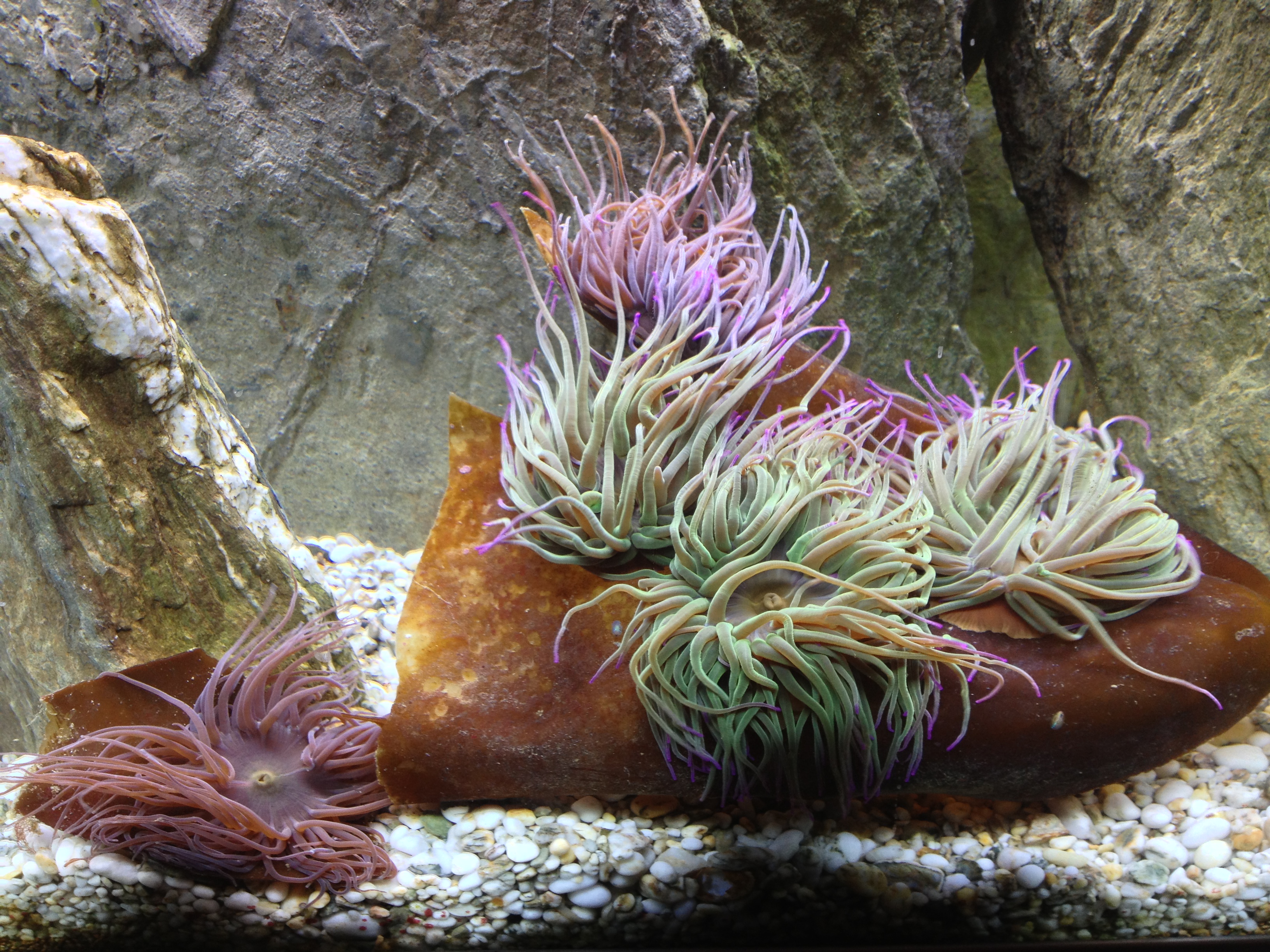
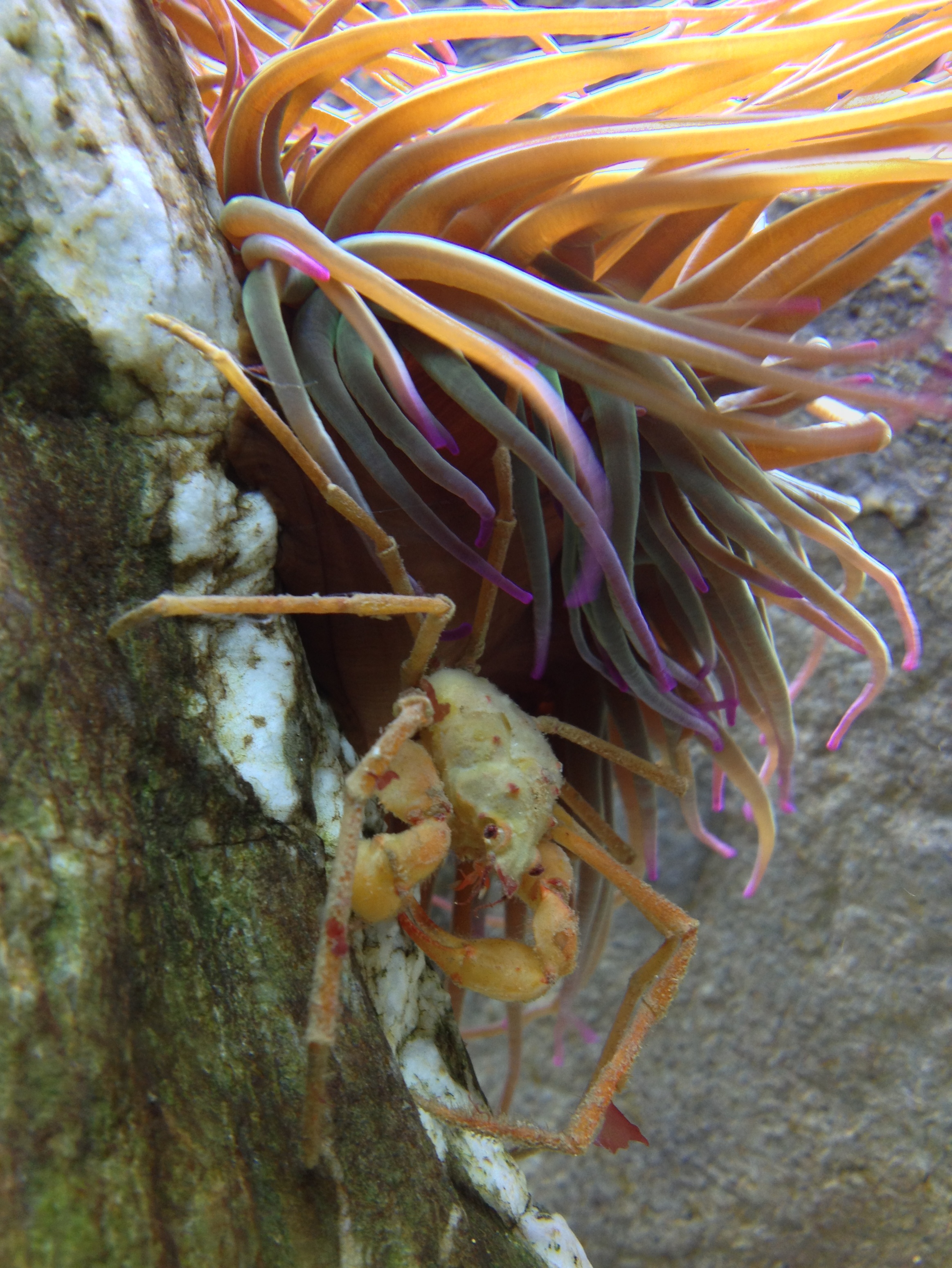
Time for an update. The five Snakelocks anemones have settled and are doing very well (I have fed them some defrosted shrimps which they quickly devour). The Leach’s spider crab was sitting happily under one of the anemones until it decided to move behind a piece of slate and now does not show itself much anymore. Perhaps this has to do with a prawn I introduced, although I have not seen any scuffles. I have to see what I’ll do about this. If it is really shy then I perhaps have to choose between keeping it or introducing fish. In any case I have seen it munching on some algae and a dead Cushion star and it seems to do OK.

IMG_6422

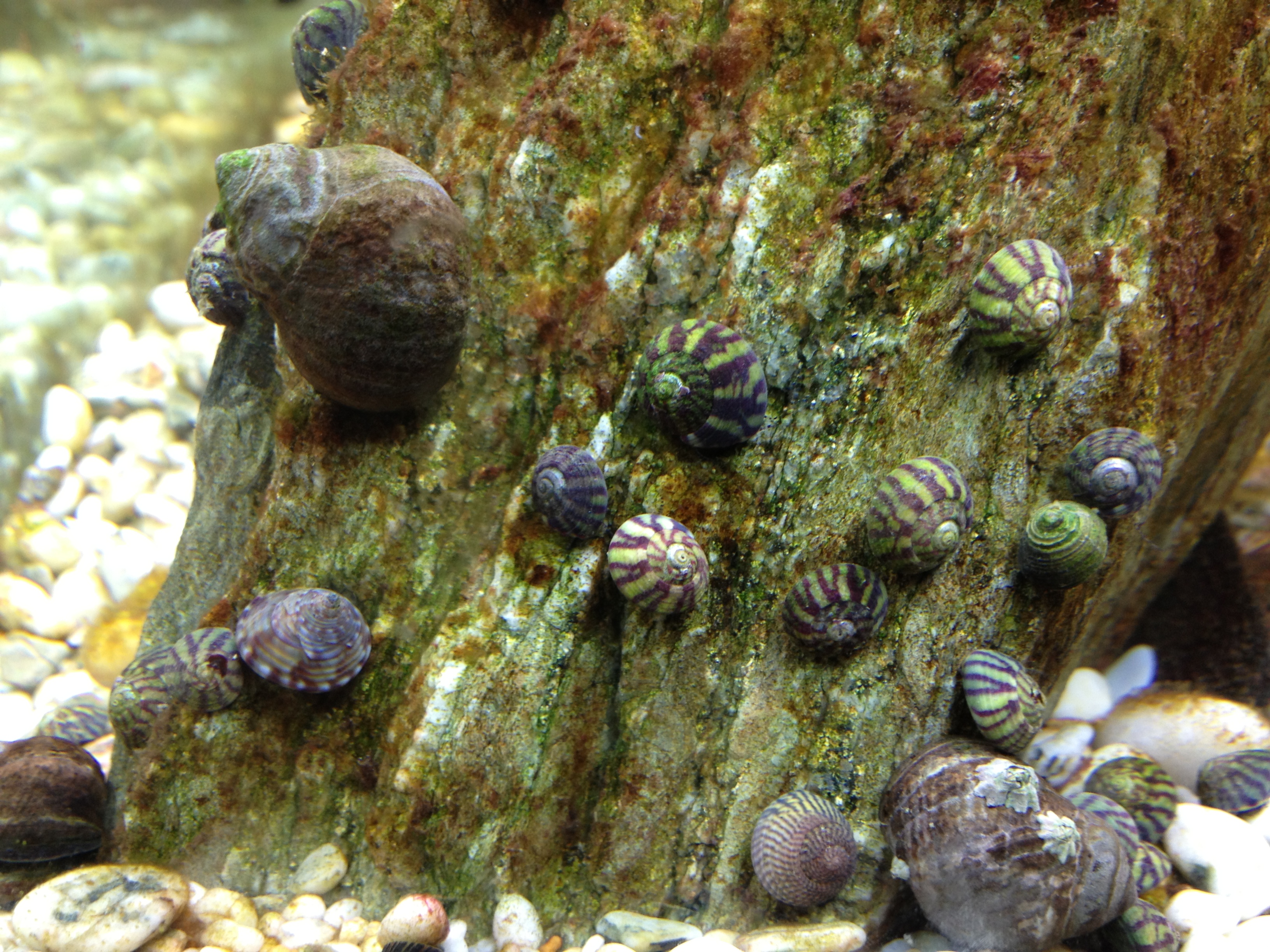
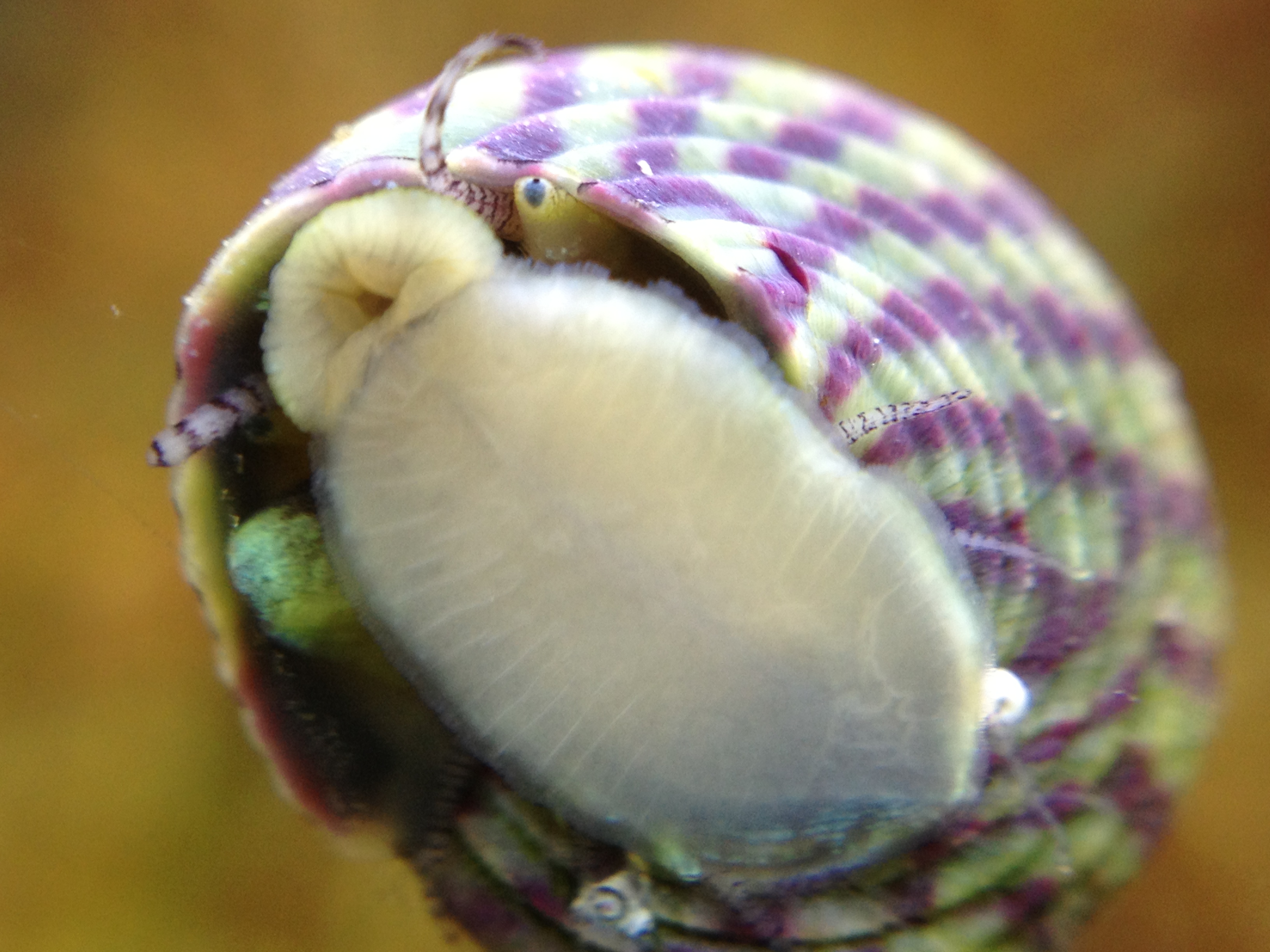
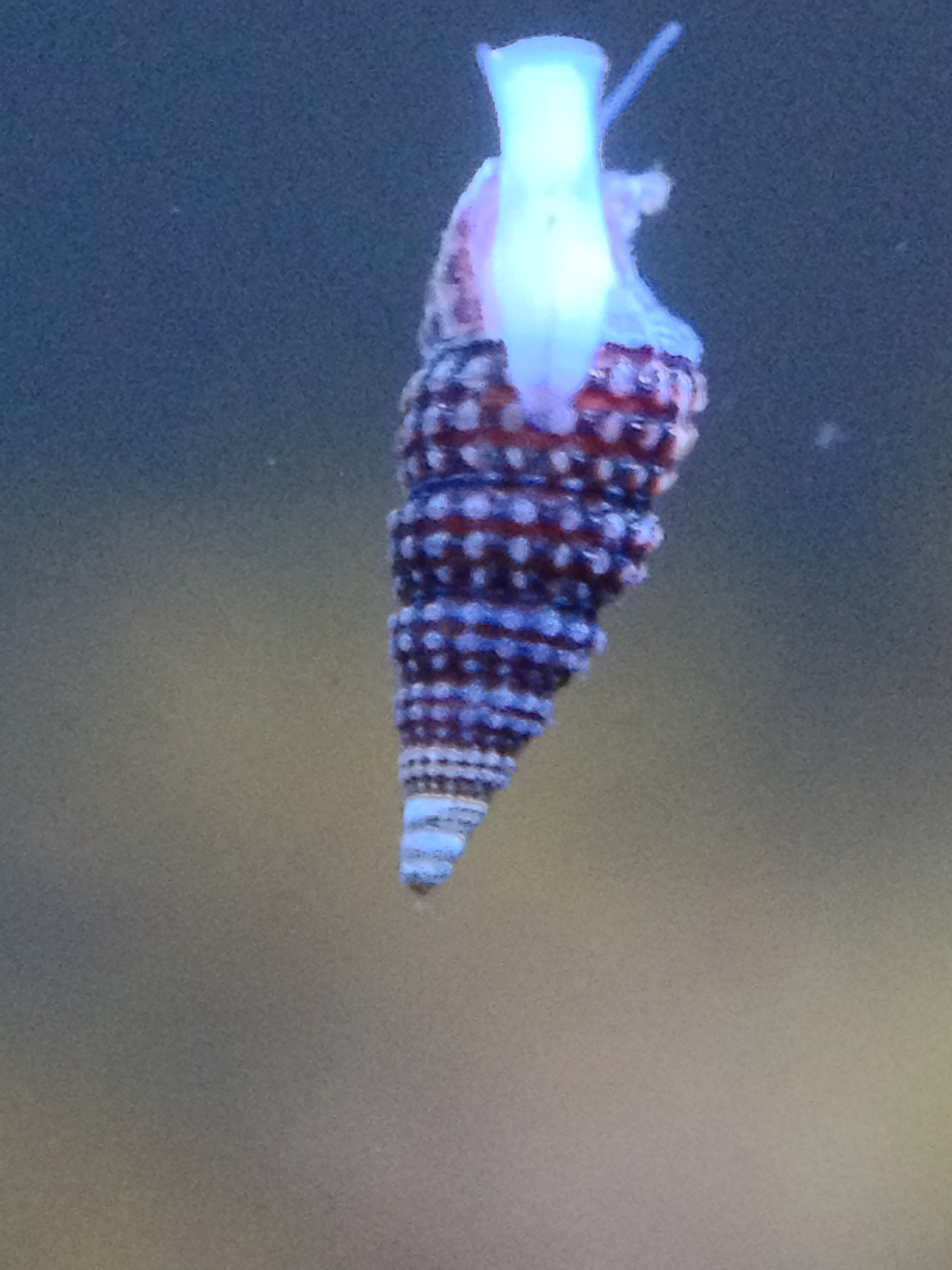
The main problem I have is the dreaded return of algae…There is quite a diversity of them: fuzzy green ones, darker green blotches, slimy purple ones, brown diatoms and more. All interesting organisms surely but I do not want them to take over the tank! I have used food sparingly and used the skimmer most nights, but now have also removed my daylight lamp, to leave a single actinic lamp (see this post about lighting). I still have to get used to this new look, but less light must surely help. Most interestingly, I have enlisted the help of 80 or so grazing snails. Mainly the Common periwinkle Littorina littorea and the Flat top shell Gibbula umbilicalis but also some other species, including two very small Painted top shells Calliostoma zizyphimum. I never had many snails in my aquarium, as they were always eaten by Shannies, but hopefully they will survive this time. I will dunk in a lot more snails, and keep an eye out which species does best. A Flat top shell (picture taken using my olloclip macrolens for the iPhone):

IMG_6468

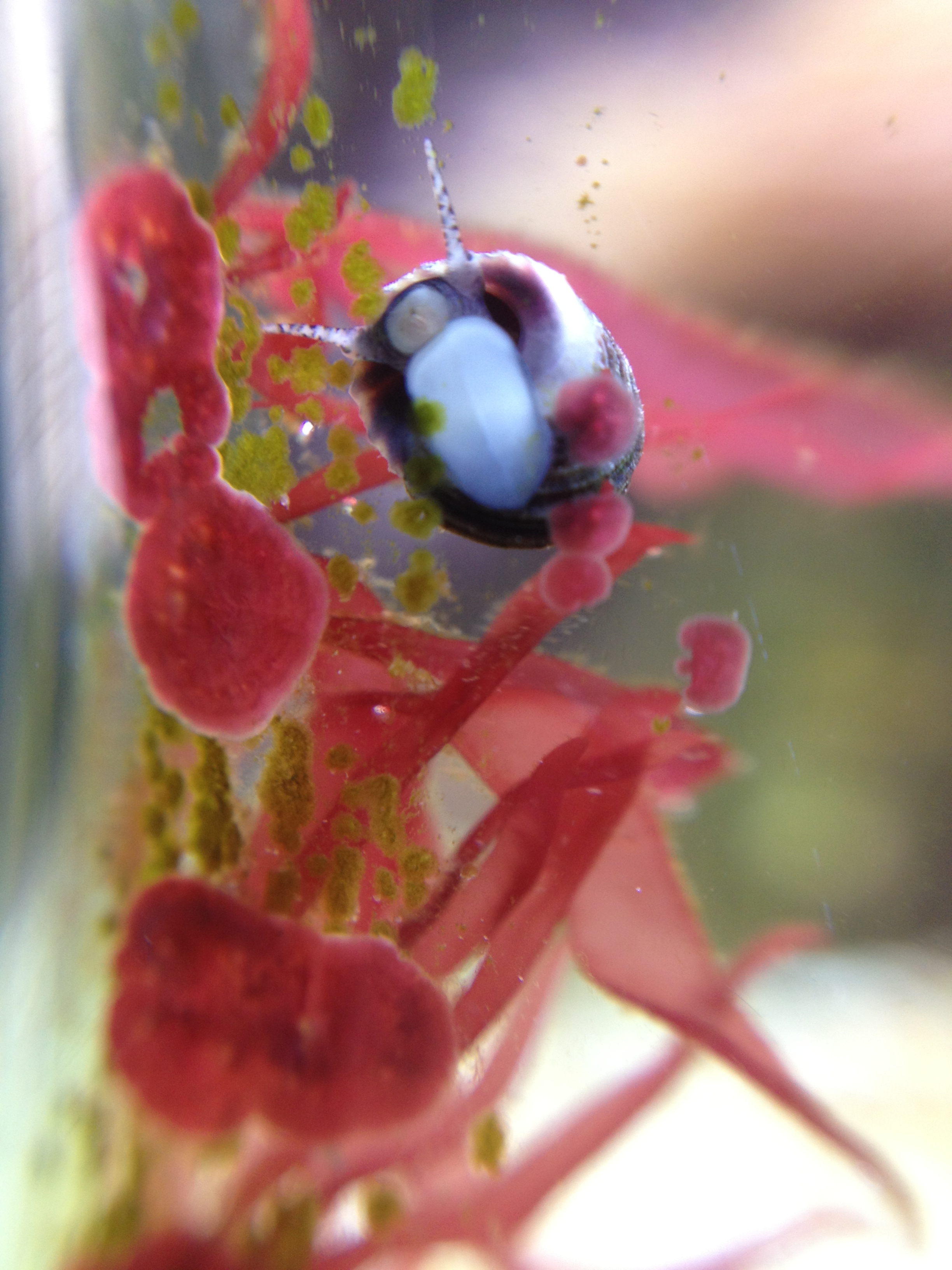
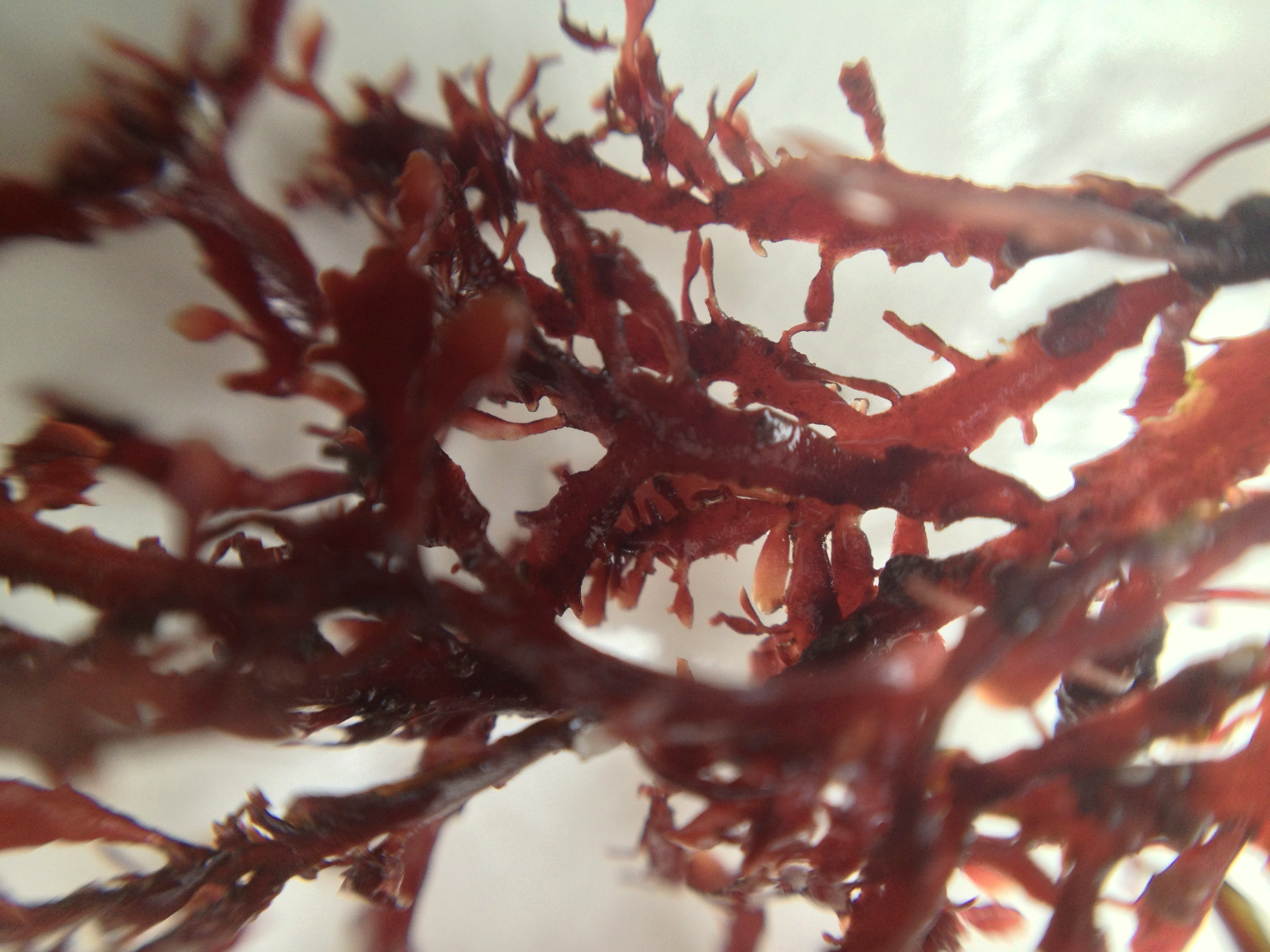
One returning encrusting red algae is actually a seaweed, with new ‘leaves’ growing from the round crusts. I suspect it is Devil’s tongue weed Grateloupia turuturu. I have been scraping it off the glass, except from the corners where the scraper is of no use, but will let the rest sit and see how it grows:

IMG_6431

I also noticed that Sea lettuce Ulva has started to grow from the slate. The aquarium does not look that nice yet, but with the new animals there is plenty to watch in any case!

new inhabitants

Last weekend I went for a bit of snorkeling off Pendennis Point to catch some new inhabitants of my tank: some Snakelocks anemones and a Leach’s spider crab (just one for a start). Although it was overcast and late, it was nice to be in the water. I was lucky to straight away find a diving knife, this helped me to cut of some kelp housing snakelocks. I took a perforated plastic Lidl bag with me in the water to serve as a net for the crab, low tech but it worked fine. The tricky thing was to get the snakelocks from the kelp afterwards (I did not want a load of rotting kelp pieces in the tank):

IMG_6148

With some finicking I could get the anemones off the kelp and on the rocks or gravel. The Leach’s spider crab (decorated with small pieces of red seaweed) quickly hid behind a rock. However, after two days it was accustomed to its new surroundings and found a place underneath one of the anemones right in the front of the tank:

IMG_6216

A fresh start

After having the aquarium almost empty over summer, I finally got round to start it up again. I reinstalled the Tunze nanostream, went back from the finer, brown Maerl gravel to normal, coarse gravel and collected some new rocks (slate I think). I looked for these on the middle shore; on the lower shore they are covered with the barnacles and limpets that I do not want and on the high shore they have not yet been eroded by water and have very sharp edges. Still have to get used to the new look. Now on to collect some animals!

IMG_6139

new lighting

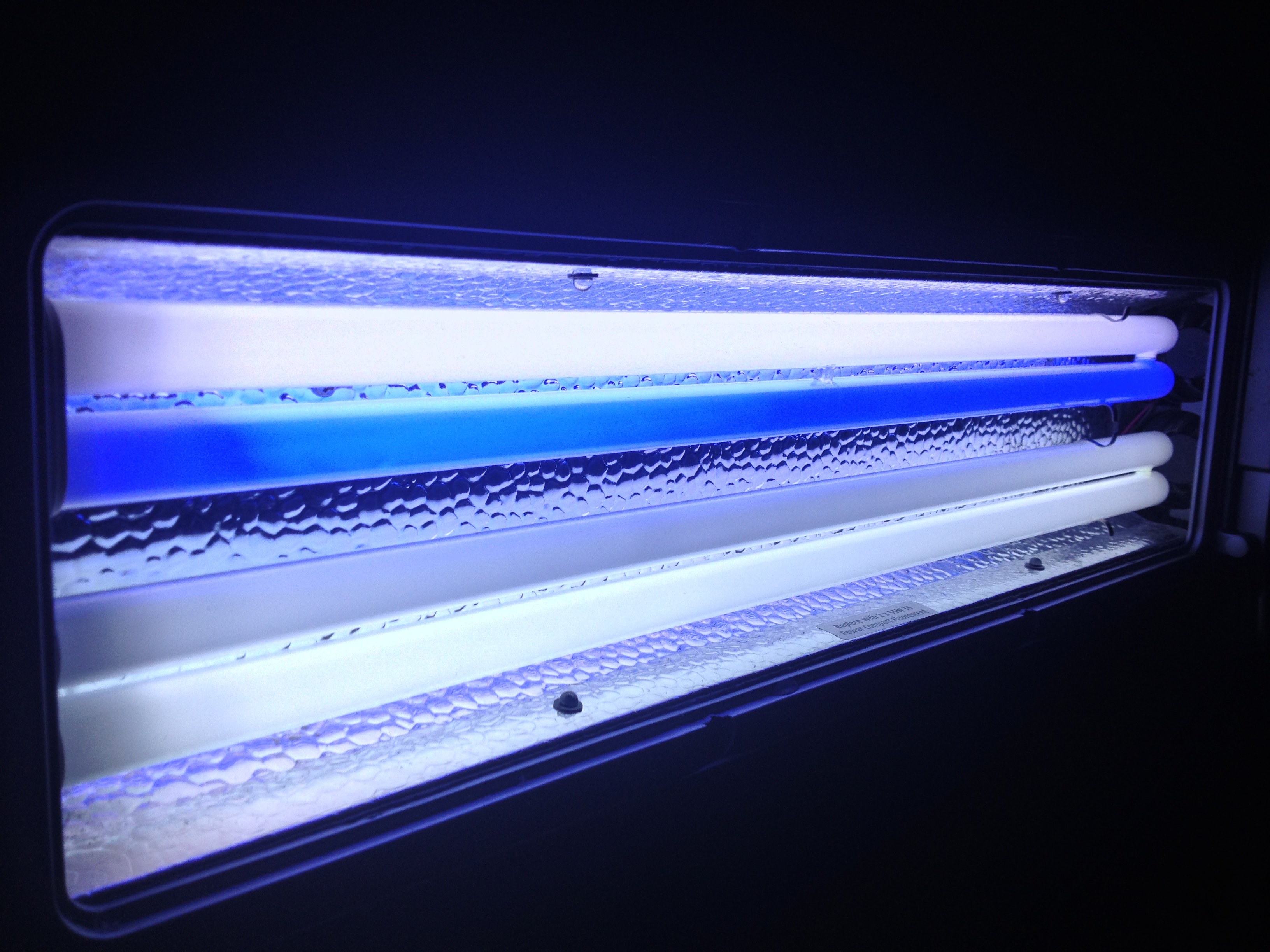
My new 55 watt fluorescent Philips daylight lamps arrived last week. The first picture shows the two standard 10.000 K actinic lamps that come with the Red Sea Max 130D; the second picture shows the two new daylight lamps. I found he light coming from the actinic lamps always looking rather harsh, but the daylight lamps looked awfully yellow. I decided to compromise between photosynthesis and aesthetics and go for one of each type (third picture):

IMG_2870 IMG_2875IMG_2874

As you can see, the Wireweed and Dudresnays whorled weed are doing very well.

IMG_2873

The 10.000 K lamp (top) and the 6500 K lamp. Contrary to my expectation, the temperature dropped using the new lighting: from 25C to 23C, good! I have ‘planted’ some Furcellaria lumbricalis, let’s see what it does:


IMG_2871

Yesterday I discovered a big patch of Bushy rainbow wrack Cystoseira tamariscifolia on Castle beach in Falmouth (I noticed that this seaweed grows quite high on the shore at this location). I should have brought a small plant back to test with the new lighting (and lower temperature and salinity) but I reckoned it would be best to wait a bit until I have a chiller as well to get all conditions right. Hmmm, maybe I’ll go back today…

IMG_2858

IMG_2859

disturbing data

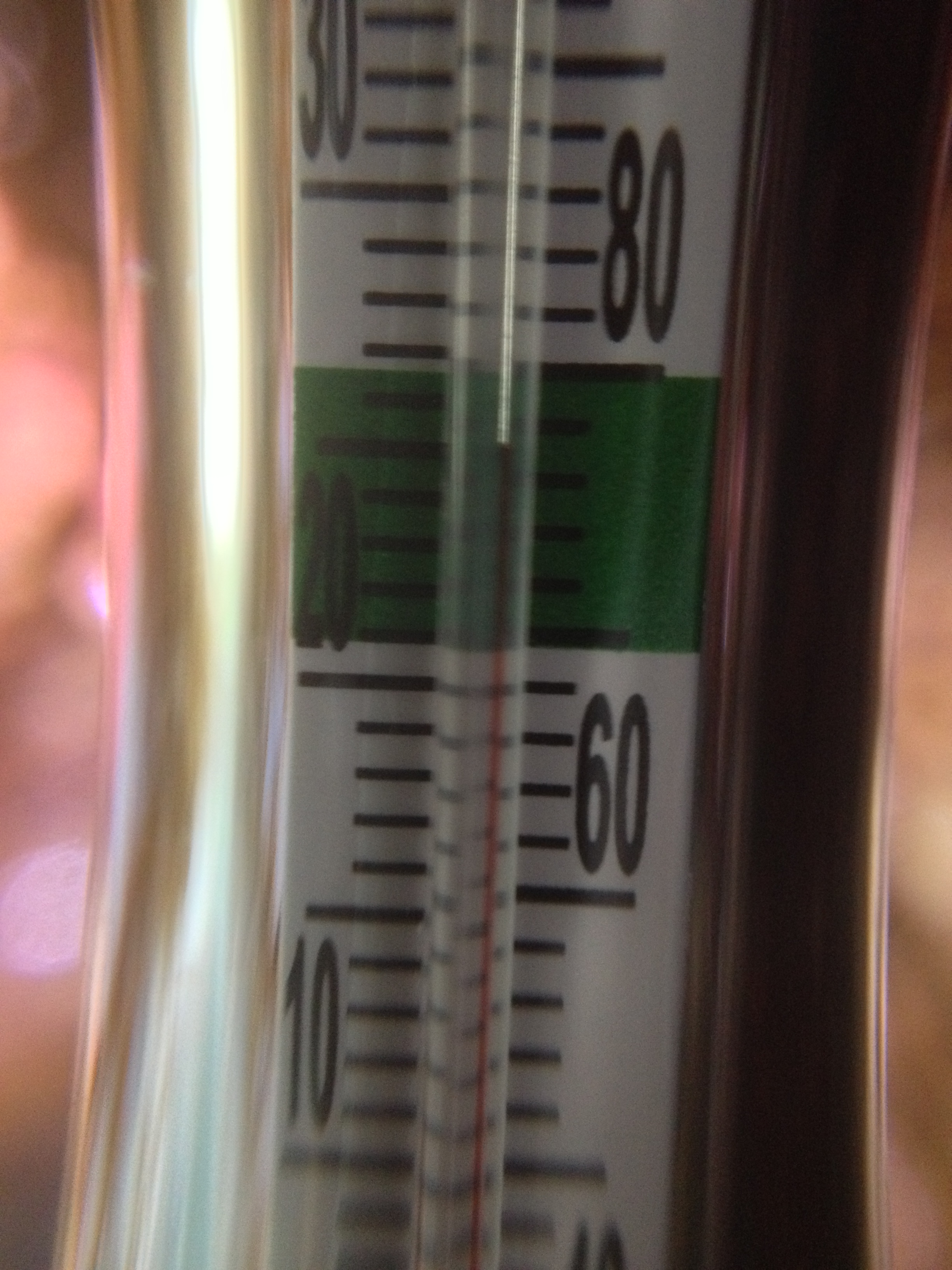
Allright, I finally have a thermometer. I ordered it online and it turned out to be way to small (not helped by the addition of the arcane Fahrenheit scale…). Anyhow, my water turns out to be 25 degrees (Celsius)! This is a couple of degrees warmer than I thought, and not exactly characteristic of British Seas. I will have to save money for a chiller…

IMG_2788

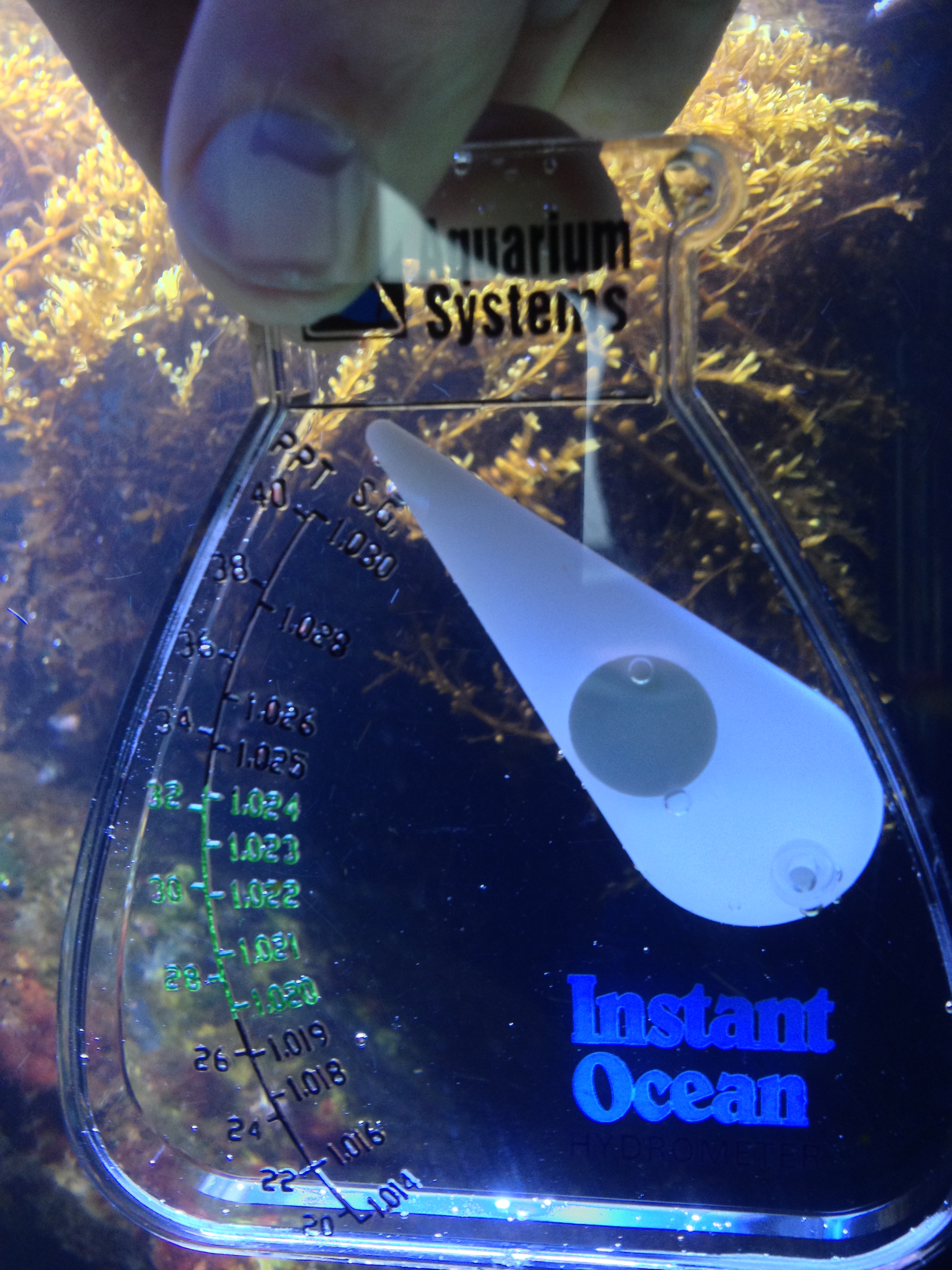
I also bought a hydrometer (cheaper than a refractometer) to measure salinity. This was even more of a shocker, the salinity was literally of the scale! >40 g/l instead of the 35 g/l or so of ‘regular’ seawater!

IMG_2789

I have recently started to change water more frequently, which means I have not been topping up evaporated water with distilled water but instead replacing this water of 0 g/l salinity with seawater of 35 g/l salinity. Stupid. Tomorrow I will take back distilled water from the lab for a good water change (gradual of course). My temperature and salinity values demonstrate that rock pool critters are quite hardy: all my fish and anemones seem to be doing just fine. However, who knows these high salinity levels might have caused problems in the aquarium for some of the seaweeds collected from the lower shore…

P.S.

Actually, recently one organism died a week after I put it in the aquarium, probably because of the temperature and salinity shock, the beautiful Dahlia anemone Urticina felina (not a very good photo):

IMG_2629

more seaweeds

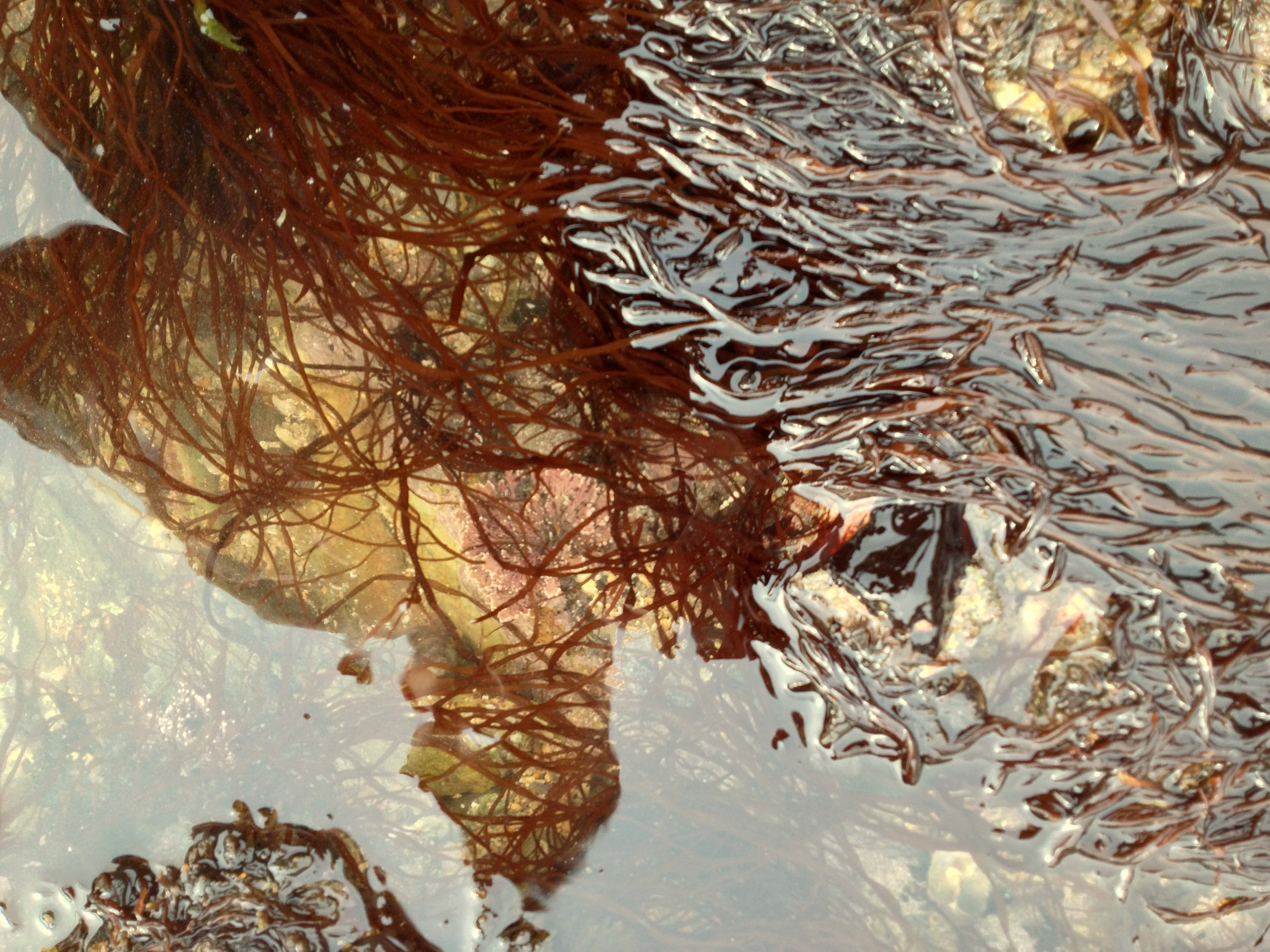
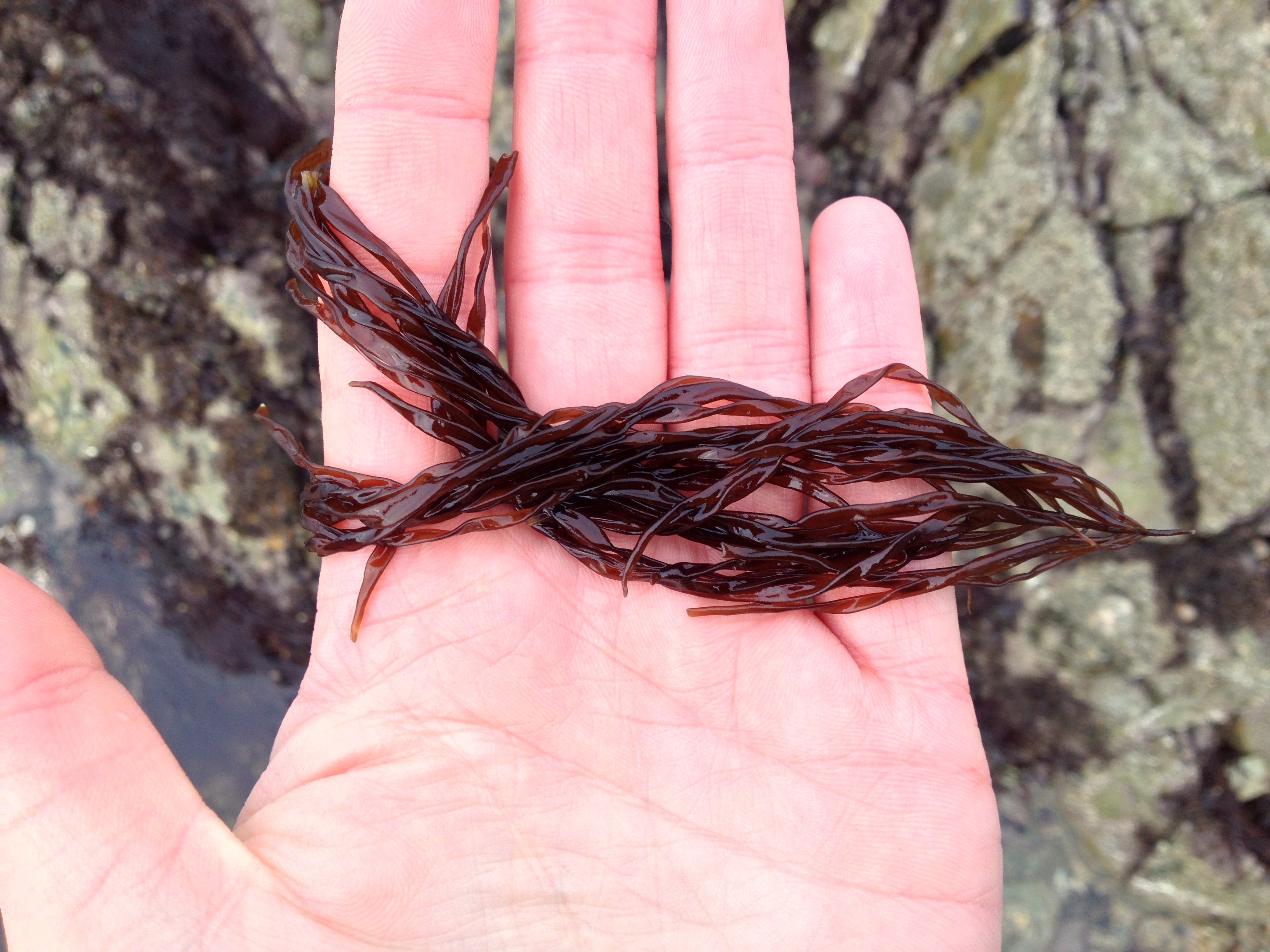
I had to remove the False eyelash weed from the aquarium; some bits were looking fine but in general a substantial amount of the branches had died off. Perhaps this is what normally happens in nature, only in rock pools any dead material is quickly washed away and so it goes unnoticed. I had to make some water changes to get rid of the debris which required some healthy exercise bringing buckets of waters down from the quay. Although it was windy and cold, I could not resist the urge to have a look at my local beach in Flushing last Saturday, hunting for some more seaweeds. It was noticeable that one particular seaweed had started to grow everywhere: Dumont’s tubular weed Dumontia contorta:

IMG_2459

 IMG_2460

Slightly slimy and impossible to remove from the rock without ending up with a hand of loose strands. I therefore have placed a large pebble with one small plant in the aquarium just to see how it goes. I found small plants of Solier’s red string weed Soliera chordalis again that did well in the aquarium last year, as well as a whole bunch of other red seaweeds that I have trouble to identify (not the first one, that is Bunny ears Lomentaria articulata):

   IMG_2528IMG_2527 IMG_2518 IMG_2513IMG_2512

To test whether they are able to grow in the aquarium, I have placed them in an old floating fish fry box I had lying around:

IMG_2532

tank update

Time for an update on the tank. Switching to two lamps instead of one looks good but has not brought the iridescence of the Bushy rainbow wrack back. I could not resist putting a new specimen in. Iridescence is defined as the property of certain surfaces to appear to change color as the angle of view or the angle of illumination changes. Left: viewed from below, right: viewed from above.

IMG_2407IMG_2409

I noticed that the underside of the rock the weed was attached to harbored a nice little strawberry worm, but before I could photograph it, the large rock goby gulped it down. It is noticeable that the fish have full bellies after putting in a new piece of seaweed, which is no surprise as there is so much growing on and in it.I have seen the very cute amphipod Caprella acanthifera which looks like a tiny, marine cross between a praying mantis and a caterpillar, but since they did not come not near the glass I could not get a good shot. I have seen one Cushion star Asterina Phylactica as well, which looks nicer than the light grey Asterina gibbosa I have. I also noticed a couple of Cerithiopsis tubercularis (3-4 mm):

IMG_2102

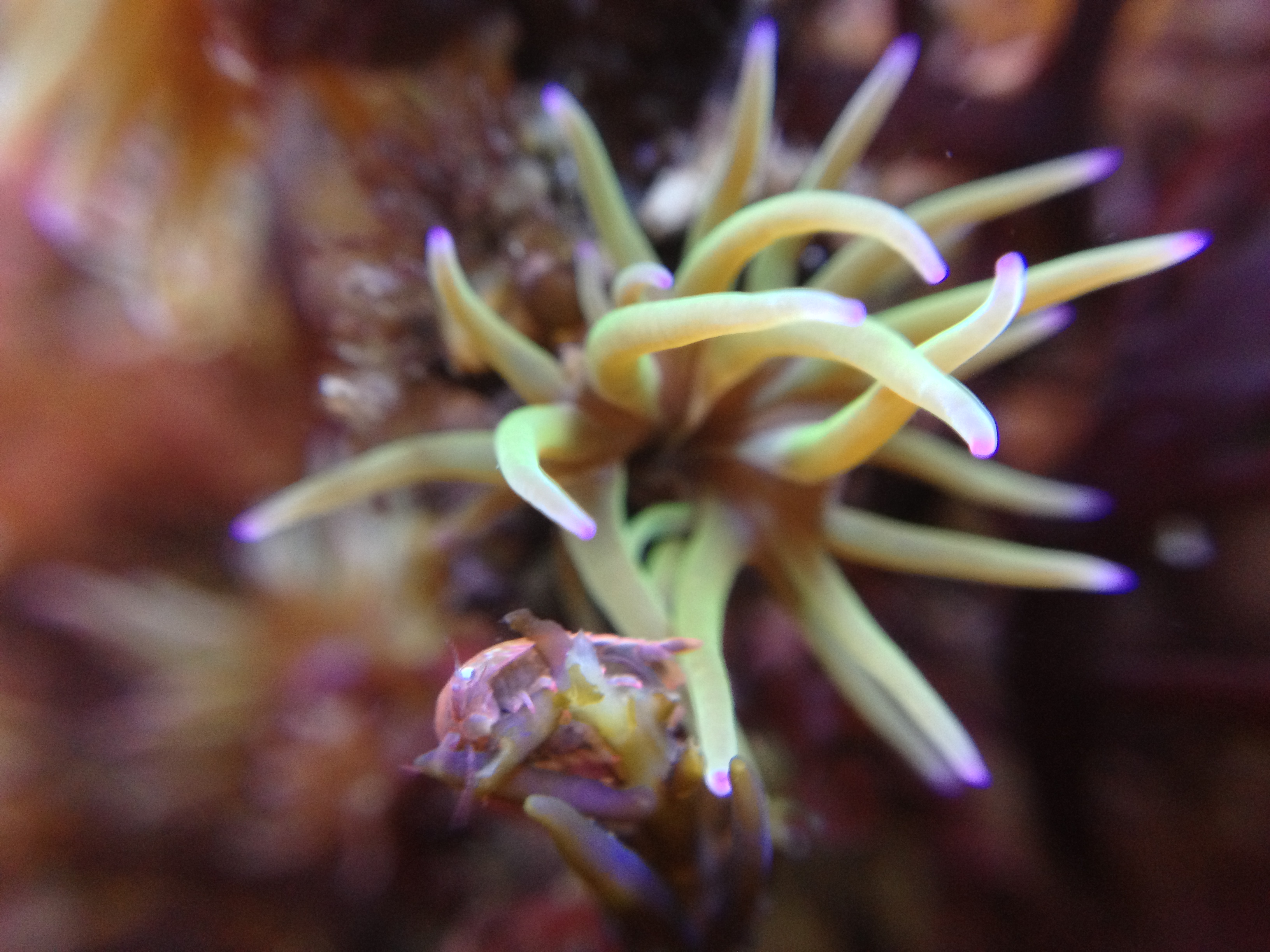
The tank is completely full of snakelocks anemones, hundreds maybe:

IMG_2410

IMG_2107

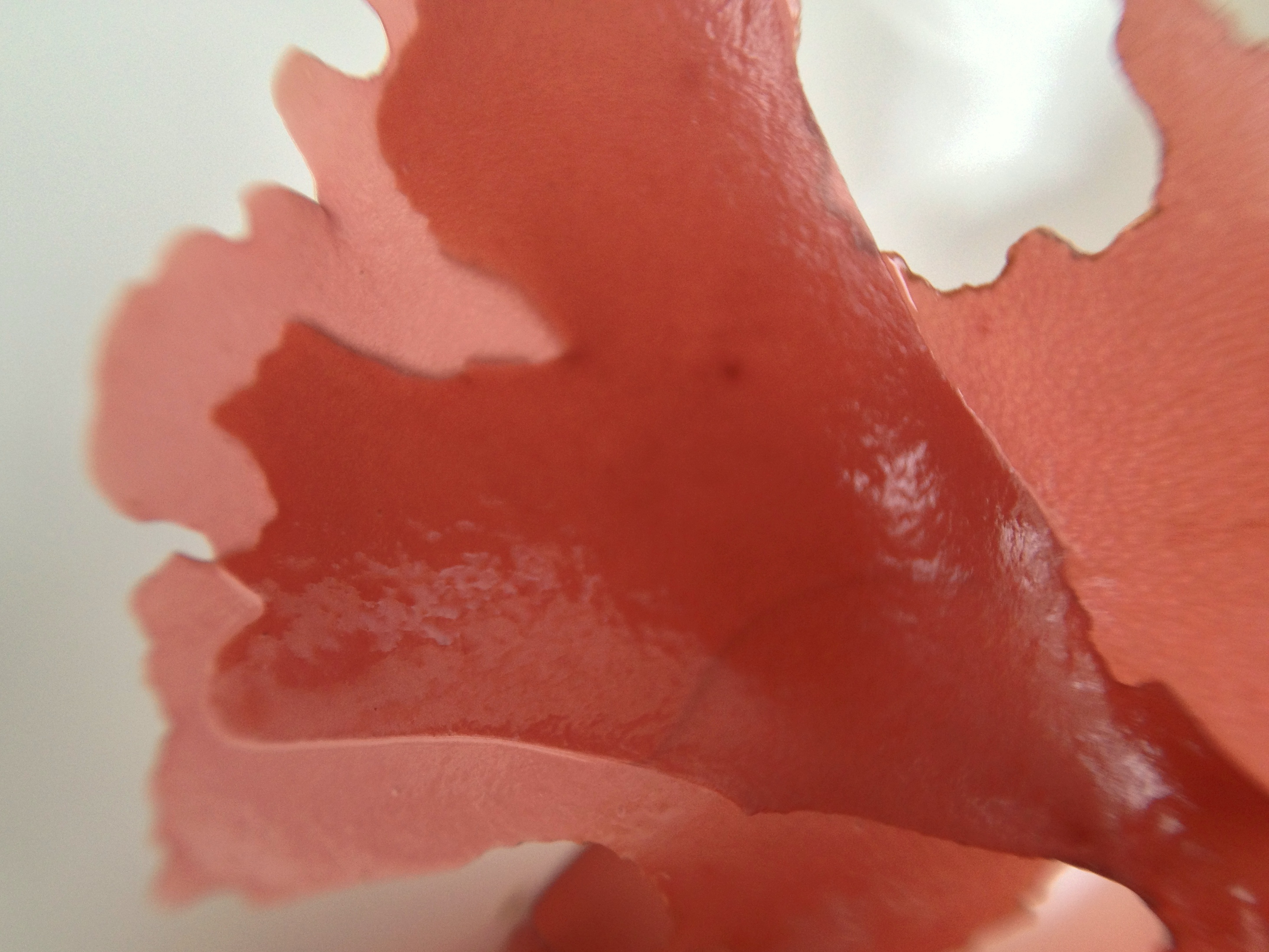
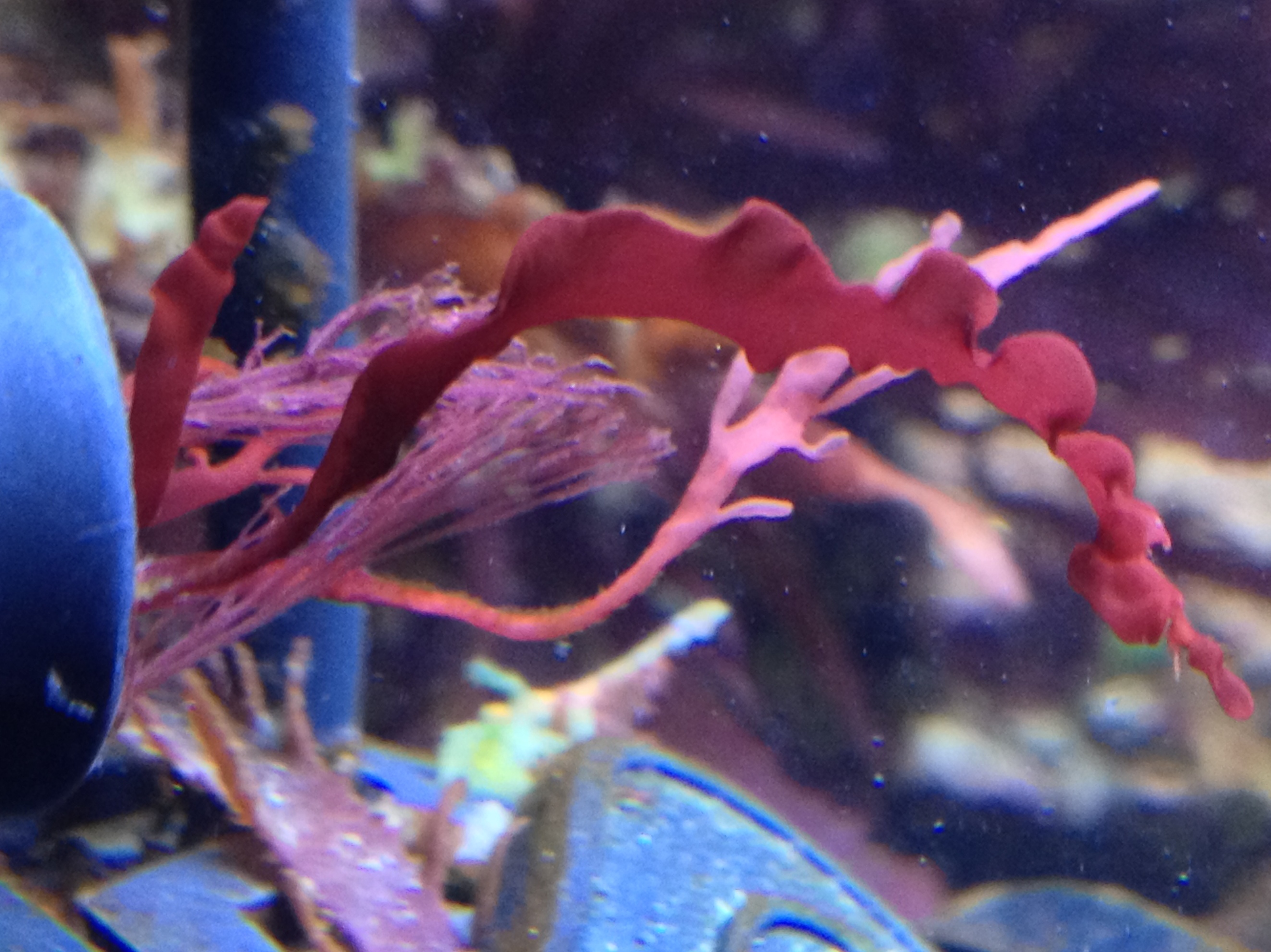
In the foreground an Idiotea isopod; there are many of these sitting on seaweed branches and occasionally swimming around, although most of them will probably be eaten by now. Finally, three seaweeds have started to grow from the pump outlets. Dudresnay’s whorled weed, a fine purple weed and a broadleaved red seaweed. I have placed adult plants of the latter species (30 cm or so)  in my aquarium before, but these were quickly eaten. It is either a type of laver or dulse, but I am not sure. It has also settled on the glass, but seldomly grows ‘leaves’ on there. Growing in the water current protects the weeds from predation from shrimps, let’s see how big they can grow!

IMG_2354