I have not posted too many pictures of seaweeds in rock pools because they are a real pain to properly photograph. However, when rock pooling two weeks ago in Falmouth, my friend Thor took some great pictures using his DSLR, two of which shown here. The IDs of these two epiphytic seaweeds on wracks were verified with invaluable help from Seaweeds of the NW Atlantic facebook group members: the first picture is Pylaiella littoralis (a species I had only seen on kelp sublittorally). The second species is Polysiphonia (or Vertebrata) lanosa: 
Tag Archives: seaweeds
tropical seaweed aquariums
The focus of the blog has recently been on rock pooling a lot more than on my aquarium, as unfortunately it has been in a state of limbo for months now. I received my new LED retrofit kit a while back, but have been caught in the unholy triangle of being busy, hopelessly technically unsavvy and prone to procrastinate. Although the LED kit was solderless (easy), the dimmer to go with it was not (not very easy). I asked my local sparky but he managed to only make it halfway through the installation and I am now waiting for someone else to drop by to help out. I am really curious what the LEDs will look like and desperate to go from the current unlit disgrace in the living room to a nice tank again (especially now I have a chiller as well).
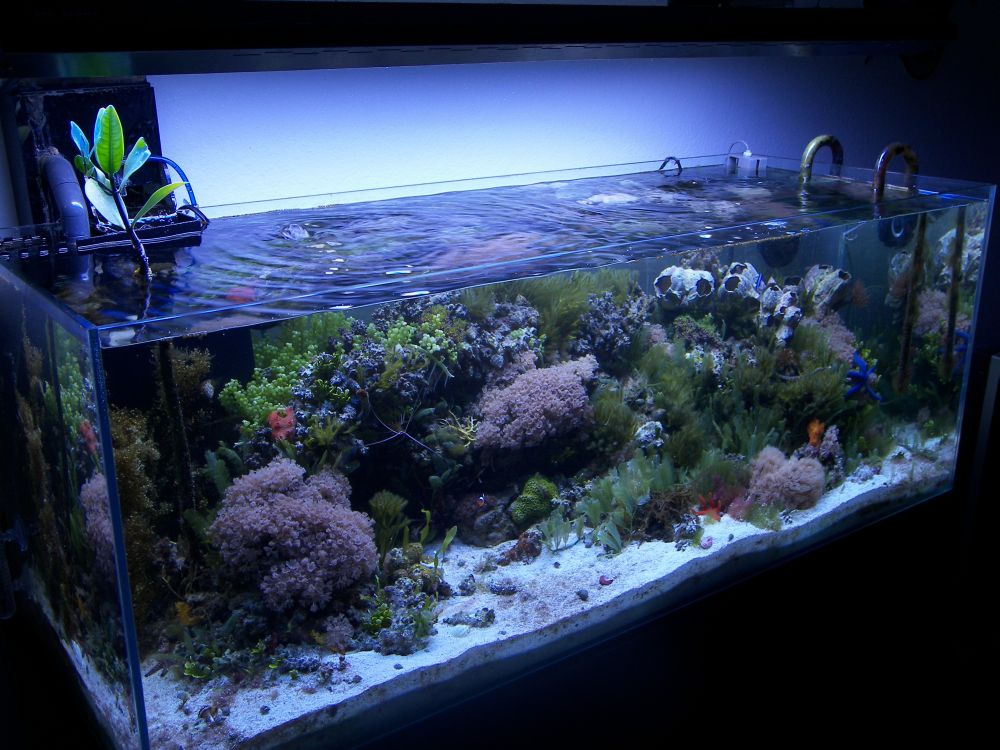
So in the mean time this post about tropical seaweed aquariums I found whilst trawling the internet. Although there are few aquarium blogs, there are many aquarium diaries on forums. Just a couple of those are devoted to seaweed aquariums (for examples see here and here). The first one I found on this thread (not much information on species) is a stunning looking tank mixing corals and seaweeds:
I found a similarly impressive tank on the nano-reef forum, which has a special section on macroalgae, eelgrass and mangroves:
Absolutely beautiful seaweeds (follow the link to see many more pictures and a species list). Apparently, there are several aquarium retailers that sell tropical seaweeds; the ones in this aquarium came from LA Reefs and Gulf Coast Ecosystems, which have large collections of many very interesting species. (See for an amazing, unidentified, iridescent seaweed this picture and this video.) Gulf Coast Ecosystems has an especially large collection of seaweeds from Florida with good descriptions of their requirements, see for example this page on the very distinct green alga Acetabularia. It even has a short guide on how to keep seaweeds in the aquarium. After some more browsing, including on the marine plants and macroalgae forum at Reef Central, I found that there were actually quite some suppliers of tropical species, for instance reefs2go, aquacon and reefcleaners. Another stunning tank:
This one is a bit more conventional with many corals and seaweed species that are quite often encountered in ‘normal’ reef tanks such as Caulerpa. Caulerpa species can actually turn into a nuisance as they can grow very fast. Moreover, it can enter the sexual part of its lifecycle causing cloudy water (lots of threads are dedicated to these problems). This aquarium also features a little mangrove seedling, which is often used in sumps (as are green seaweeds such as Caulerpa and Chaetomorpha) to remove nutrients from the water. Looking at these pictures I am almost tempted to go for a tropical aquarium, as it allows both corals and seaweeds. However, I’ll stick to my native beasties that I can collect (and put back) myself, which is half the fun. Perhaps I’ll post another time about eelgrass aquariums. I have seen a bunch of tropical examples but it would in theory be possible to have a cold water seagrass aquarium as well. Hopefully my LEDs will soon be fixed so I can post about my own aquarium instead though.
Seaweeds in the aquarium part III
A final post summarizing my experiences with seaweeds and writing this, I have regained my enthusiasm for trying to grow seaweeds in my aquarium. My New Years Resolution will be to get a proper marine planted tank going again! (The fact that the aquarium, currently devoid of seaweeds, looks less than great at the moment has made the decision to change it around easier as well…)
5. Some seaweeds establish naturally in the aquarium
I mentioned in the first seaweed post that it can be hard to ‘plant’ seaweeds in the aquarium but sometimes they just settle by themselves. One of my favourites, Chrysymenia wrightii (consistently misidentified as Dudresnay’s whorled weed throughout this blog…) started growing spontaneously from a rock:
This is currently happening with bright green Sea lettuce Ulva and what is probably Devil’s tongue weed Grateloupia turuturu. The outlet grid of the Tunze nanostream is a good place for seaweeds to settle it seems; I have currently a little pluck of Flax brick weed Chaetomorpha linum growing and had a couple of other species there in the past too. Spontaneous growth is of course the best way to get a seaweed aquarium going.
6. A list of Seaweed species I had in my aquarium
Perhaps of interest to a handful of people… I have tried to list all seaweeds I managed to identify and remember, and whether they did well (YES) or not (NO) in my unchilled aquarium (lighting spectrum and intensity used varied somewhat over time). Why some species did not do well I have no idea (see previous post); in some cases, seaweeds were eaten. I have not tried larger species such as Kelp as my aquarium is not that big.
Above: Green (Velvet horn), Brown (Wireweed) and Red (Harpoon Weed) seaweeds in the aquarium.
Red Seaweeds:
Solier’s red Stringweed Soliera chordalis – YES
Chrysymenia wrightii (no common name) – YES
Dulse Palmaria palmata – NO (eaten)
Harpoon weed Asparagopsis armata – NO
Common coral weed Corallina officinalis – NO
False eyelash weed Calliblepharis jubata – NO
Dumont’s tubular weed Dumontia cortorta – NO
Clawed fork weed Furcellaria lumbricalis– NO
Red grape weed Gastroclonium ovatum – NO
Bunny ears Lomentaria armentata – NO
Devil’s tongue weed Grateloupia turuturu – YES
Iridescent drachiella Drachiella spectabilis – NO
A tangle of different Red Seaweeds:
Brown seaweeds:
Estuary wrack Fucus ceranoides – YES
Serrated wrack Fucus serratus – YES
Bushy berry wrack Cystoseira baccata – NO
Bushy rainbow wrack Cystoseira tamariscifolia – NO (still my holy grail)
Wireweed Sargassum muticum – YES (this proved to be the easiest one of all to keep)
Green Seaweeds:
Common green branched weed Cladophora rupestris – NO
Flax brick weed Chaetomorpha linum – YES
Sea lettuce Ulva (lactuca) – YES
Velvet horn Codium tomentosum – YES
So 9 out of 21 species did OK in my aquarium which is actually not too bad (although I have forgotten a number of species that did not do well). Unsurprisingly, the invasive species were easiest to keep (5 YES in 16 natives, 4 YES in 5 non-natives; the difference is not statistically significant though).
Finally, I just wanted to mention that I have been updating the ‘links’ page recently. Regular commenter Marius has recently started a great blog about his new native marine aquarium with organisms collected at the west coast of Ireland: Irish Rockpool Aquarium Adventures, go check it out. A very nice rock pooling blog also is The Salty Scavenger which features loads of seaweed pictures. From now on, I will also register my rock pooling finds online here; with lots of volunteers doing that a great resource will be created that can be used for protecting marine habitats which of course is very important! I have also added a bunch of really useful links to facebook pages, for instance the ‘Coldwater Marine Aquarium Owners‘ group page.
Some Red Seaweeds
Last weekend I took a little stroll on my local beach in Flushing and had a quick look at the variety of red seaweeds washed ashore. I saw some that I did not know, some that I knew, and some that I thought I knew….

I have recently joined the facebook group ‘Seaweeds of the NE Atlantic‘ and so immediately asked the experts for some help in identification. It turned out that the only one I correctly identified was the one on the bottom right: Solier’s red string weed Soliera chordalis. This (invasive) species did well in the aquarium and so did the one on the top right, which I always thought was Dudresnay’s whorled weed Dudresnaya verticillata but it isn’t! It is actually Chrysymenia wrightii, which is also an invasive species. Moreover, my ID of the bottom left species was also wrong: not Fine-veined crinkle weed Cryptopleura ramosa but Beautiful fan weed Callophyllis laciniata (I should have known this as I have found crinkle weed in France this year…). The small flat seaweed on top is Cock’s comb Plocamium cartilagineum. The dark mop top left could not be identified based on this picture so I have to go back to take a better one. So dear reader be warned and take my identification of seaweeds in previous posts with a grain of (sea)salt!
seaweeds in the aquarium Part II
Time for the second post on the topic of seaweeds in the aquarium and I will write a part III as well.
4. What conditions are right for seaweeds?
The short answer is: I don’t know yet (and they will vary for different species). I have some clues that add up to a longer answer though. Obviously light is an important factor. Most tanks come with actinic (blueish) light representative of deeper waters. The seaweeds I collect are from shallow water (rock pools) and so are adapted to whiter daylight (as in freshwater planted tanks). I have played around with lighting (see this post) but not in a very systematic way and so am not too sure about what wavelength and intensity is best. Another factor that is important is sufficient wave action. Before I used a Tunze nanostream to create extra flow, I noticed that detritus and algae could settle on seaweeds, see this picture of Serrated wrack Fucus serratus taken from an older post:
High nutrient levels could benefit some microalgae more than they benefit macroalgae (seaweeds) as is the case for plants in fresh water aquariums and could lead to problems. Another factor that must be very important is temperature. I do not have a chiller and my tank is around 25C (higher than room temperature because of the lighting). Seaweeds from rock pools must have not much problems tolerating this temperature for hours on end, but many might have a problem with it for months on end. I therefore will probably buy a chiller next year… One very interesting parameter that I have not yet seriously considered is CO2. CO2 can be a limiting factor in photosynthesis, that is why many fresh water aquarium keepers add it (in gas or liquid form) to promote plant growth. I found a very interesting article on the role of CO2 in reef aquariums by a very clever chemist named Randy Holmes-Farley. It could be that CO2 is limiting for seaweeds in my aquarium as well and I’ll definitely need to do some pH tests to find out whether this could be the case. The article lists a table with relative rates of photosynthesis at pH 8.7 compared to pH 8.1 for a number of seaweeds. This is 57% for my favorite seaweed Bushy rainbow wrack Cystoseira tamariscifolia. Very interesting stuff indeed and I shall investigate!
seaweeds in the aquarium Part I
After some musing on animals that I had good- (here and here) or bad (here) experiences with during the past year-and-a-bit that I have my aquarium, I thought it would also be good to take stock of my experiences with seaweeds. Not many people have temperate marine aquariums, and only few of those who do seem to focus on seaweeds. That is understandable, because it is hard keeping seaweeds! I currently have almost no seaweeds in my tank, as I wanted a break from the problems I had with die backs and resulting detritus. Below a picture of my 130 liter aquarium at its prettiest (see this post); unfortunately it did not look that way for long (see this post):
Although keeping seaweeds in the aquarium is difficult, they are so beautiful, diverse and abundant that it is definitely worthwhile to try. The range of shapes and colors is much greater than that of the vascular plants in freshwater tanks. Also, the fact that so few people seriously try to grow different seaweeds in their tank makes it an extra interesting challenge. My fellow aquarists reading this will agree that it is great to look at a ‘finished’ tank, but building it up and experimenting to ‘get it right’ is an integral part of the fun. Keeping a native tank means that you can collect yourself which is a great activity in itself (and free). being able to observe organisms in their own habitat also gives you some clues on how to best keep them in the aquarium. Anyway, below my personal- and somewhat disjointed thoughts on the topic of keeping seaweeds in the aquarium (with some links to previous posts). Quite a lot to write about so I’ll save some pondering for a part II.
1. Many Seaweeds are seasonal
Coming back to the same rock pools over the course of the year, it is very striking to see the composition of seaweed species change. Some species are annuals and always there (although sometimes somewhat overgrown and smaller), but many species are only abundant for a season or even less than that. For example, Dumont’s tubular weed Dumontia contorta was abundant only in early spring this year, whereas Codium tomentosum has just appeared now and will disappear come spring. This must be due to adaptation to annual variations in temperature and daylight (and competition with other species that are present in different months). Although light and temperature conditions can be kept constant in the aquarium, seaweeds are likely ‘programmed’ to thrive at specific times of the year. So in contrast to fresh water planted aquariums where plants just grow and need occasional trimming but otherwise stay the same, marine planted tanks never stay the same. A good example of how a tank can change over time is the series of monthly pictures taken by Jon Olav of his Norwegian native aquarium. I guess for some people, the unpredictability of seaweeds is a downside, not an upside.
2. ‘Planting’ Seaweeds is difficult
The above picture is of Grape pip weed Mastocarpus stellatus. Like many seaweeds, it is very firmly attached to the rocks. Ripping it off results in a handful of separate fronds which will just float around when transferred to the aquarium. Such species (see here for another example) can only be brought over to the aquarium attached to a rock. Some species readily grow on smaller rocks (Solier’s red string weed often is washed up attached to shells) but others don’t. It is possible with suitably shapedseaweeds to weigh them down using a piece of string and a pebble. (I am not sure about the lead weights used to weigh down plants in freshwater aquariums; on one hand lead is toxic, but on the other hand a layer of lead oxide will form around the weight which prevents leaching. Leaching should be less of a problem in salt water which is slightly alkaline anyway. I’ll stick with pebbles in any case!) Some seaweeds on Castle beach in Falmouth when pulled from the substrate take with it a shard of rock, which makes it easy to anchor them in the aquarium (check):
3. Seaweeds can get eaten
Herbivores, such as snails or prawns can start munching on some seaweeds, especially flat greens and reds seemed vulnerable. Perhaps if you provide enough food, they will leave the seaweeds alone (but you risk overfeeding and the disasters that come with that of course). If you are really into your seaweeds, you could also choose to ditch such critters.
short seaweed film
An interesting short movie about the use of algae as food. I happen to work in the same building as Tim of The Cornish Seaweed Company, and hope to try out some of the delicious-sounding seaweed recipes from their site soon!
Bretagne: Pleneuf-Val-Andre – part 2
In addition to animals, loads of different seaweed species could be found washed up on the beach in Pleneuf-Val-Andre:
Some of the species would look great in the aquarium I am sure. For instance Fine-veined crinkle weed Cryptopleura ramosa:
Pestle weed Gigartina pistillata: (EDIT 2017: does not look like this species at all, be very suspiscious of my seaweed ID skills in older posts please!)
Maybe a Plocamium species, I am not sure. I really like my Seasearch Guide to Seaweeds of Britain and Ireland, but it does not contain a key and I find it hard to determine some species based on a photograph.
What would be great is to have a seaweed key app. I saw a great one this weekend for trees: leaf snap: take a picture of a leaf with your phone or tablet and it automatically gives you a list of best hits based on the outline (and perhaps colour, I don’t know), it worked really well. Seaweeds (actually pretty much all organisms) are too complex in shape, size and color for this. However, I could see an app working where the first screen would give you a number of pictograms, eg ‘dark encrusting reds’, ‘chalky reds’, ‘feathery reds’, ‘fan-shaped reds’ etc. After touching a first pictogram, new ones would appear, for instance to select the branching pattern, ‘irregular’, ‘whorled’, ‘opposite’ or ‘alternate’ and so on. Instead of such a purely dichotomous approach, it could also be possible to be presented with a wide variety of pictograms describing different properties (eg, colour, overall shape, texture, location on the shore), where it is possible to skip properties you are unsure about and still go ahead with the next steps. This would be a brilliant resource and help me identifying weeds such as this one:
Anyway, a final seaweed (there were many, many more but this one I immediately recognized): Sugar Kelp Saccharina latissima. It is surrounded by various species of flat and tubular Sea Lettuce Ulva: