This seems like a familiar way to start a blog post but here I go again: ‘the weather has been terrible lately and I have not been in the water!’. March used to be my favourite time for snorkeling because the seaweeds look at their best, but the last three years it has been windy and wet, surely because of climate change…
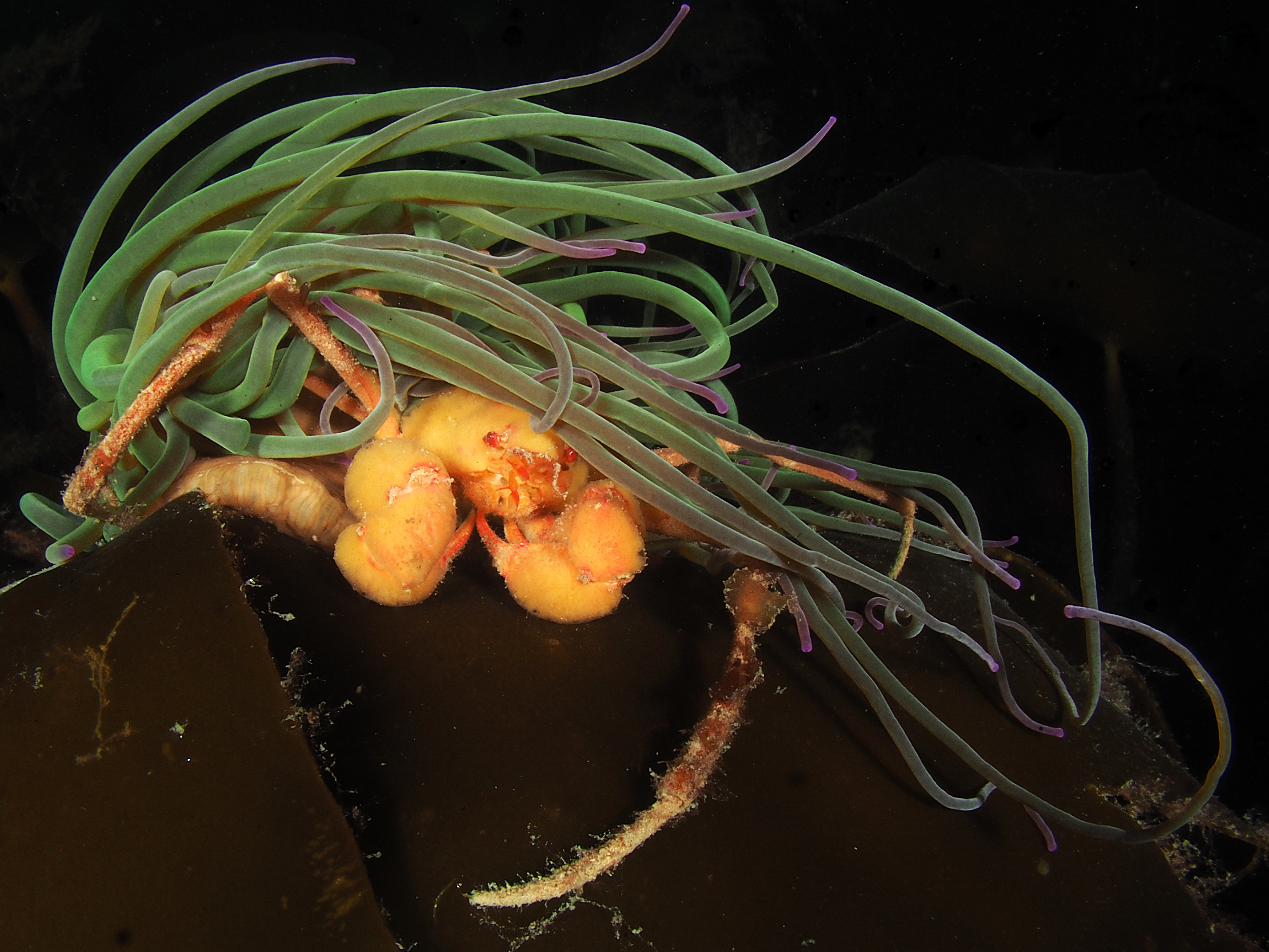
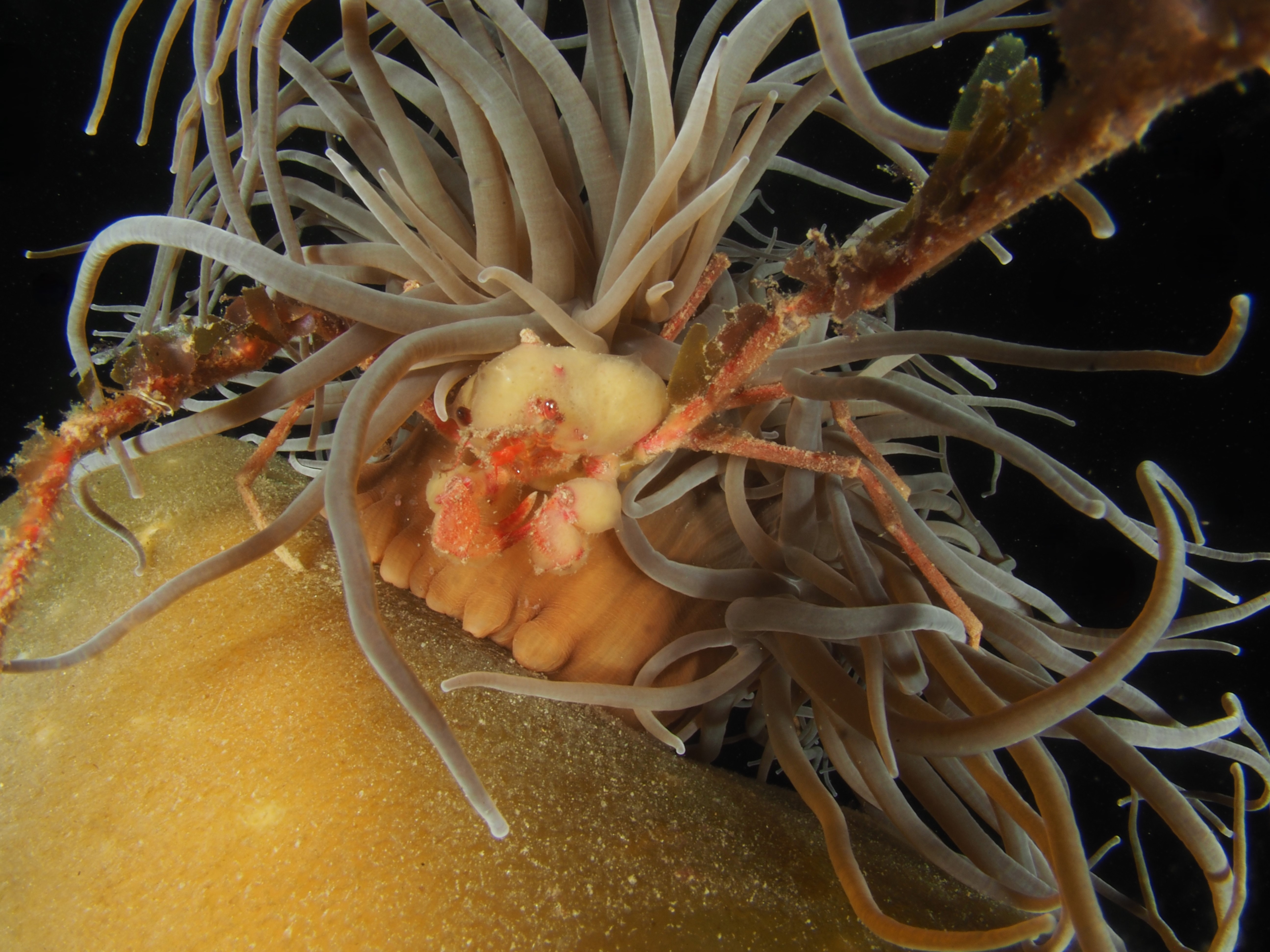
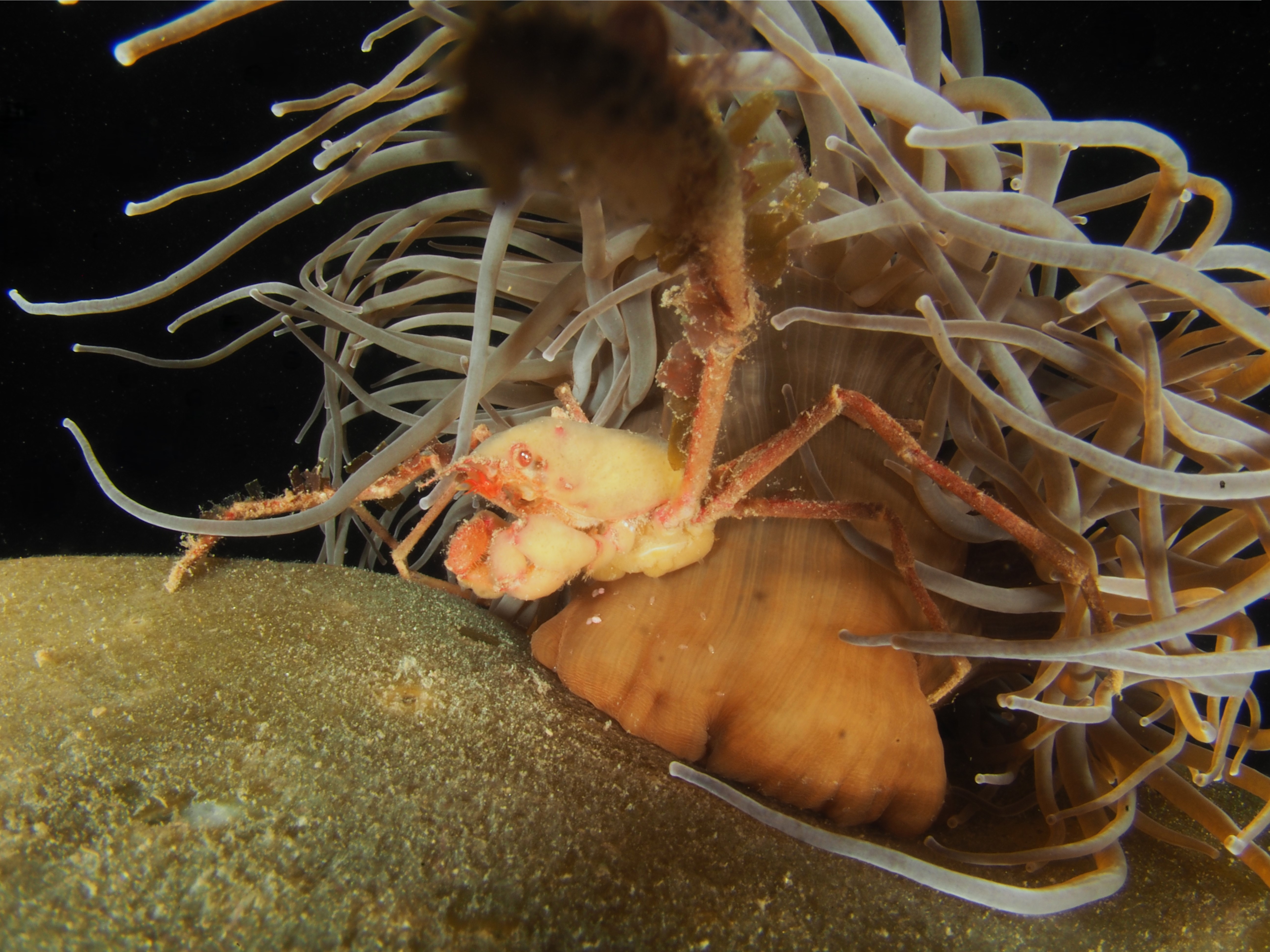
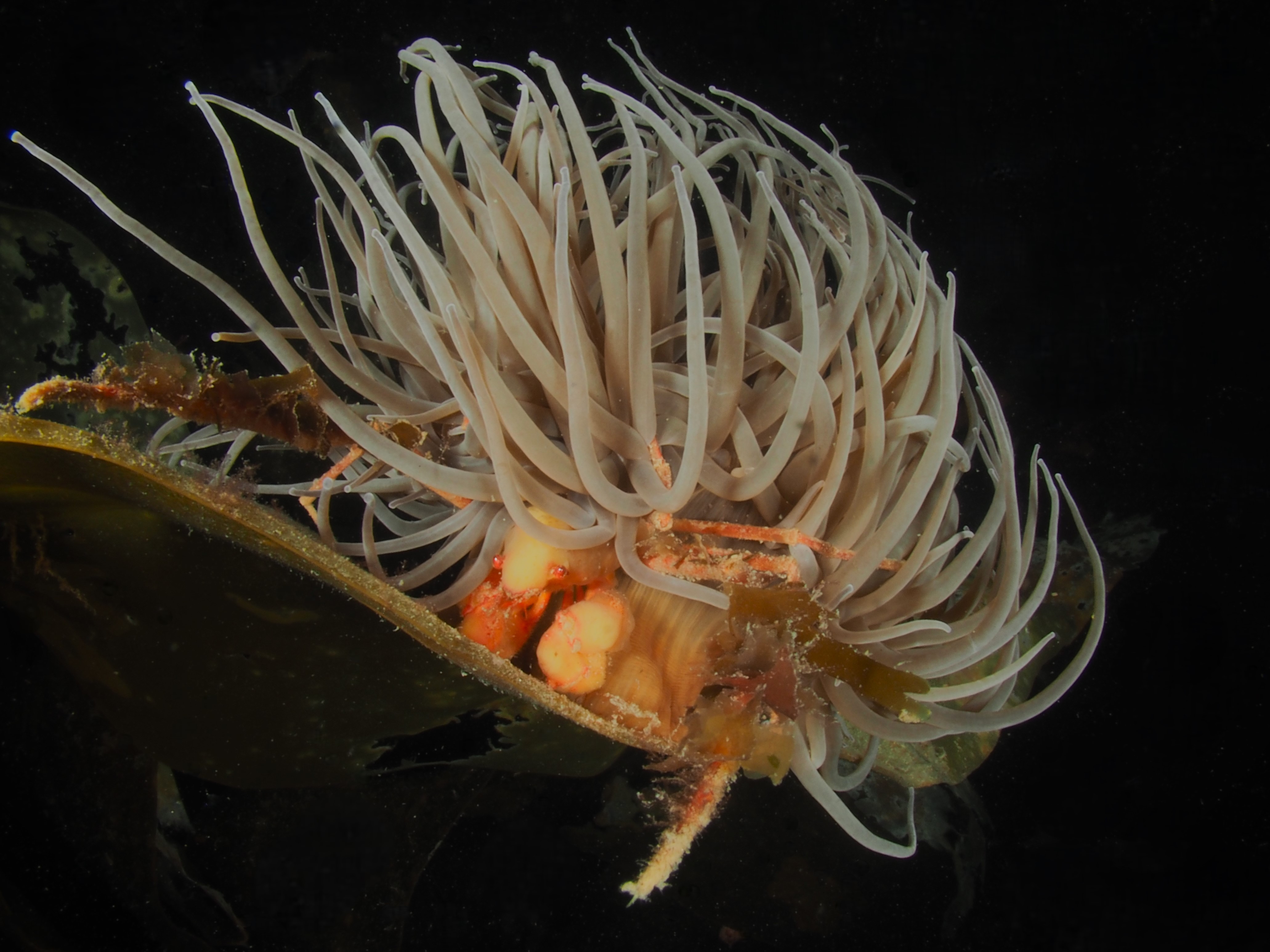
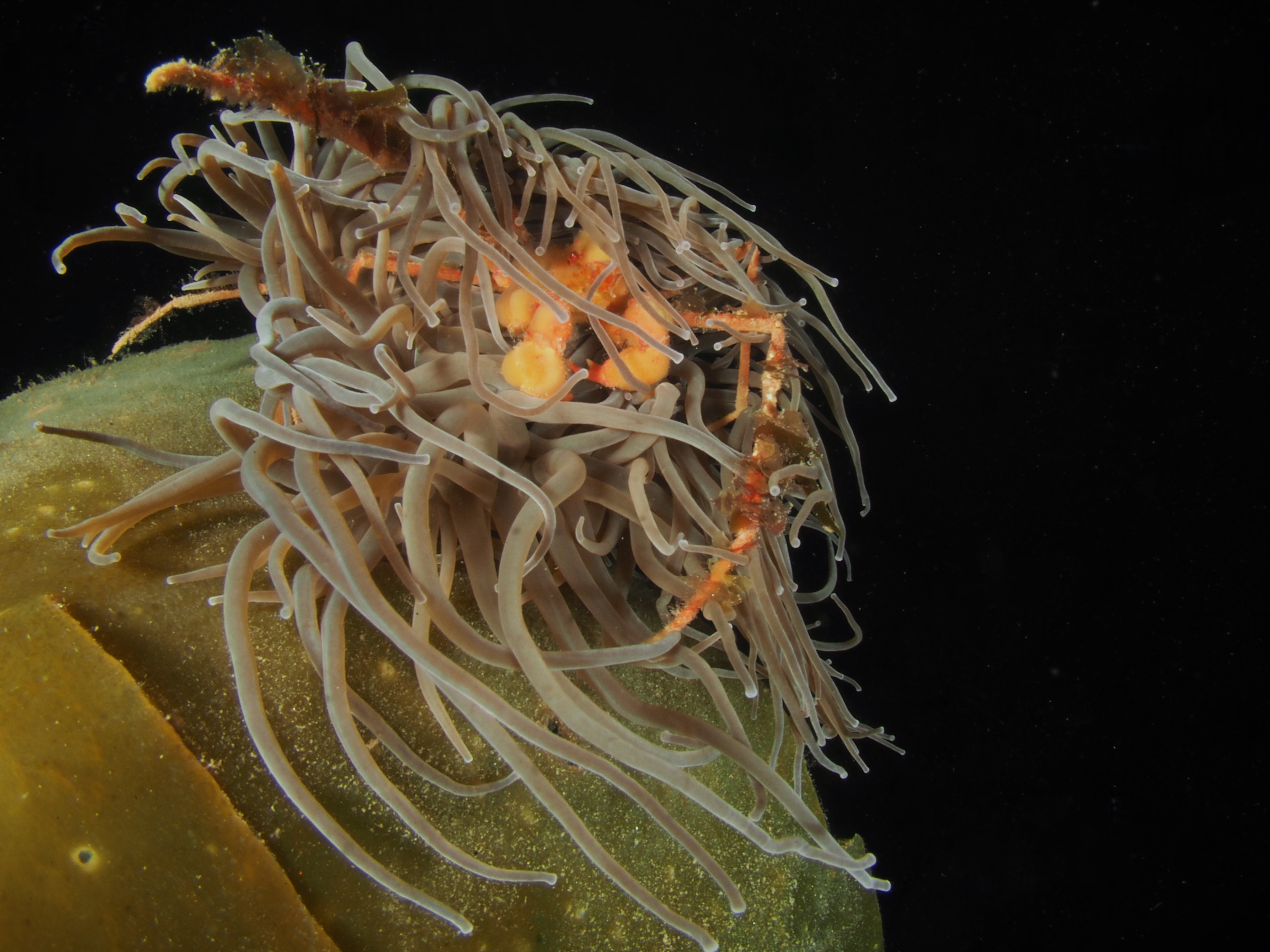
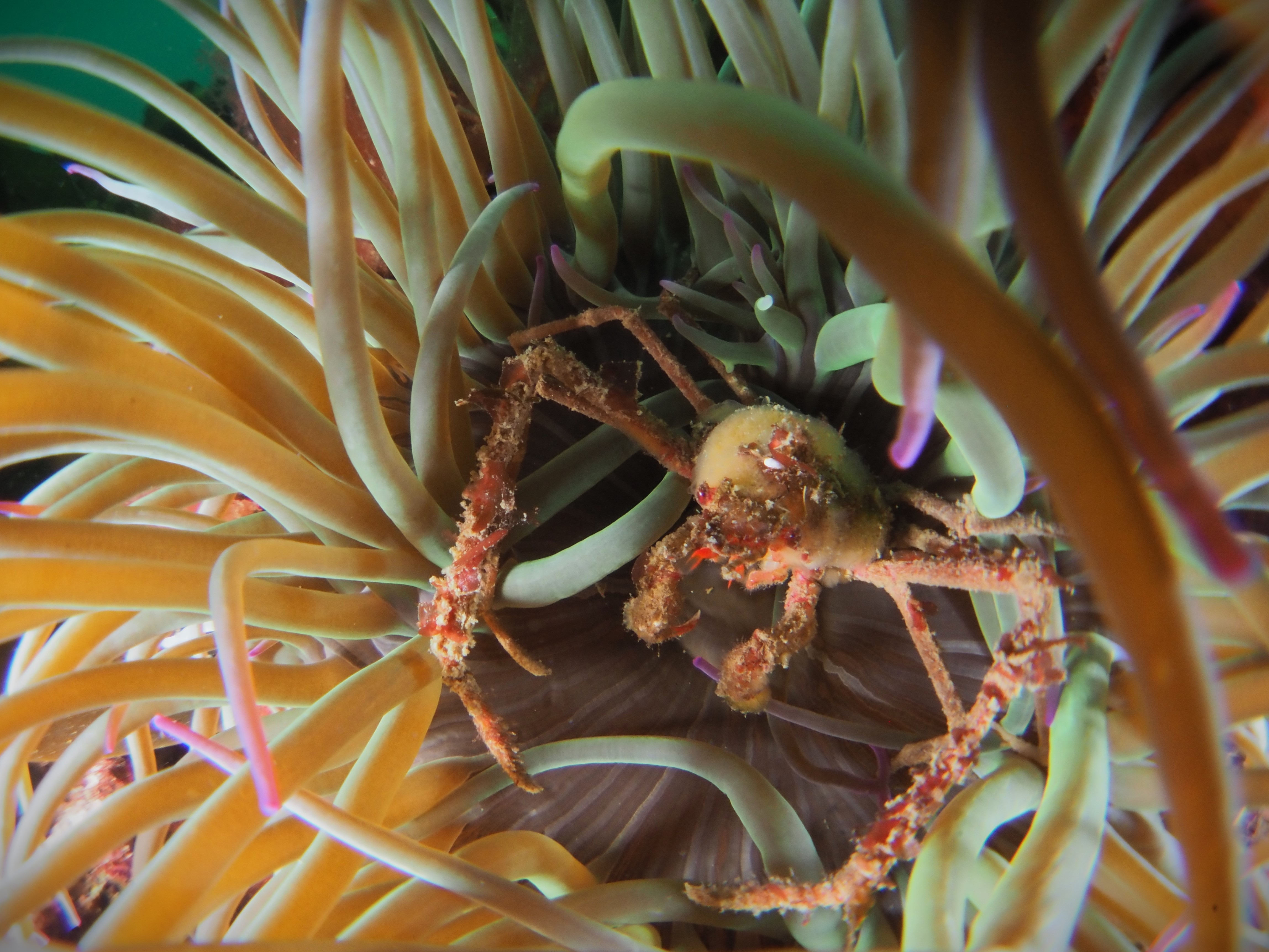
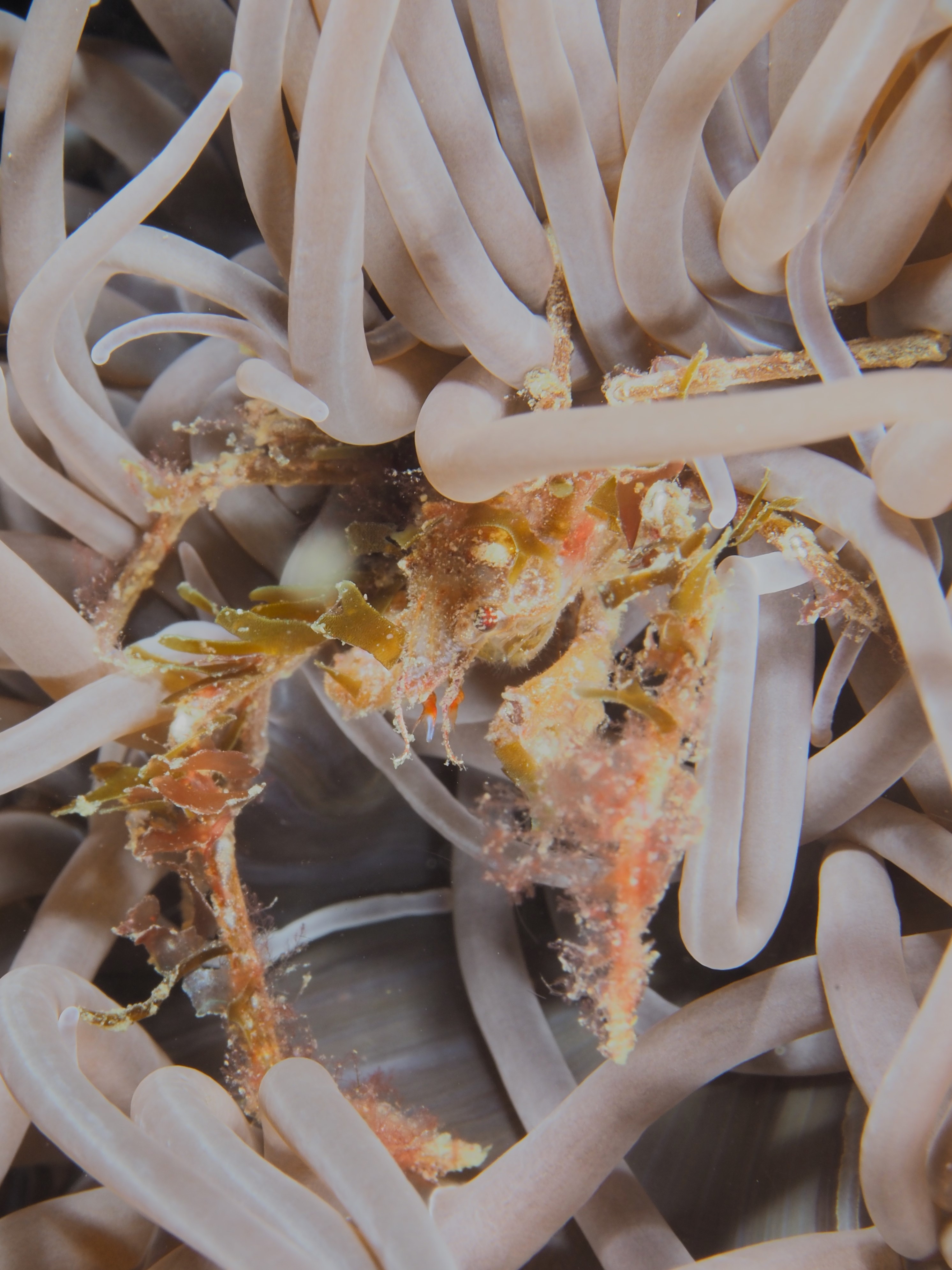
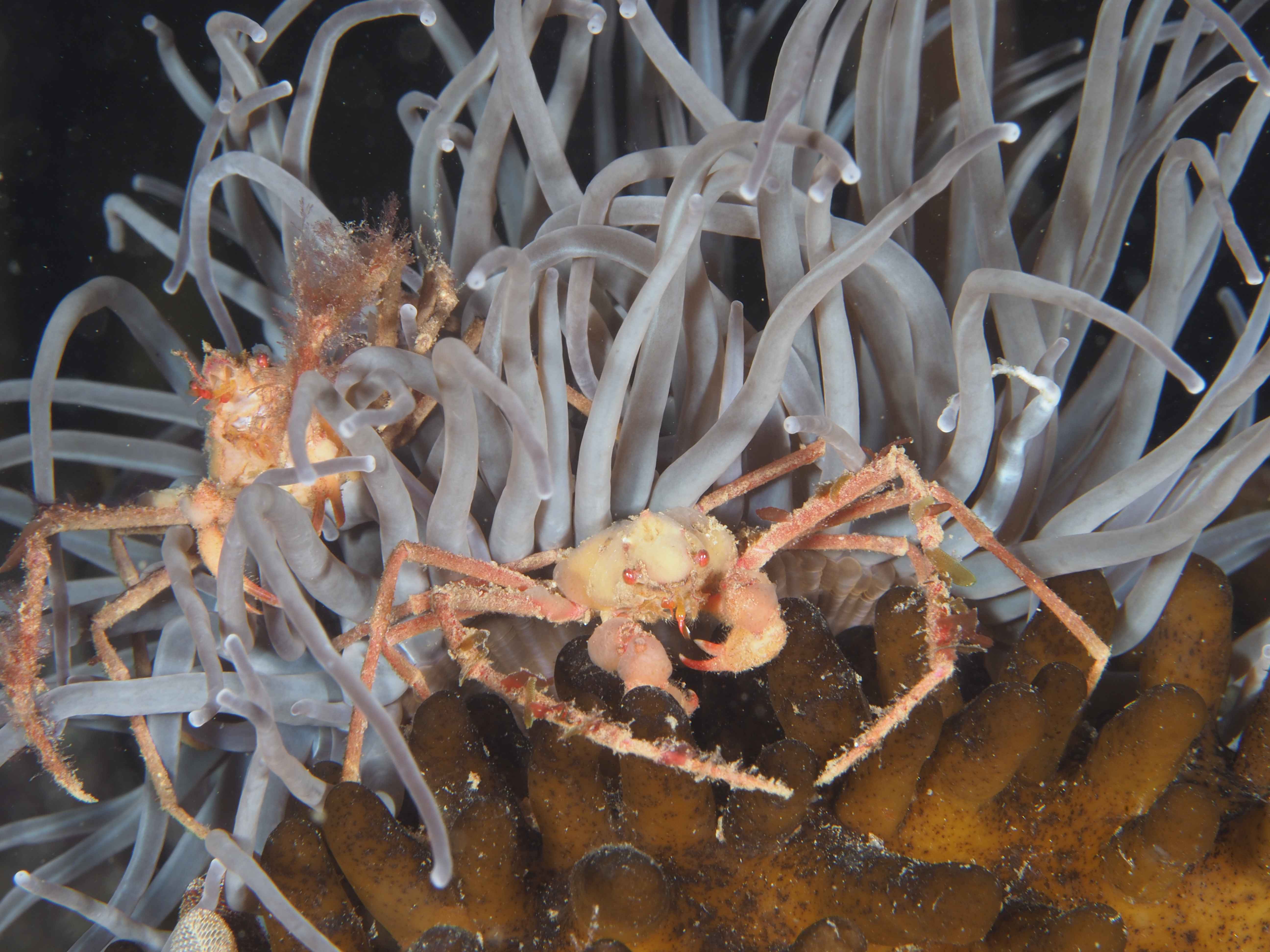
To keep the blog going (a bit), I have dug out some images from a few dives last year featuring Inachus spider crabs. There are three species, I. phalangium, I. dorsettensis and I. leptochirus, which can be told apart by the arrangement of tubercules on their carapace, but these are often obscured by epiphyte growth, and so I am keeping it to Inachus sp. All species are associated with Snakelocks Anemone (Anemonia viridis) hosts. The photo above is taken using a weird ‘wide angle macro’ wetlens (INON UFL-M150 ZM80). This perspective always fascinated me but it is difficult to achieve. This lens does the job, although it is incredibly ‘soft’, especially around the edges. The close focusing also makes it difficult to direct the strobe light on the subject. So there is a tradeoff between getting the surroundings in view and sharpness. Below first some sharper shots using my 60mm macrolens, followed by some macro wide angle shots (they happen to be each of the different Anemonia colour morph):

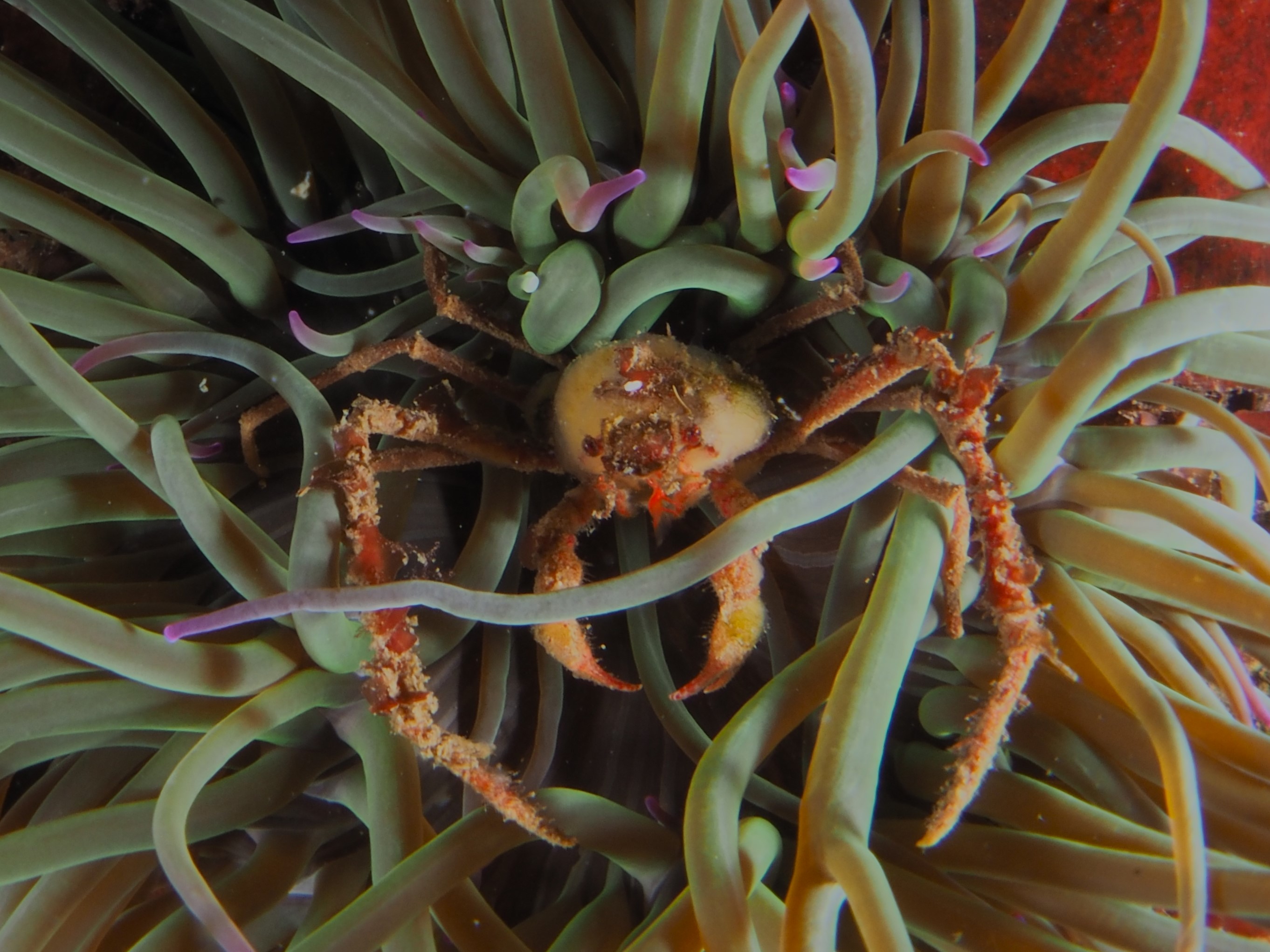

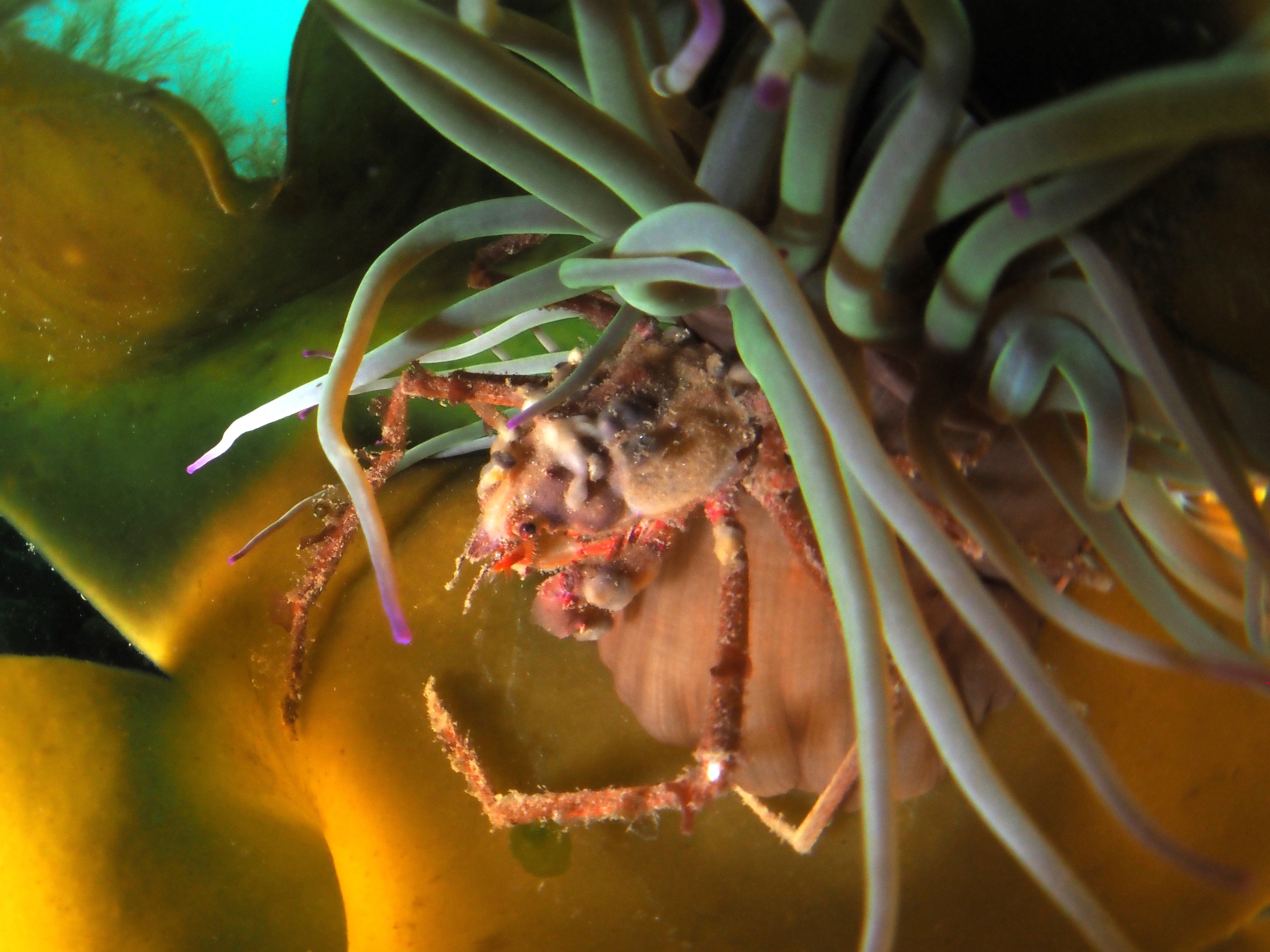
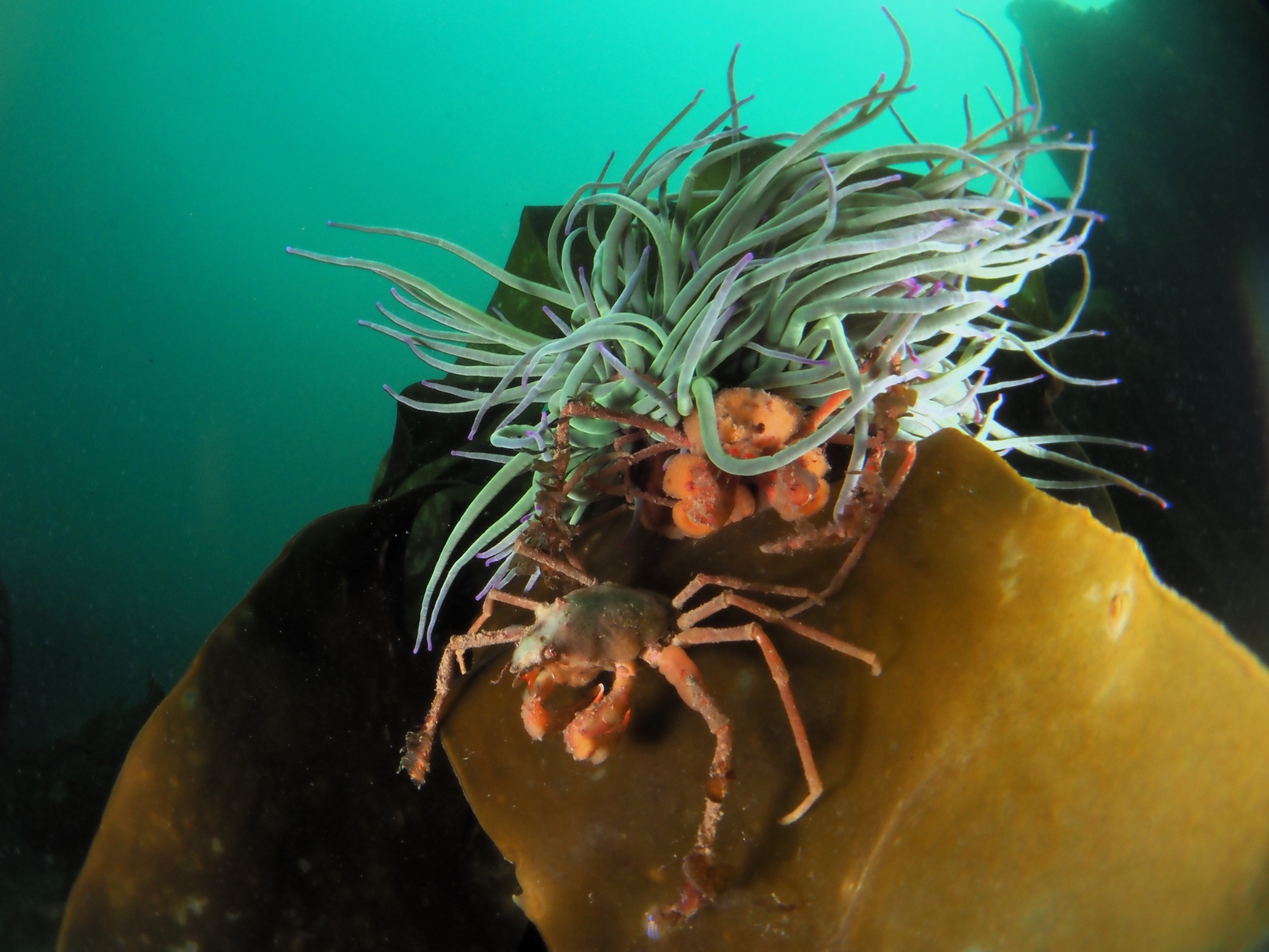
I will leave you with the following interesting bit on the biology of these crabs by Diesel (Ethology, 1986):
I. phalangium females are site-constant, and live in the protection of one anemone or group. Males travel frequently between anemones harbouring females due to spawn; they copulate and guard the females until spawning, after which the male leaves again. A male operates in a patrol area containing 3-8 anemone groups and up to 8 females, visiting each female in turn repeatedly just before it is due to spawn. Patrol areas of different males may overlap, with resulting competition to fertilize a female’s next brood. Large males have higher reproductive success than small ones. Females live up to 8 months after the moult of puberty and hatch up to six broods, and males live up to 7 months as adults. A male could fertilize a calculated 26,000 eggs, whilst a female’s reproductive potential is ca. 4,200 eggs. Mortality risks are higher for males than for females, probably because of increased predation while leaving the protection of anemones in order to visit females. Males learn the positions of anemones harbouring females in their patrol areas, and when these are due to spawn. This allows a male to travel with a target and arrive punctually to fertilize the next brood due in his circuit. I. phalangium is the first marine invertebrate reported to use a “schedule” of localities and times for visiting prespawning females. In this way males minimize searching time and mortality risk, and maximize the number of broods fertilized.
A new location for the second dive: Helford Passage between Falmouth and the Lizard Peninsula. This is a shallow, sheltered creek with a sandy bottom and eelgrass beds and can only be dived (well) at high tide. A good site to spot Thornback rays Raja clavata we heard and we were indeed lucky to find several of them. We entered the water at Grebe Beach next to Durgan: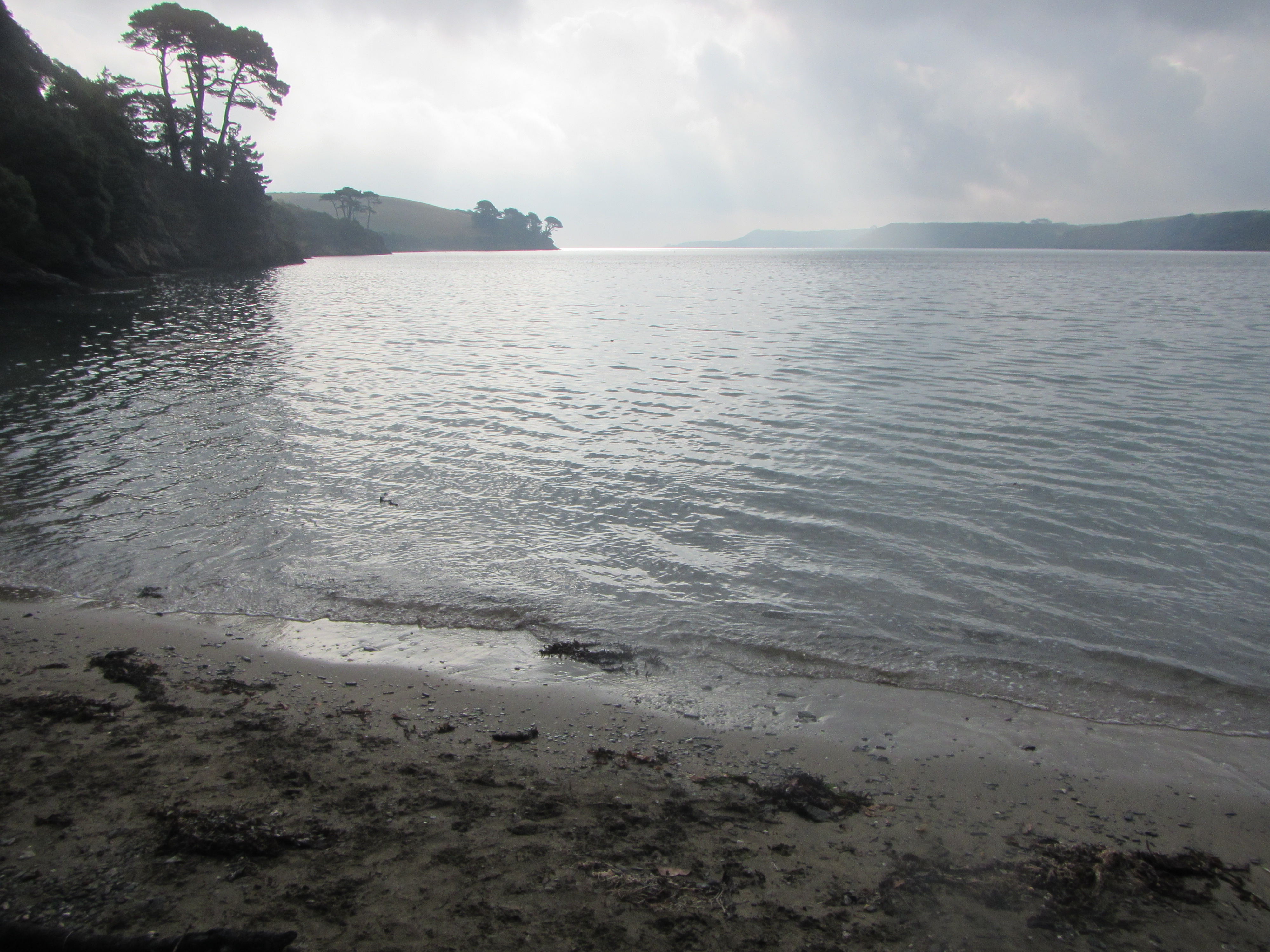
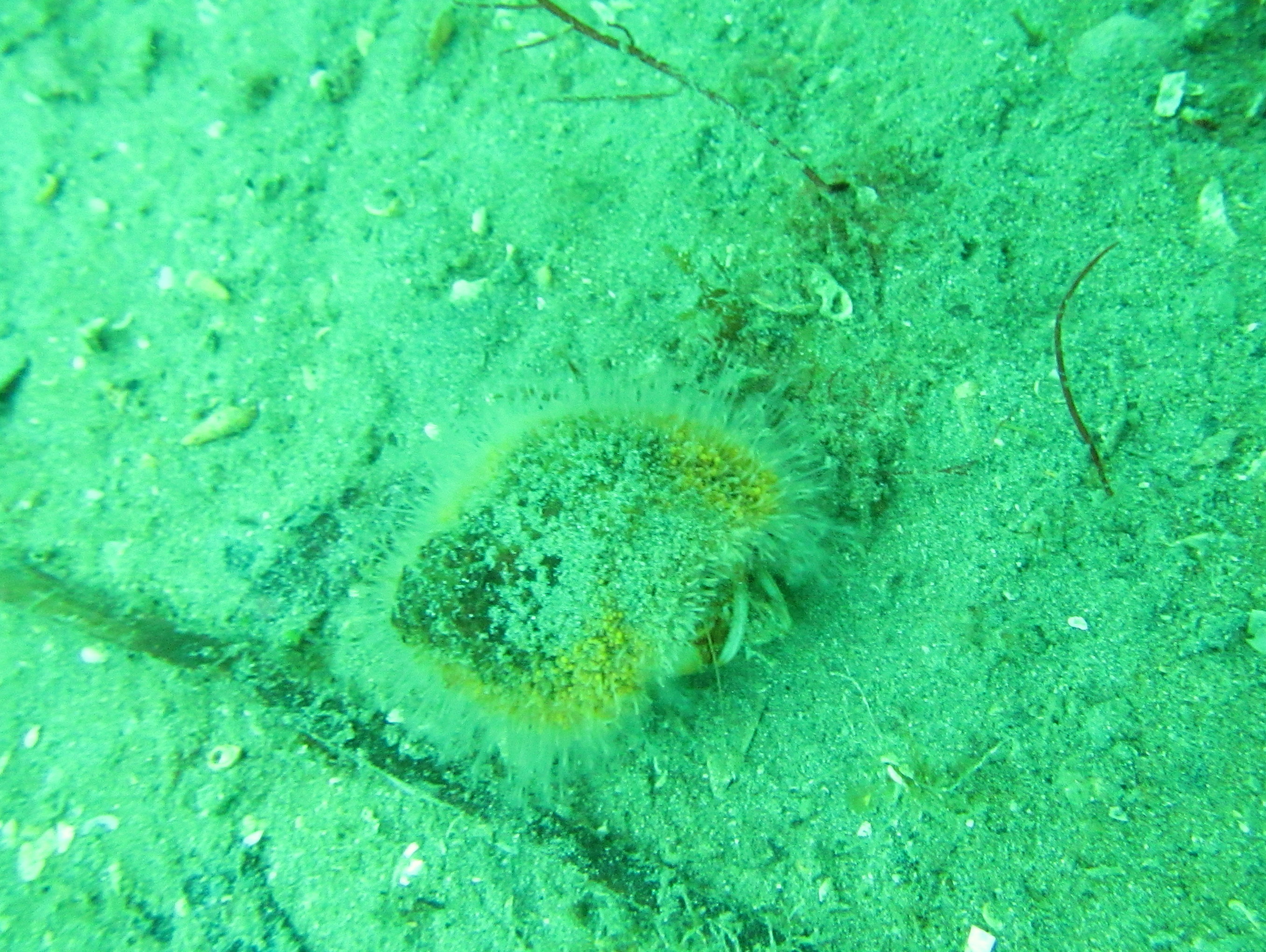
Again, we spotted some cuttlefish, which are not very shy at all. What was very cool were Great scallops Pecten maximus lying around and swimming away for a bit by opening and closing the shell, I will try to film that next time. Many Turban top shells and some large heremit crabs with one or more Parasitic anemones Calliactic parasitica on top. The shells of smaller hermit crabs were covered in the hydroid Hydractinia echinata: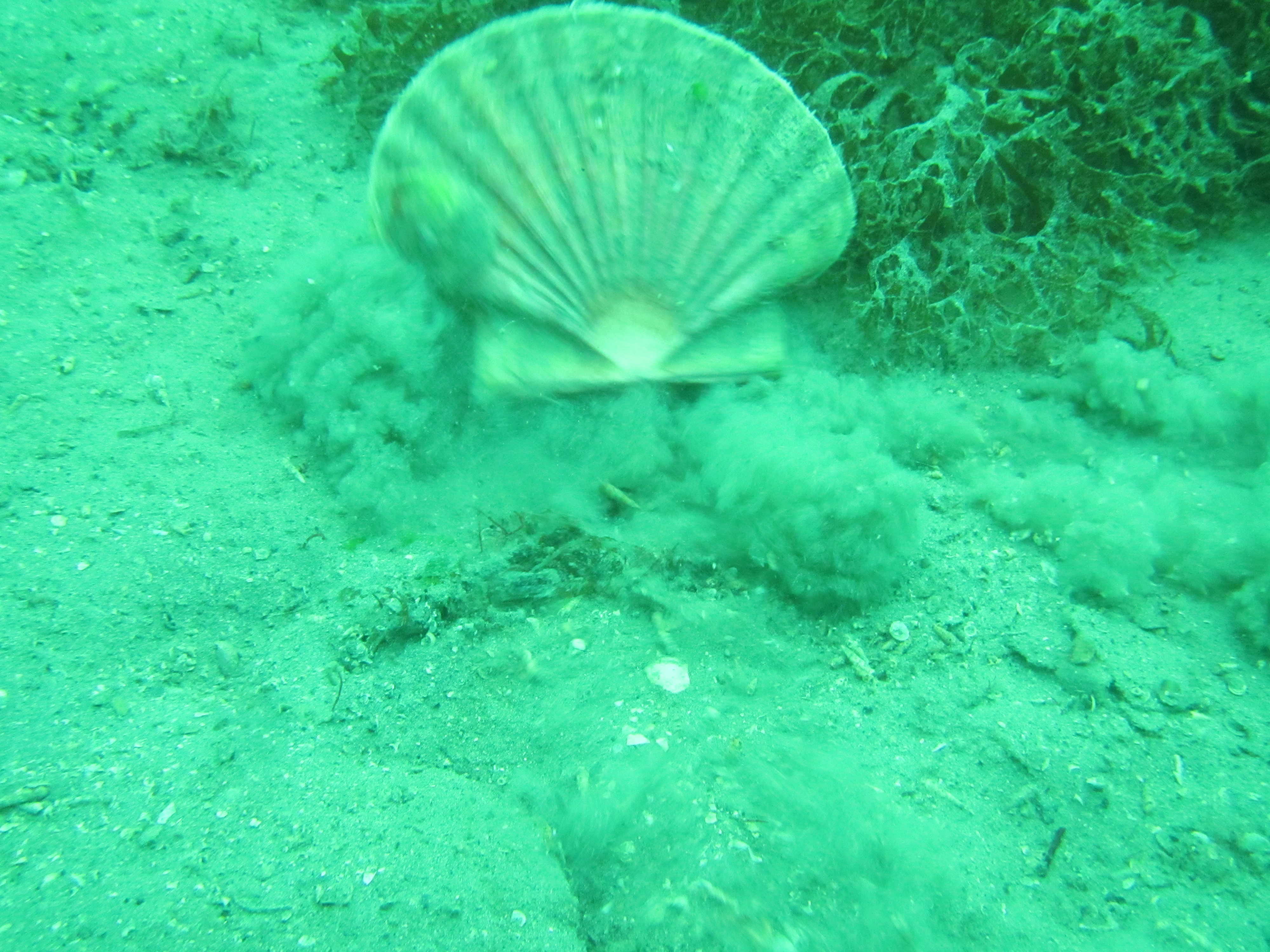
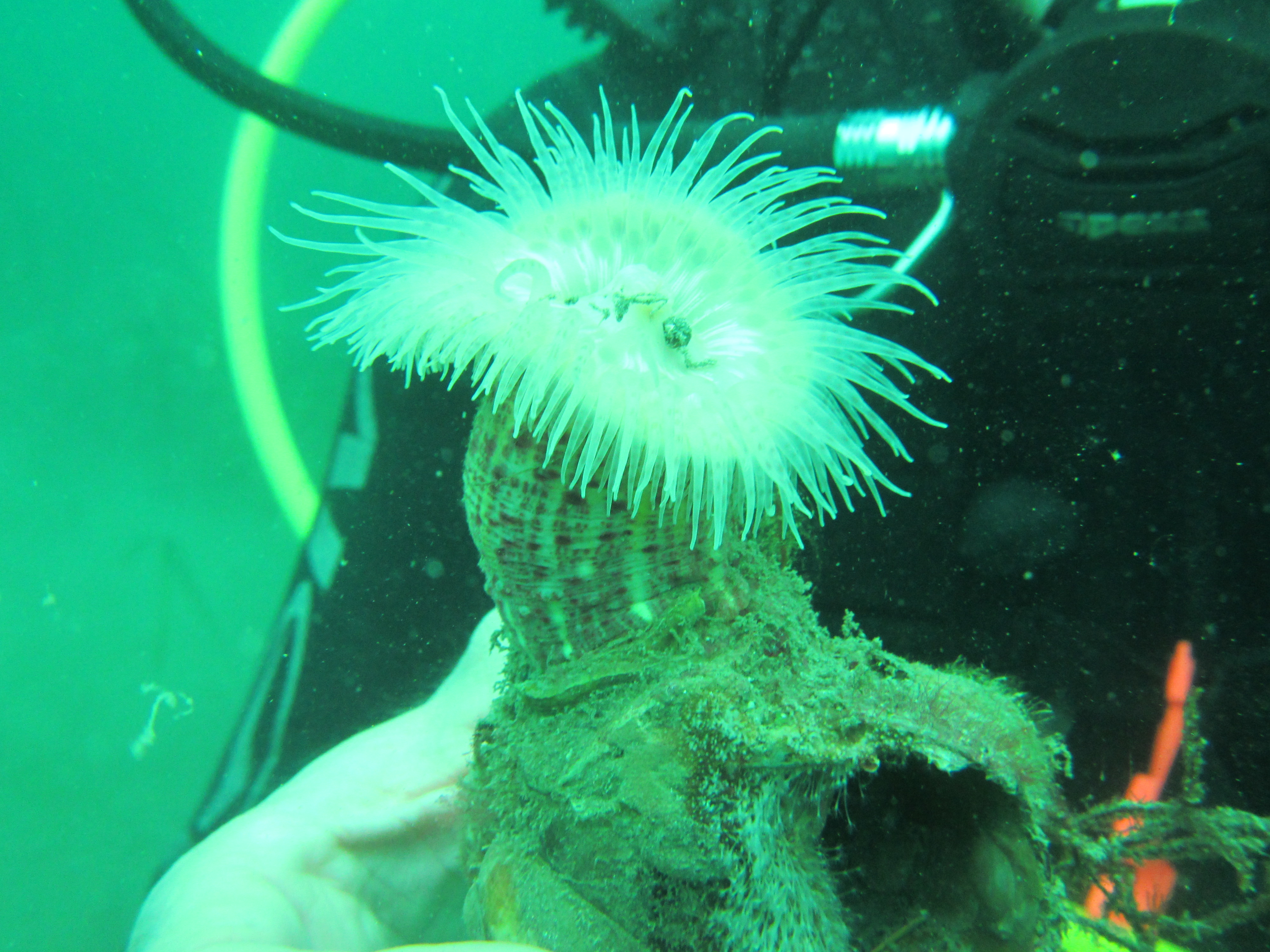
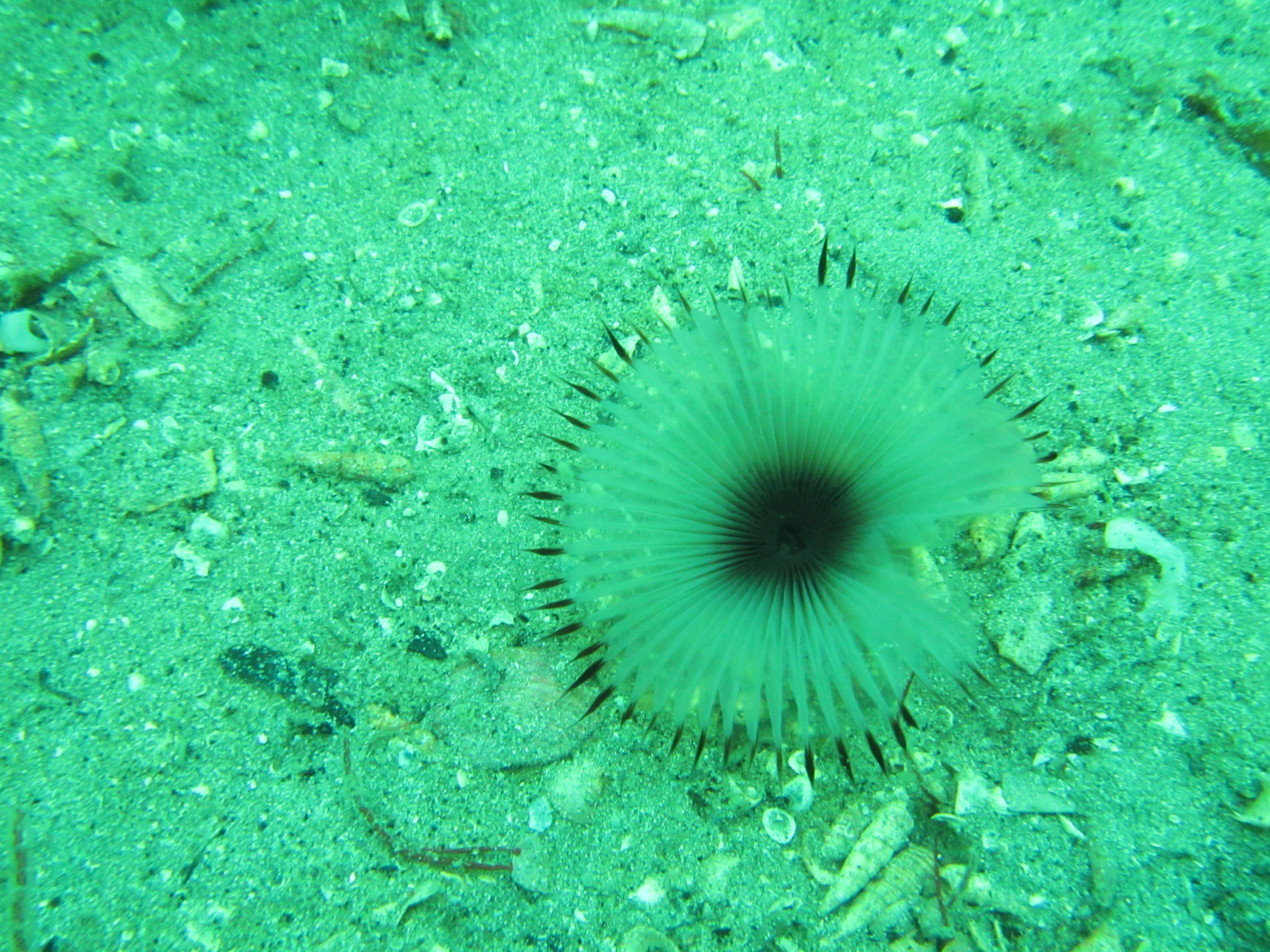
 We got to about nine meters depth (near the buoy) and found a large concrete block. Scattered among it lay the remains of crabs and in a hole dug underneath the snout of a Conger eel poked out. As I had to get close for a better look, I stirred up too much sediment and so I do not have a good picture but I will definitely like to go back and have a better look! Interesting was an old crab pot covered in sea squirts (mainly Morchellium) which was swarming with Leach’s spider crabs Inachus phalangium. Normally they sit under a Snakelocks anemone but there were none attached to the pot, strange. Very common were large Peacock Worms Sabella pavonina and Fan worms Myxicola infundibulum: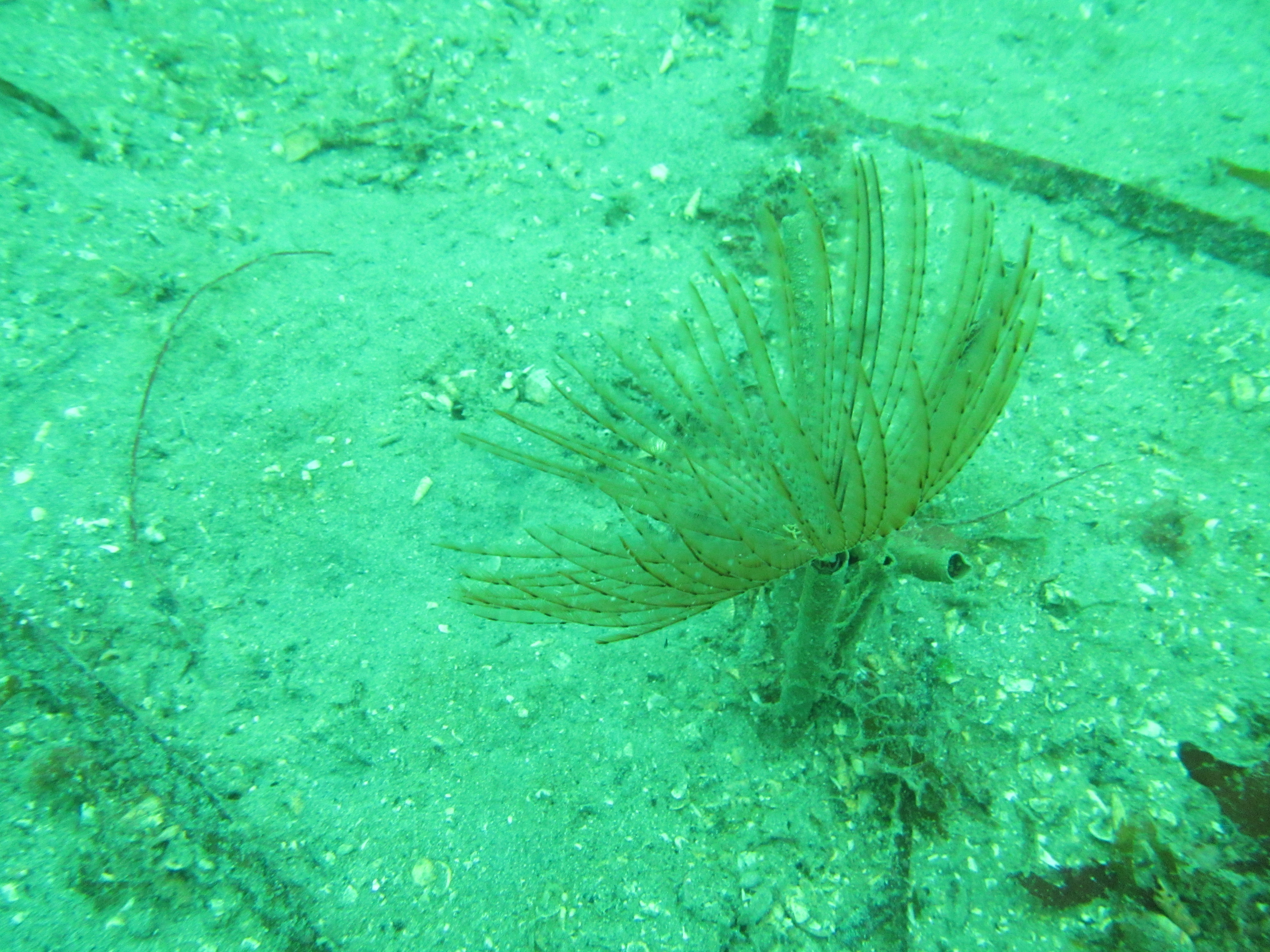
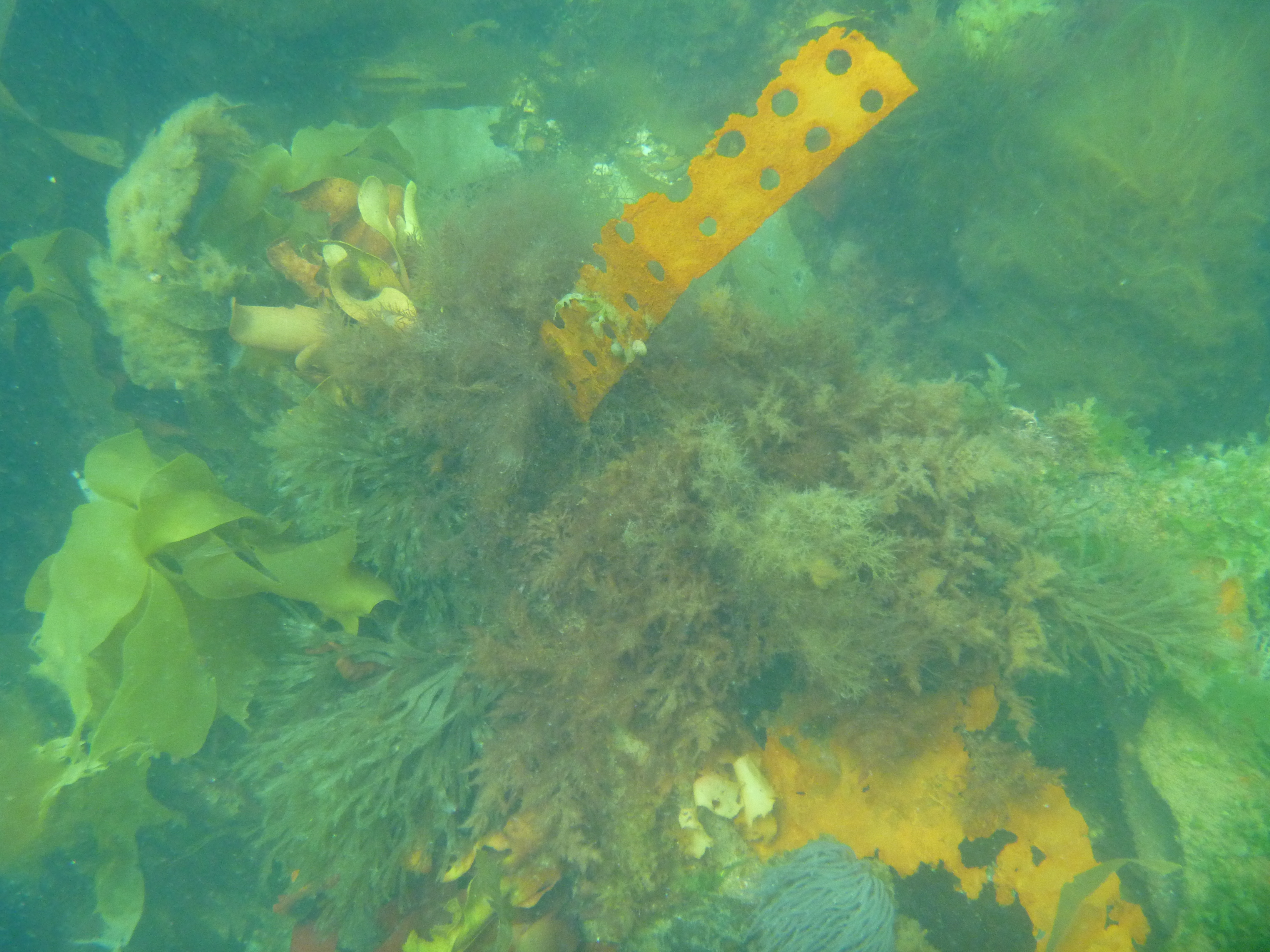
High time for a snorkel, and few better places in the area than ‘Silver Steps’, between Castle Beach and Pendennis Point in Falmouth. I took my little Lumix camera (goes up to 10 meters deep, no optical zoom) with me to take some sub-standard pics (all other photos on the blog are taken with my iPhone). This site is a mix of rocks covered in kelp and gravel and even the remains of two U-Boats (they are no longer recognisable as such though, see here for more specifics on these and other wrecks off Falmouth). There is always something to see: schools of Smelt chased by Sand eels, hovering Two-spotted gobies, Corkwing and Ballan wrasse, Spiny starfish and loads of seaweeds. In fact, there was so much to see that I have divided the pictures over two posts. First a photo of the site and some of the U-Boat wreckage: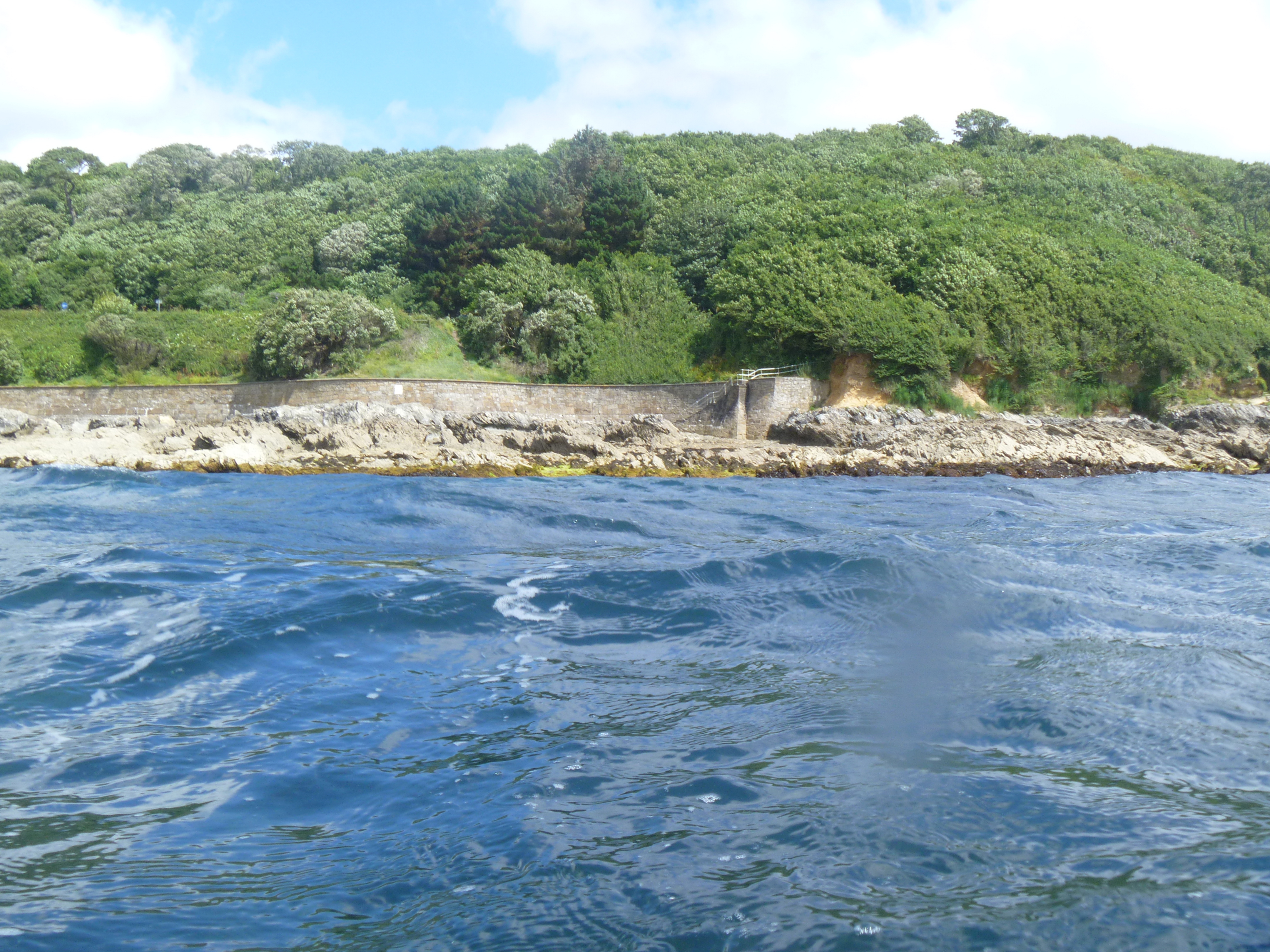
 We were in for a nice surprise: a good-sized John Dory Zeus faber at around seven meters depth. I have posted a very nice picture from my first and only dive in Cornwall courtesy of Charlotte Sams, but here a short, jittery video as well:
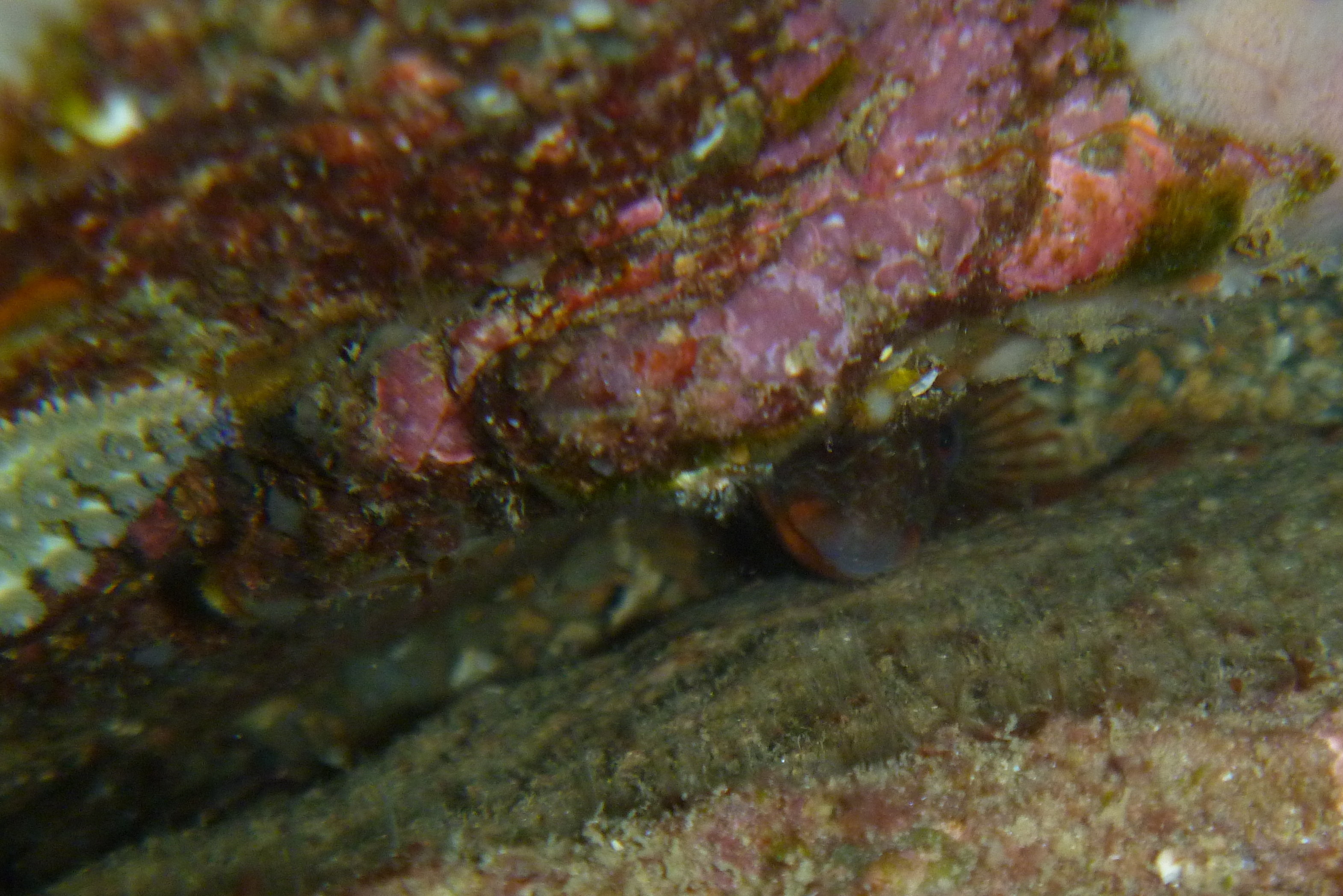
Anyway, a perhaps even nicer find were Leopard-spotted gobies Thorogobius ephippiatus. Some sources make it seem like this is a rare species only ever encountered by divers, but it is actually not uncommon and we saw them at two meters down (the tide was low though). It is a shy species that lives under ledges, burying between the rock and the gravel. The picture is crap but also proof I am not lying. The next picture is of a Tompot blenny Parablennius gattorugine peeking from a crack in the rocks. Large snakelocks anemones are everywhere on the kelp, and although a month ago I saw none, many of them again housed commensal Leach’s spider crabs Inachus phalangium. (These anemones and crabs do well in the aquarium btw, see here.) It would be interesting to know if these crabs arrive from deeper waters or just grow up really fast.
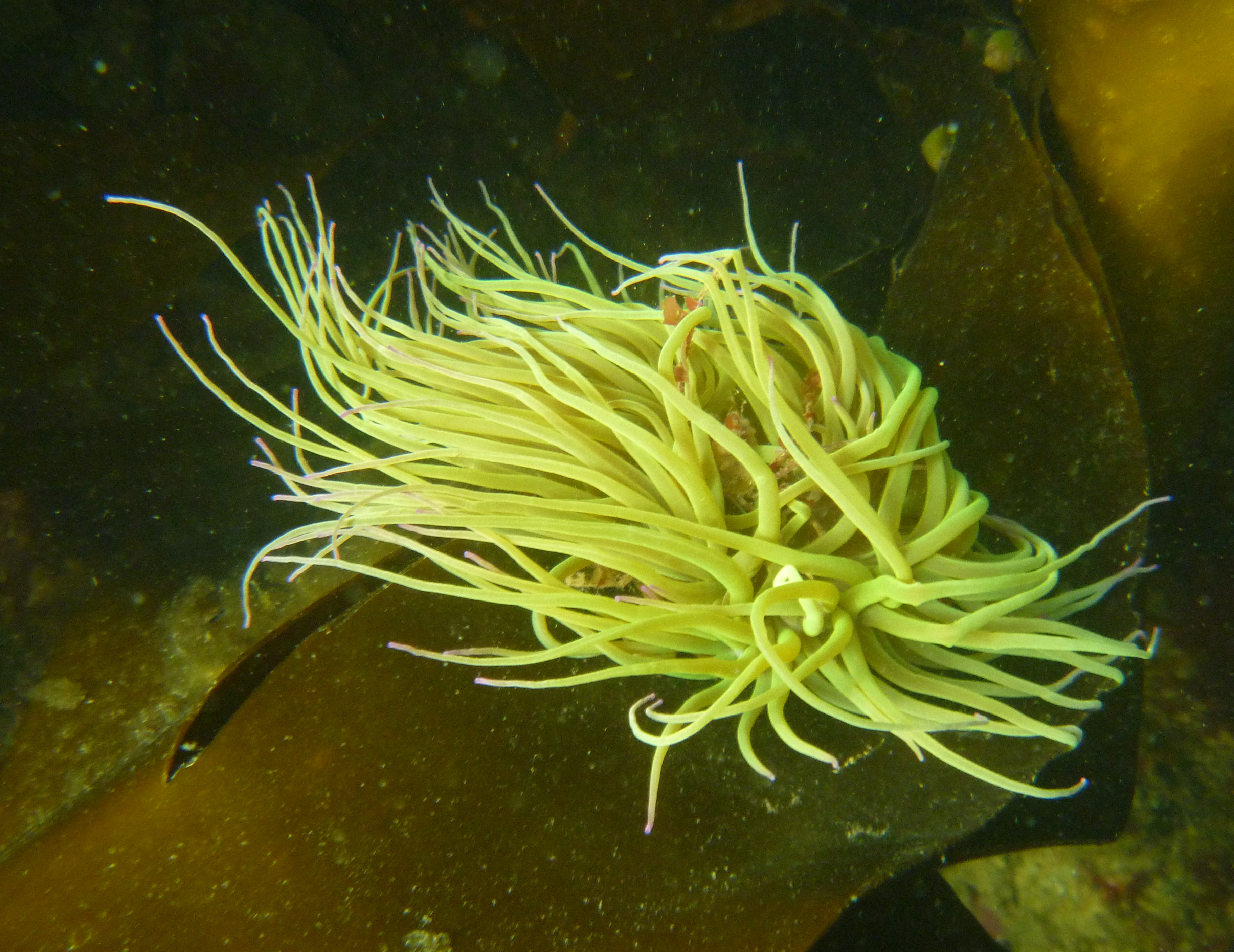
Last weekend I went for a bit of snorkeling off Pendennis Point to catch some new inhabitants of my tank: some Snakelocks anemones and a Leach’s spider crab (just one for a start). Although it was overcast and late, it was nice to be in the water. I was lucky to straight away find a diving knife, this helped me to cut of some kelp housing snakelocks. I took a perforated plastic Lidl bag with me in the water to serve as a net for the crab, low tech but it worked fine. The tricky thing was to get the snakelocks from the kelp afterwards (I did not want a load of rotting kelp pieces in the tank):
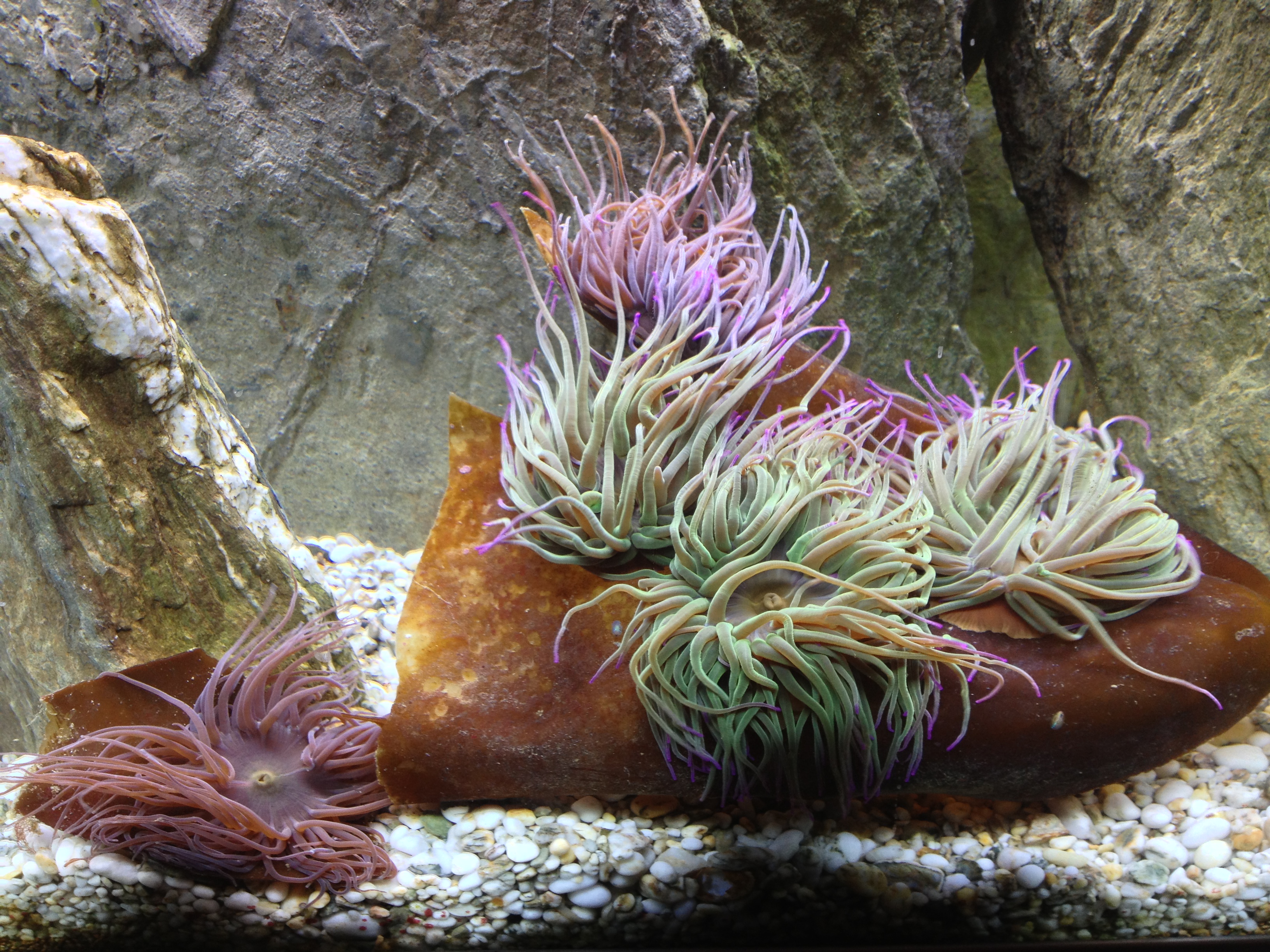
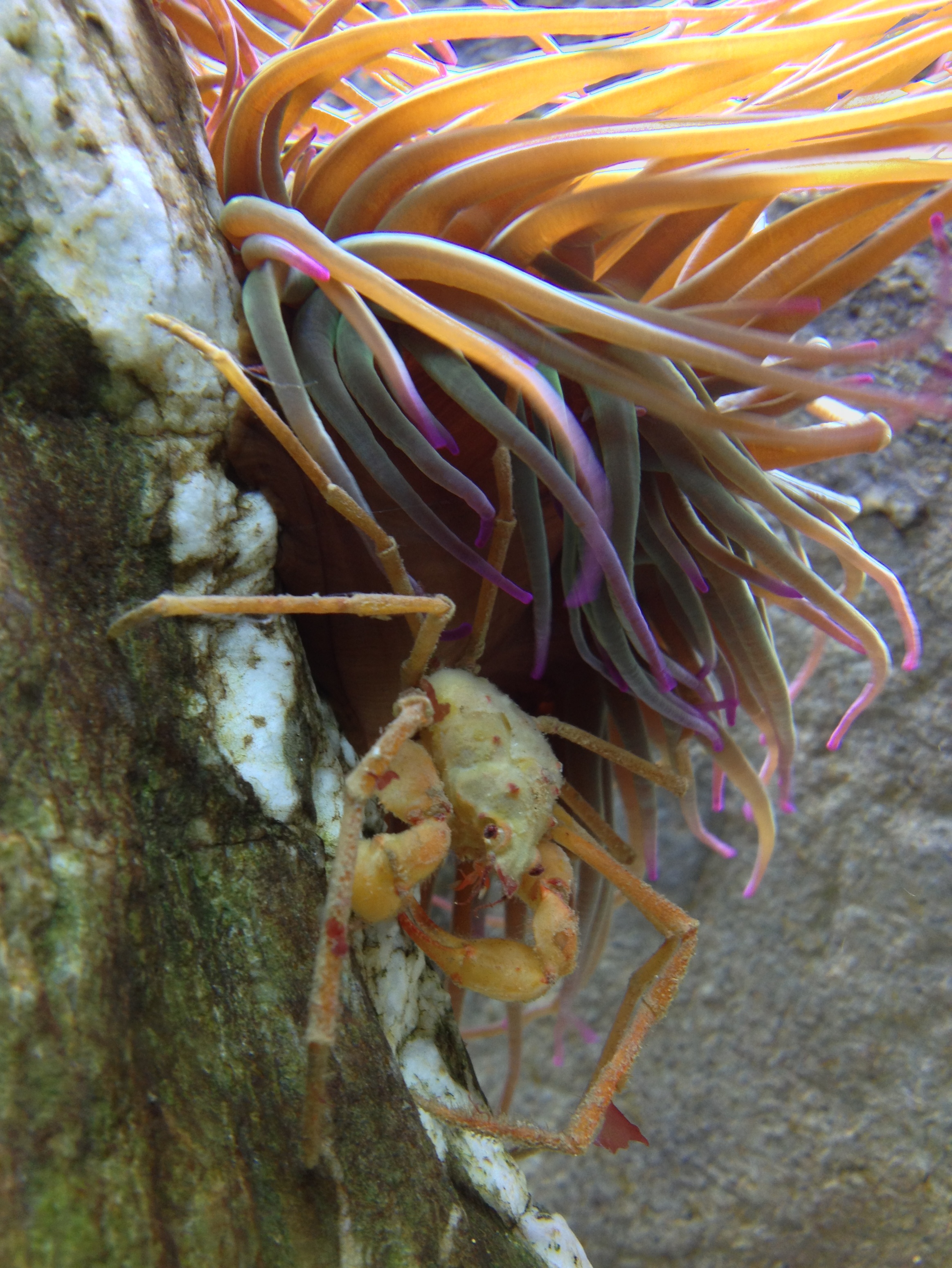
With some finicking I could get the anemones off the kelp and on the rocks or gravel. The Leach’s spider crab (decorated with small pieces of red seaweed) quickly hid behind a rock. However, after two days it was accustomed to its new surroundings and found a place underneath one of the anemones right in the front of the tank:
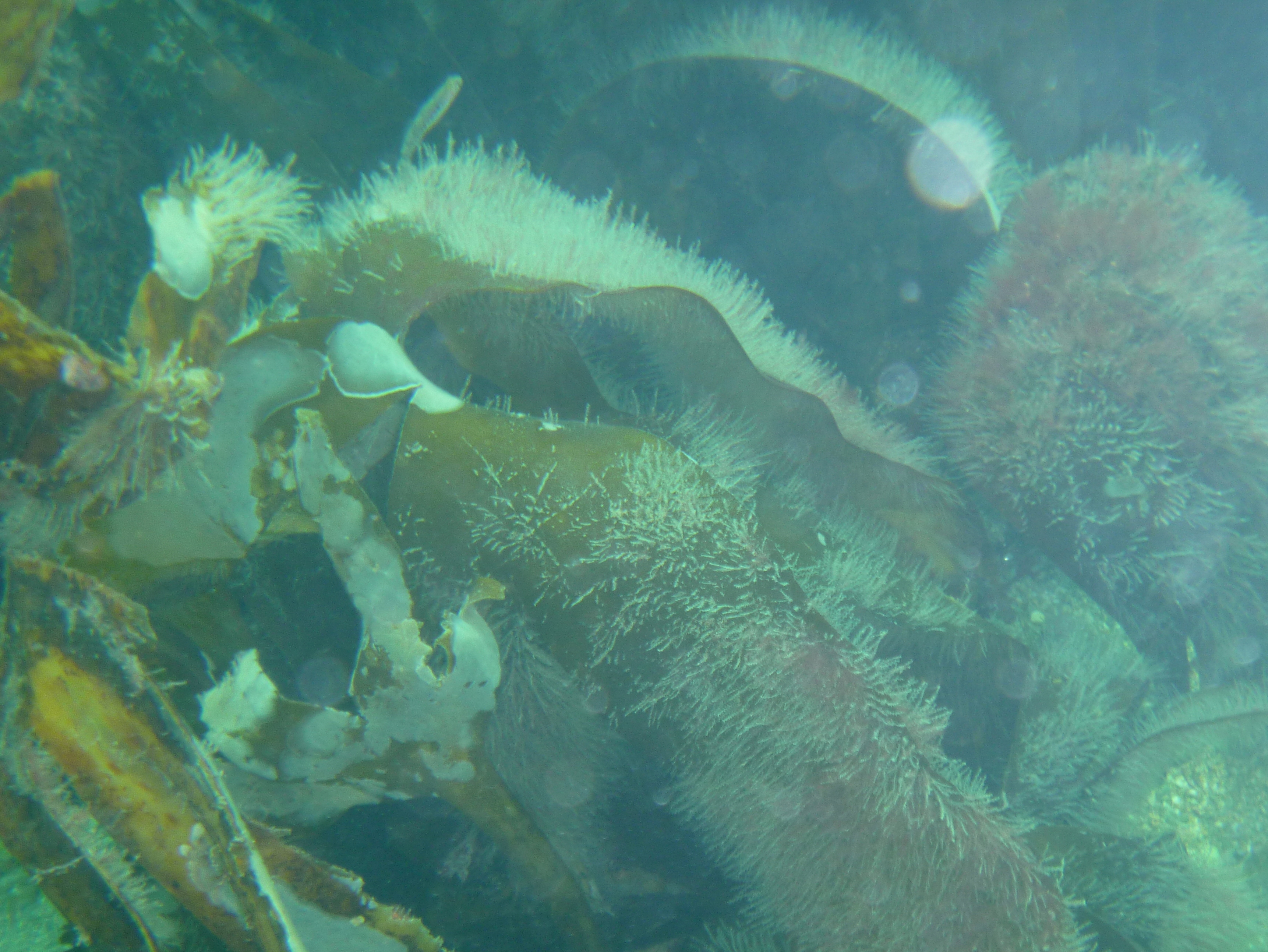
The sun was shining this weekend and the sea water is currently at its warmest so we went out for a bit of snorkeling off Pendennis Point in Falmouth. My experience with the iPhone waterproof case was not that good, so I took my Panasonic Lumix (DMC-FT10) along (which is not too great either!). The seaweeds are dying off mostly; the kelp is covered by bryozoans and hydroids to the point that they are completely fuzzy:
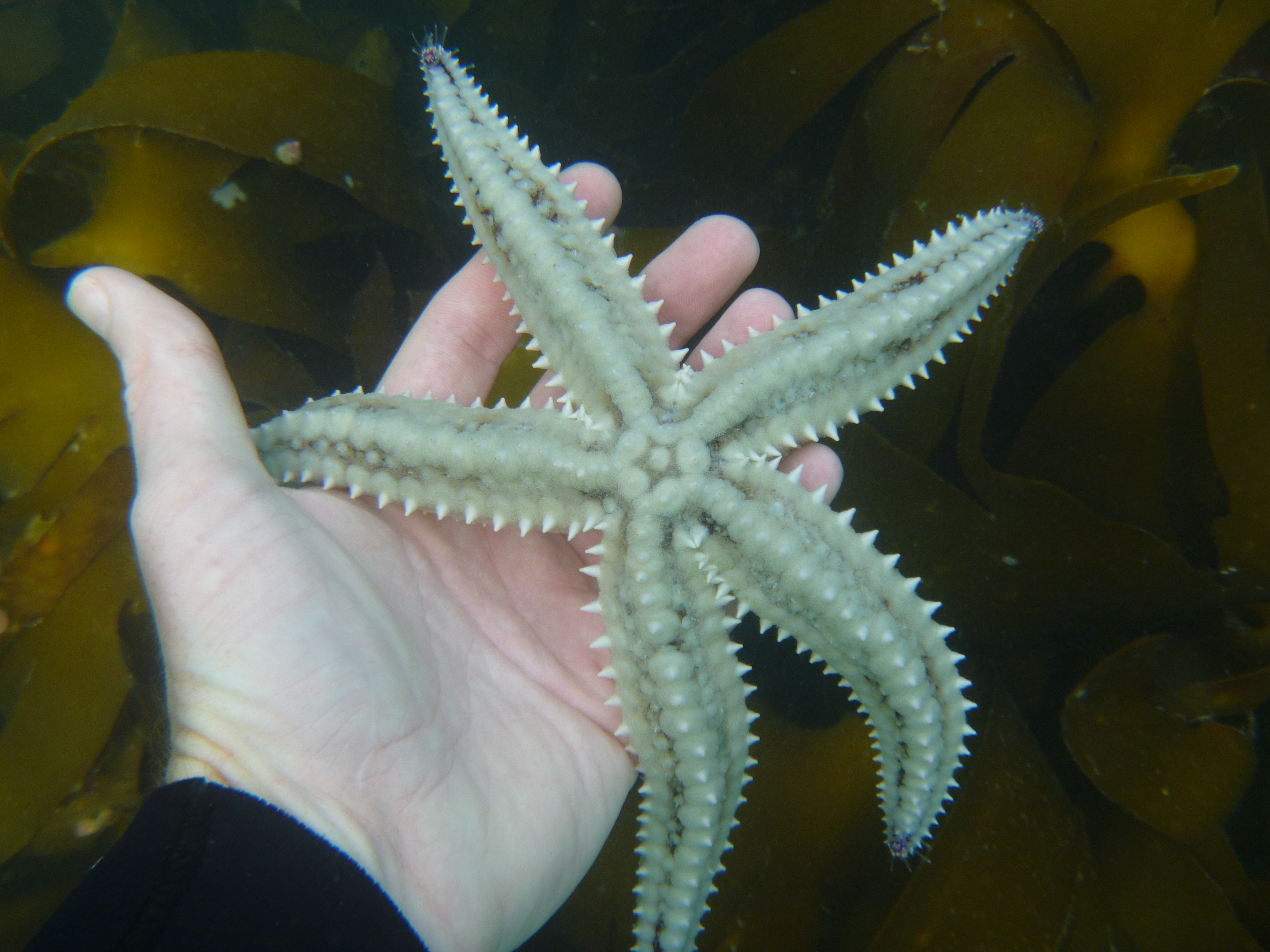
I mentioned in the previous post that the Spiny starfish Marthasterias glacialis was common in rock pools; bigger ones can be found when snorkeling:
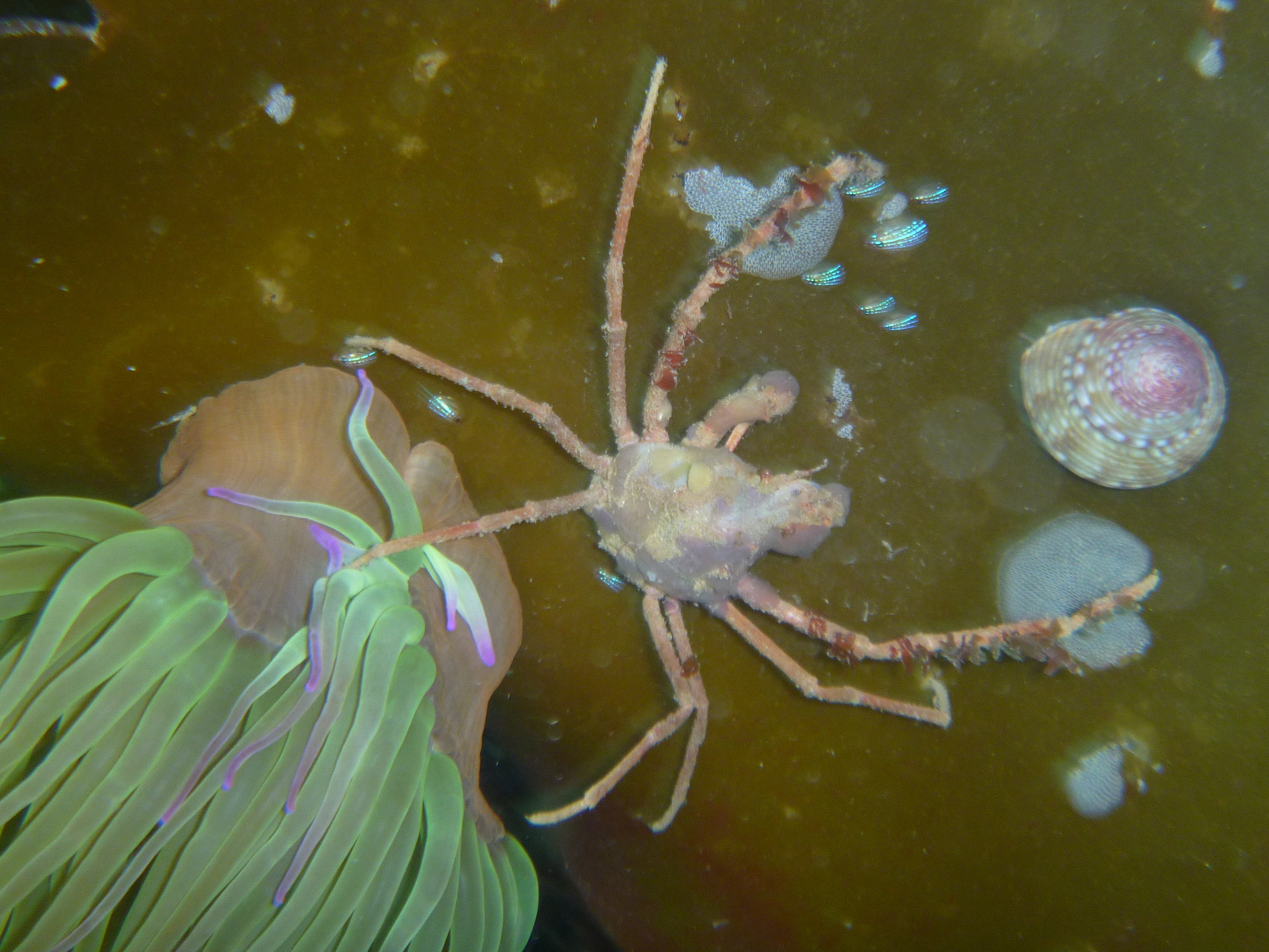
Big Snakelocks anemones Anemonia viridis were everywhere and perhaps half of them had a little Leach’s spider crab Inachus phalangium associated with them. Wikipedia tells me that these crabs eat the anemones’ leftover food and also their mucus:
This hour of snorkeling gave me some inspiration for a new aquarium set-up: less seaweeds (specifically less dying seaweeds clogging up the filter and releasing nutrients) and more rocks. On top of these a couple of big snakelocks with spider crabs and some Two-spotted gobies Gobiusculus flavescens. The latter are very common and pretty. I will have to catch them underwater with a net though, which will probably be difficult…
A couple of weeks ago I went for a bit of a spur of the moment after-work dive with colleague Andrew (like me a quite unexperienced diver) and his friend Charlotte Sams. Charlie is an experienced diver and natural history photographer, who has her own blog: Charlottesamsphotography, which you should check out. We dove in Falmouth off Pendennis point. The water was not very clear (maybe 5-6 meters visibility) but the temperature was quite nice. We saw (amongst others) Sand eels (do not know which of the two species), Pollack Pollachius pollachius, Dragonets Callionymus lyra, Two-spotted gobies Gobiusculus flavescens, a Tompot blenny Parablennius pararugine, very large Ballan wrasse Labrus bergylta and a beautiful little John dory Zeus faber:

We also saw some very large Common starfish Asteria rubens and also a nice Spiny starfish Marthasteria glacialis. We dove only to about 5-7 meters, which meant we could stay in quite long, over an hour. At seven meters, the bottom was a sandy expanse, interspersed with mounts of Laminaria Kelp covered in hydroids. In-between the kelp were other seaweeds, such as Red rags Dilsea carnosa but I was more focused on the animals during the dive. In shallower water were enormous bundles of Wireweed Sargassum muticum (also known as japweed but that is not very pc…) and the very long slimy Mermaid’s tresses or Bootlace weed Chorda filum. Snakelocks anemones were very common, and we managed to also see Leach’s spider crab Inachus phalangium, which lives associated with these anemones. All in all a fantastic experience, and I hope to find the time to go diving very soon again!
 An Bollenessor