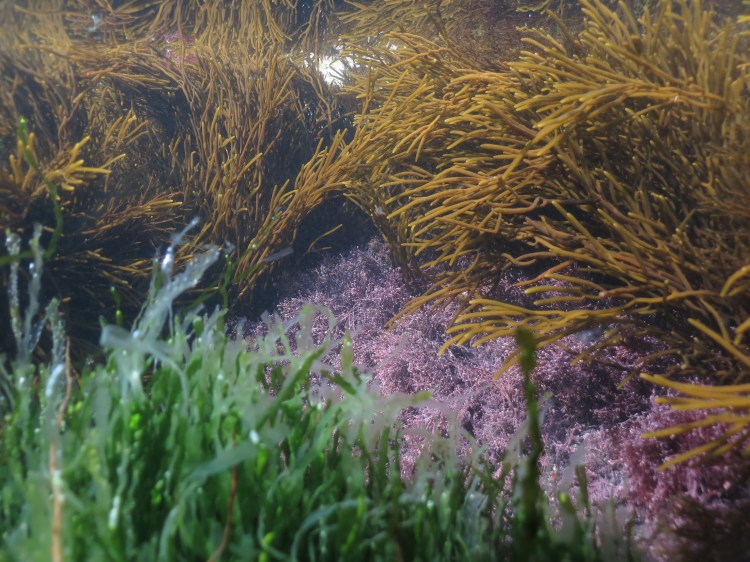
Cave of Dreams

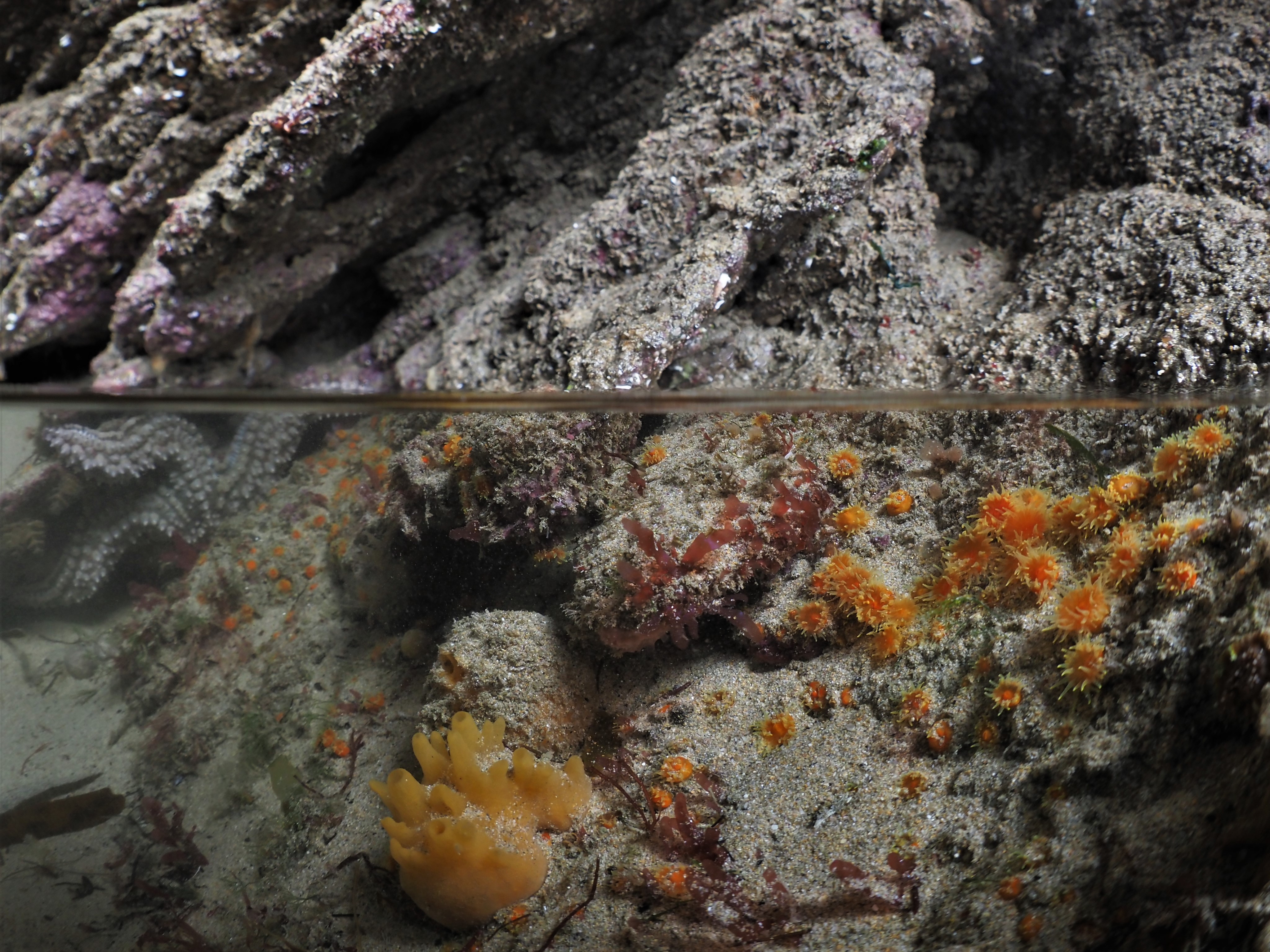
I cheekily ordered a larger dome port last week (8 inch instead of 4 inch), which should suffer less chromatic aberration (unsharp corners), but also make it easier to compose splitshots (or ‘over-under’ shots) where the top half is above water and the bottom half below water. I played around with this type of shot a bit before with the small dome (e.g. see here and here) but it should be much easier with a larger dome. Anyway, the weather was such that I did not immediately have a go at it, but this Tuesday I figured I could give it a try at Fistral Beach in Newquay, which has some good rockpools that are not directly connected to the sea at low tide and might be still enough. It was bloody hard to get a decent shot in the deeper rockpools I tried first, as the difference in ambient light above and below water really necessitates the use of strobes to result in an even exposure, As I struggle with strobe lighting for normal shots, this was a bit too much to ask. My fallback was the ‘cave of dreams’ a rather grandiose name for a small overhang containing scarlet and gold cup corals (Balanophyllia regia) and Yellow hedgehog sponges (Polymastia boletiformis) (amongst other sponge species). (Check out THIS OLD POST on the cave of dreams with some decent pics I took with my old Canon Powershot camera.) Crouching down, I could barely fit under the overhang. The picture above looks like it is a substantial scene, but I could only submerge my domeport halfway! Using strobes would have been too finicky and probably result in quite unnatural light, so I bumped the ISO to 400, lowered the shutterspeed to 1/30 and used a 6.3 F-stop to get sufficient exposure using my micro four thirds Olympus camera. I needed to go down to a shutterspeed of 1/25 and a 5 F-stop for the close-up shot below. Here is to more experimenting this spring/summer!
P.S. the sponges have been going strong for a good while, see these pics from 2014/2015!
rock pool photography

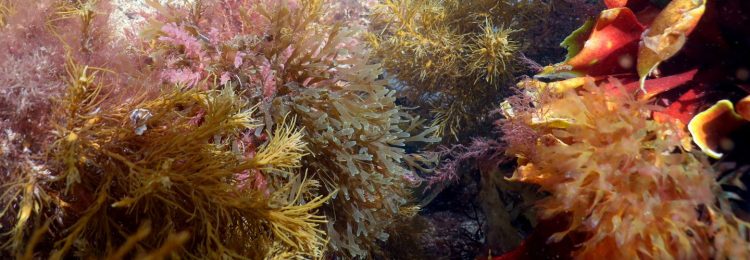
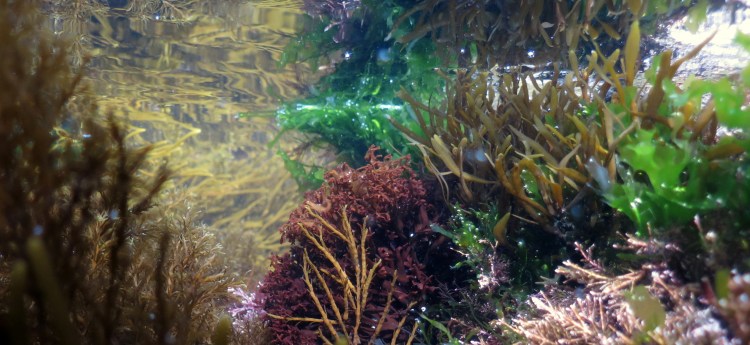
cropped-img_5998.jpgI had a few rock pooling sessions recently to play with my new camera (and wide angle lens). The main one was a workshop with North coast-based Thomas Daguerre of Hydro Motion Media (facebook). I am just a beginning photographer and so learning the ropes from an experienced hand proved immensely valuable. The session started with going through some of the basics (white balance, focusing etc), after which we headed out to the rock pools to put some of the theory in practice. We headed down to Thomas’ stomping ground of south Fistral Beach (I visited once before). Although the timing was not the best tide-wise, it was a beautiful day. This was the first time I actually submerged myself in rock pools to take photo’s; of course, being able to look through your view finder is the only way to do it right. It is hard to not stir up sediment though and in some pools salinity gradients made for bad viz. I used Thomas’ G16 setup with video lights and a strobe on a tray (something like this; should have taken a picture of it) which was very difficult! As a result of all the experimentation I ended up with few blog-worthy photos, but this session made clear that trying to capture ‘rock pool scapes’ is what I would like to focus on, the variety of seaweed species, colours and shapes I find especially cool.img_6484 img_6488I really need to try to go back to these pools and try to get better photo’s. I also will arrange a second session with Thomas later in the season to start learning how to post-process RAW files. What was very interesting to see is that the pools here teem with Giant gobies Gobius cobitis, a protected species in the UK. We saw two lying side by side in a crevice but they are shy and it was hard to get a good shot. Thomas has recently made an excellent series of short films highlighting various charismatic local marine species, and one of them features the Giant goby (see the Hydro Motion Media site for the other eleven films):