Cave of Dreams

I cheekily ordered a larger dome port last week (8 inch instead of 4 inch), which should suffer less chromatic aberration (unsharp corners), but also make it easier to compose splitshots (or ‘over-under’ shots) where the top half is above water and the bottom half below water. I played around with this type of shot a bit before with the small dome (e.g. see here and here) but it should be much easier with a larger dome. Anyway, the weather was such that I did not immediately have a go at it, but this Tuesday I figured I could give it a try at Fistral Beach in Newquay, which has some good rockpools that are not directly connected to the sea at low tide and might be still enough. It was bloody hard to get a decent shot in the deeper rockpools I tried first, as the difference in ambient light above and below water really necessitates the use of strobes to result in an even exposure, As I struggle with strobe lighting for normal shots, this was a bit too much to ask. My fallback was the ‘cave of dreams’ a rather grandiose name for a small overhang containing scarlet and gold cup corals (Balanophyllia regia) and Yellow hedgehog sponges (Polymastia boletiformis) (amongst other sponge species). (Check out THIS OLD POST on the cave of dreams with some decent pics I took with my old Canon Powershot camera.) Crouching down, I could barely fit under the overhang. The picture above looks like it is a substantial scene, but I could only submerge my domeport halfway! Using strobes would have been too finicky and probably result in quite unnatural light, so I bumped the ISO to 400, lowered the shutterspeed to 1/30 and used a 6.3 F-stop to get sufficient exposure using my micro four thirds Olympus camera. I needed to go down to a shutterspeed of 1/25 and a 5 F-stop for the close-up shot below. Here is to more experimenting this spring/summer!
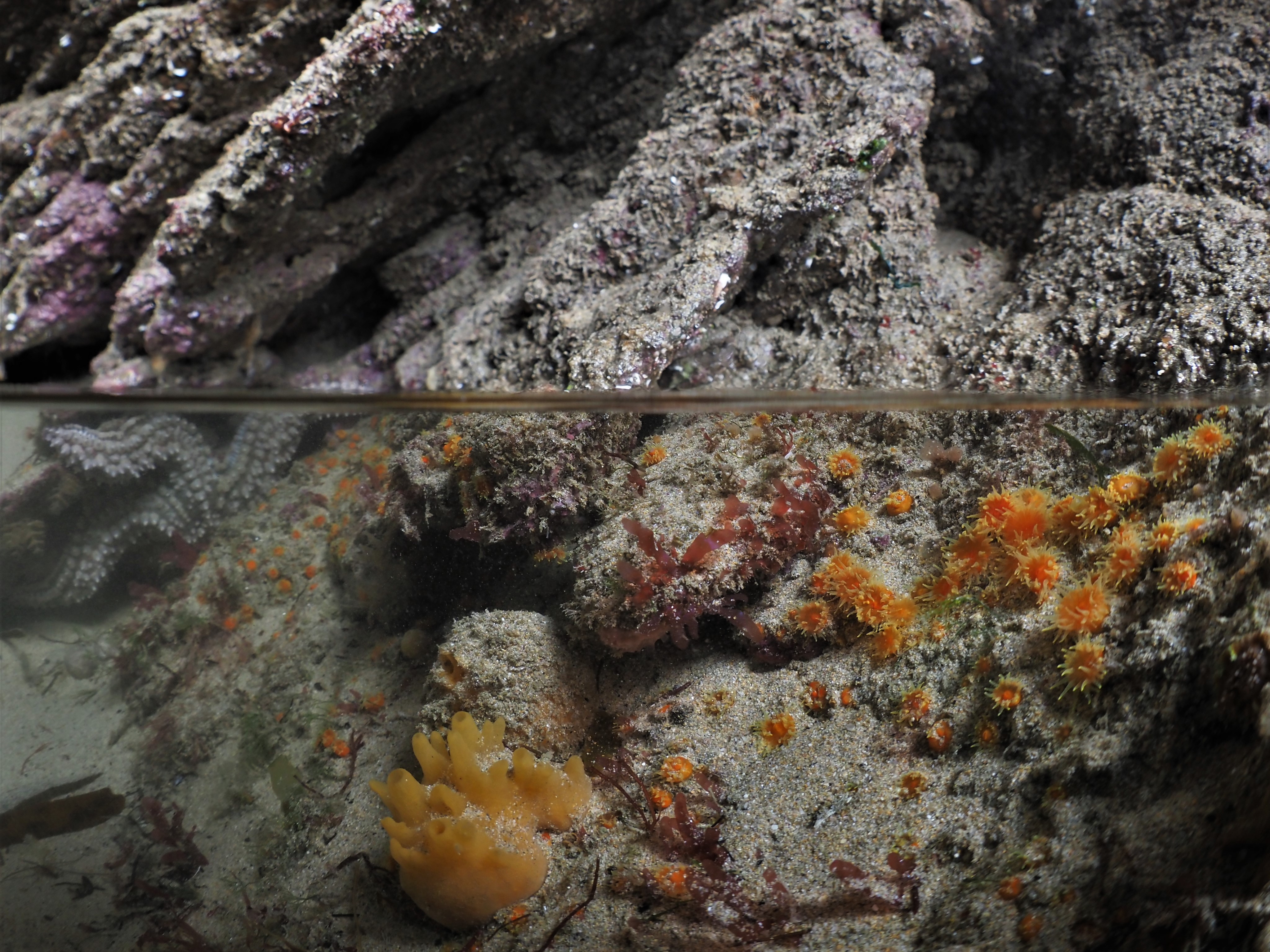
P.S. the sponges have been going strong for a good while, see these pics from 2014/2015!
St. Cuthbert’s Cave

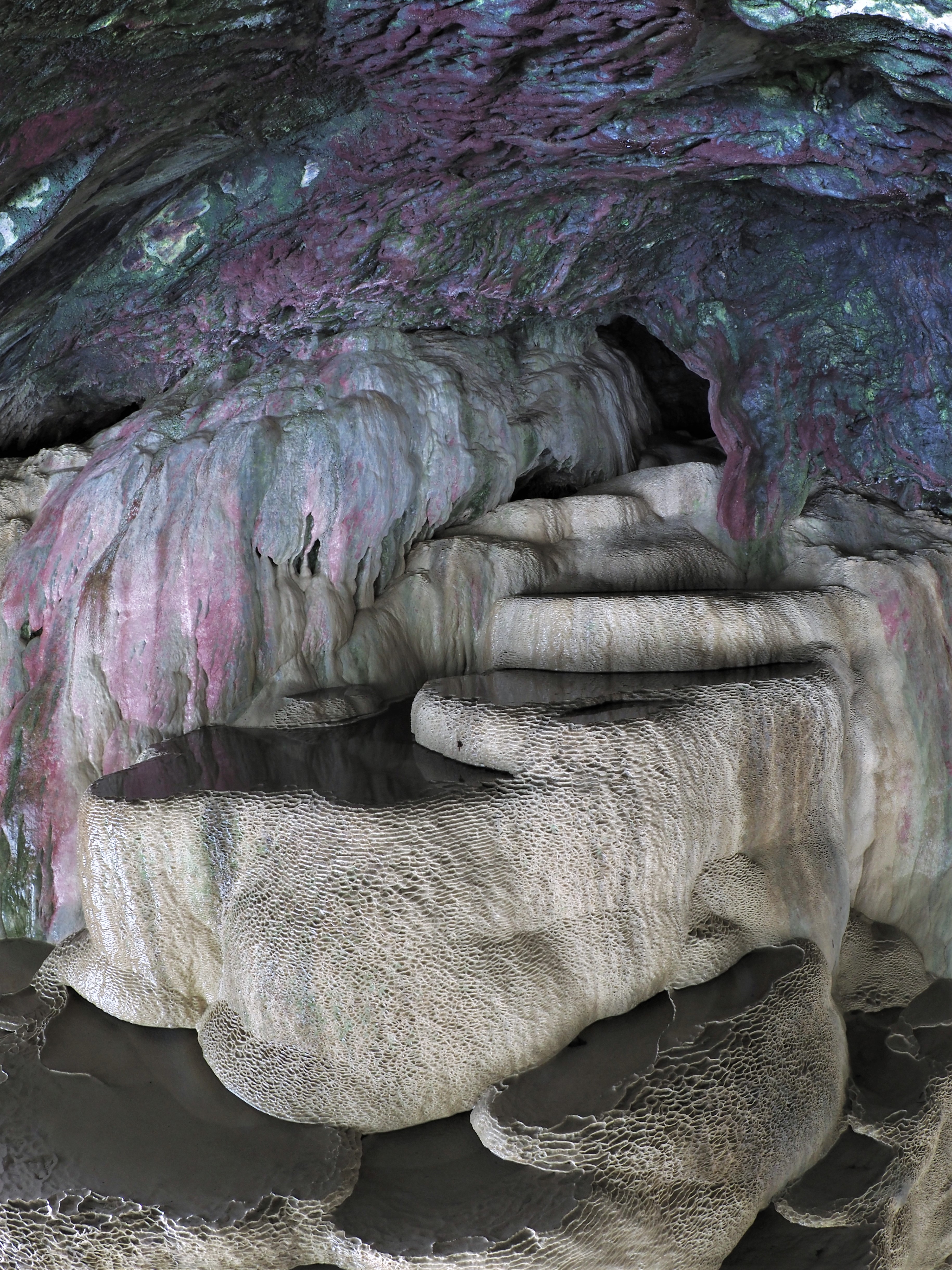
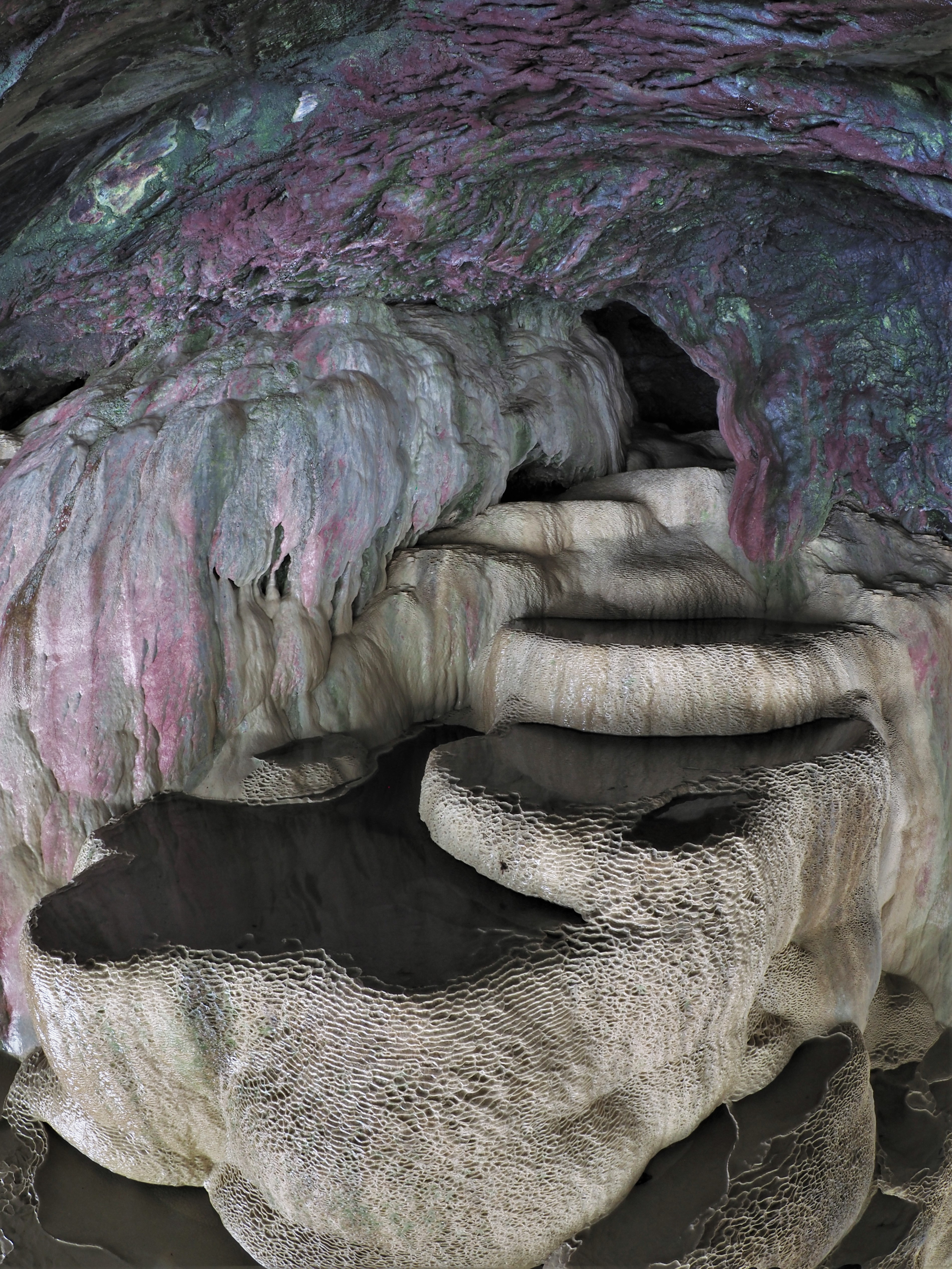
Holywell Beach on the North Coast of Cornwall is known for a small sea cave which houses a ‘holy well’. According to Mabel Quiller-Couch, in her 1894 book “Ancient Holy Wells of Cornwall” in 995 AD the bishop of Lindisfarne, Aldhun, was bringing the remains of saint Cuthbert back to Ireland. Blown off course in a gale, he was left stranded in Cornwall where he settled and built a church dedicated to St Cuthbert. After some years however, an oracle instructed Aldhun to return the relics of St Cuthbert to Durham. As he was leaving from Holywell Bay, the saint’s bones touched the side of the well, giving the spring its magical healing powers. In medieval times, many people flocked to this cave to seek out the healing powers of the spring.

I was in the area this week when the tide was low (at high tide the cave is completely flooded, so you have to check the tides!) and decided to bring out the fisheye lens and a tripod to take some long exposure pics. They came out all right. There are more colourful photos available online, but my suspicion is that these use artificial light and sometimes also some enthusiastic post-processing. By using the longest possible exposure time on my camera (Olympus OMD E-M1markII), a full minute, I was able to let enough light into the camera. This enabled me to use f/18, allowing great depth of field, and ISO200, meaning little noise.

The formations result from a rare (in Cornwall) limestone deposit in the roof of the cave. Slightly acidic rainwater percolates through this limestone, dissolving calcite and becoming enriched in calcium bicarbonate. When the water drips down the rocks, the process is reversed and calcite precipitates, especially in areas where the water moves a little, causing CO2 to gas off. This results in the dam-like rimstone (or gours) formations. The tiny ‘rice terrace’-like formations on the dams are called microgours. I’d like to go back one time to experiment more and also to take some macro photos of the microgours and colourful microbes.