A quick post, again of macro shots on-land using the cygnustech diffuser. A Montagu’s Blenny (Coryphoblennius galerita) and a Shanny (Lipophrys pholis) (check its teeth, it is a combtooth blenny). Due to the recent storm I did not venture into the water but had a wander down the shore here in Flushing. The fish were gently placed on some wet seaweed where they lay still before hopping back in their rockpool. The diffuser really gives the photos a moody atmosphere! I hope one day I can find a Tompot blenny on a very low tide to complete the set.
A trip to one of our favourite places today: Kynance Cove on the Lizard Peninsula. The weather was such that snorkeling was a big no, but after some wind and rain, luckily the sun came out for a bit (which it should, it is July!). I took some macro shots of the rocks at low tide using my new Cygnustech diffuser. This contraption makes the flash light much less harsh, and is pretty much essential when taking (non-natural light) macro shots. This is one of the best diffusers out there and I can highly recommended it (are plenty of reviews are available online). Some of the shots were taken with the Raynox DCR-250 macro attachment in front of the macro lens for a little bit of extra magnification.
Anyway, there is not a lot of animal diversity on this battered coast of green and red serpentine rock: barnacles, dog whelks, mussels and limpets mainly. Above a selection of photos highlighting some small Dog Whelks (Nucella lapillus). This predatory species can come in many more colour varieties than we found today (see here for example). The limpets are either the Common Limpet (Patella vulgata) or the Blackfooted Limpet (P. depressa); you need to be able to see the animal to be sure. The barnacles are Montagu’s Stellate Barnacles (Chthamalus montagui) (I might have this wrong; I must confess I never really gave barnacles the attention they deserve). Not too spectacular but you gotta try something when you cannot take photos underwater!
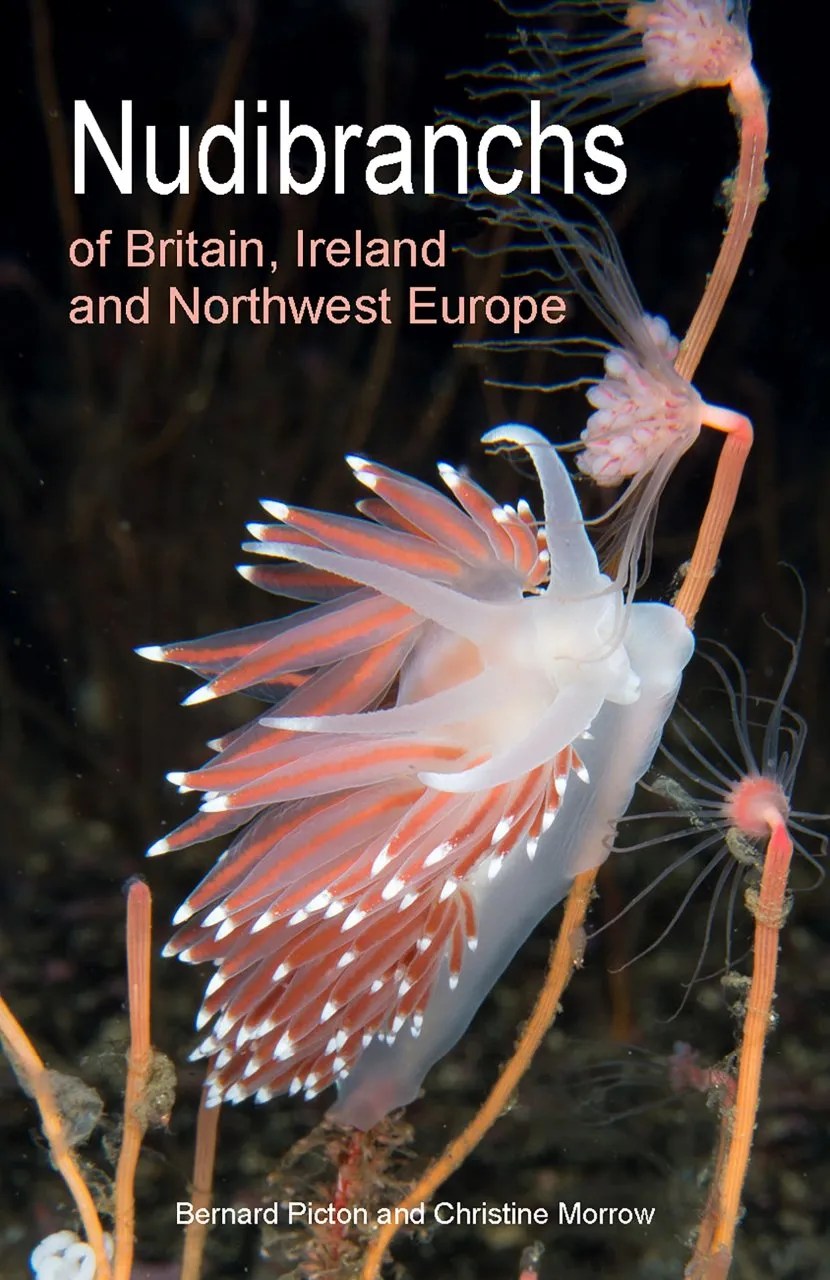
Last week I had a very special delivery in the post: the second edition of Nudibranchs of Britain, Ireland and Northwest Europe by Picton and Morrow (available HERE amongst other (web)shops). I received a free copy because I contributed photos for two not so commonly encountered egg-eating seaslugs: Calma glaucoides and Calma gobioophaga. I was really chuffed with this, as apart from the authors, many real experts contributed photos (including Cornwall’s very own David ‘aphotomarine‘ Fenwick). Although sea slugs might seem ‘niche’ to some, they are among the prettiest and most diverse marine creatures and I am sure many divers, snorkelers and rockpoolers (and readers of this blog) will really enjoy this book (see also this review)!
The funny thing is that I have actually not taken many photos of nudibranchs at all…. I have only been serious about macro (and in the possession of strobes that actually work…) for a few years but moreover, I am not very good at finding them! This publication has really spurred me on to go look for nudibranchs and learn more about them though. What is also exciting is that I bought (secondhand) scuba kit a few weeks ago, so i will be able to go back to diving and see a wider range of things. Now if only the wind dies down!
The Sea Hares (Aplysia punctata) are still out in force. They are great characters, with faces like Star Wars extras, crawling over seaweeds and each other. Here another batch of pictures!
When the viz is bad, I take my macrolens (sometimes with the Nauticam CMC-1 wetlens for a bit of extra magnification) out to the pools. Sometimes I stick to the surface of rocks and seaweeds (to look for stalked jellyfish for instance), but other times I turn over rocks under water to see what hides beneath. Quite a lot! There are larger animals, such as Topknots and different types of crabs (and Worm pipefish as pictured here) but mainly they are quite small (around a centimetre or even less). See the selection below (Tricolia, Bittium and Limacia were not from under rocks but I had to make the grid fit!).
Just a really quick post featuring two characters I encountered last week. Above a Topknot (Zeugopterus punctatus), a little (<10 cm) flatfish. Below a Seahare (Aplysia punctata), an ophistobranch mollusc which is enjoying a bit of a population boom at the moment. Been in a bit more lately with so-so results but hope to post more soon.
Sorry for you non-photography geeks, this is a short post about a lens, the “Panasonic H-X09E Lumix LEICA DG SUMMILUX 9mm F1.7 Lens” to be precise… During the spell of bad weather I was practically forced to browse, and yes, spend money on photo gear. I had long wanted a lens suitable both for landscape and street photography, but especially one that allowed me to focus on say a reptile or amphibian and still have the habitat in the background. A fisheye lens can do this a bit (see the previous post), but on land it results in distortions that just look unnatural. This is a lens that can do the job, as it has a minimum focusing distance of about 10 cm – resulting not in real macro shots but being able to come pretty close, combined with a wide angle background. After having it taken out this weekend for the first time I must say I am really happy with it.
The bank holiday Monday warranted a morning visit to one of our favourite haunts Windmill Farm to do some ‘herping’. Adders and slow worms were found after lifting up corrugated iron sheets, but they slithered off before I could take any good shots. However, there was a toad that sat nice and still so I was able to take multiple shots, camera in one hand, diffuser in the other. For a first try, I was pretty happy with the result. Next, we took a walk from nearby Lizard Point to Housel Bay. The weather was absolutely glorious, with many wild flowers on the cliffs and fulmars, choughs and pipits flying around. The water was blue and crystal clear – you could see the seals swimming underwater! A small part of me was cursing that I was not in the water myself to take photos, but it was a fantastic day on land too.
P.S. annoyed that the Windows photo software straightening tool is not very precise – the horizon is not straight!
I cheekily ordered a larger dome port last week (8 inch instead of 4 inch), which should suffer less chromatic aberration (unsharp corners), but also make it easier to compose splitshots (or ‘over-under’ shots) where the top half is above water and the bottom half below water. I played around with this type of shot a bit before with the small dome (e.g. see here and here) but it should be much easier with a larger dome. Anyway, the weather was such that I did not immediately have a go at it, but this Tuesday I figured I could give it a try at Fistral Beach in Newquay, which has some good rockpools that are not directly connected to the sea at low tide and might be still enough. It was bloody hard to get a decent shot in the deeper rockpools I tried first, as the difference in ambient light above and below water really necessitates the use of strobes to result in an even exposure, As I struggle with strobe lighting for normal shots, this was a bit too much to ask. My fallback was the ‘cave of dreams’ a rather grandiose name for a small overhang containing scarlet and gold cup corals (Balanophyllia regia) and Yellow hedgehog sponges (Polymastia boletiformis) (amongst other sponge species). (Check out THIS OLD POST on the cave of dreams with some decent pics I took with my old Canon Powershot camera.) Crouching down, I could barely fit under the overhang. The picture above looks like it is a substantial scene, but I could only submerge my domeport halfway! Using strobes would have been too finicky and probably result in quite unnatural light, so I bumped the ISO to 400, lowered the shutterspeed to 1/30 and used a 6.3 F-stop to get sufficient exposure using my micro four thirds Olympus camera. I needed to go down to a shutterspeed of 1/25 and a 5 F-stop for the close-up shot below. Here is to more experimenting this spring/summer!
We have had some sunny spells but generally the weather has been disappointing lately, especially with regards to wind and waves. I did some snorkels with the fisheye lens to try to capture the seaweeds but the viz was such that I did not even bother to copy the images from my camera to my laptop….A crying shame as it means I have to wait a whole other year to capture the seaweeds in their full glory! (although even when most seaweed species are in decline, with good viz and some sun the pools can still look fantastic later in the season, see for example HERE or HERE). Anyhow, instead of taking my fisheye lens underwater, I tried it out on land instead, specifically on the muddy foreshore of my village Flushing. (A wide angle lens would have been better for this – no warped horizons etc – but I don’t have one.) I had a go at this a while back, before I really knew about softboxes to disperse flash light….what can I say, I am a slow learner… I recently bought a flash and a trigger so I can hold my flash in a softbox near subjects which is the way forward for these types of shots. Although not home to the most spectacular animals or backgrounds, it was fun playing around a bit. Top left: Montagu’s Breadcrumb Sponge (Hymeniacidon perlevis), top right: something that looks superficially like Elephant Hide Sponge (Pachymatisma johnstonia), although the colour and texture are off. (This specimen will be sampled by David Fenwick for a close look at the spicules (if it is a sponge and not a seasquirt!)
There are many oysters here too, mostly the invasive Pacific oyster (Magallana gigas) (pictured above), but also the native oyster (Ostrea edulis). I hoped to get a shot of an eel, but the ones we caught were small and a bit too active. We also found rocklings, shannies, rock gobies, a sea scorpion and interestingly a dragonet and a painted goby (I had not seen one of these before). Although there are quite a lot of interesting species to be found in the mud, I hope I’m able to go snorkeling in some clear blue water very soon!
‘Portfolio’ sounds a bit pretentious so ‘Photo Gallery’ it is…. check the page link on top for some of my better pics. These also feature on my instagram account ‘@an_bollenessor‘.