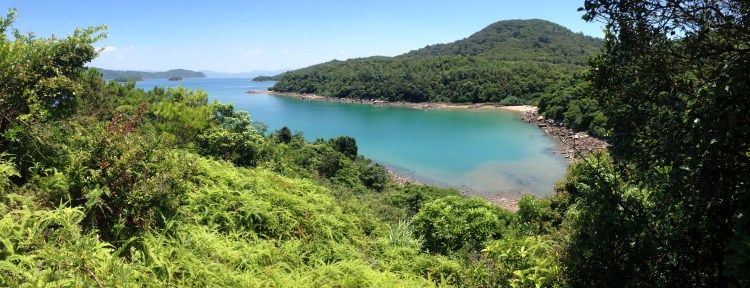
 Last week I spent a week in Hong Kong for work; of course I had also reserved a couple of days to explore the marine life! My notion that Hong Kong was some kind of city state without any wildlife had already been dispelled after reading the Green Blue Sea blog, which documents Emilie’s (free)diving adventures in local waters (as well her trips to more well-known Asian and Pacific diving destinations). Although Hong Kong is the most vertical city in the world, and one of the most densely populated ones, 40% of the country is comprised of nature parks and the surrounding seas are home to corals. With 84 species of hard corals and 26 soft coral species, coral diversity is higher even than in the Caribbean. However, diversity is lower than in other areas in the region such as Taiwan or Okinawa, which is in large part due to habitat destruction.
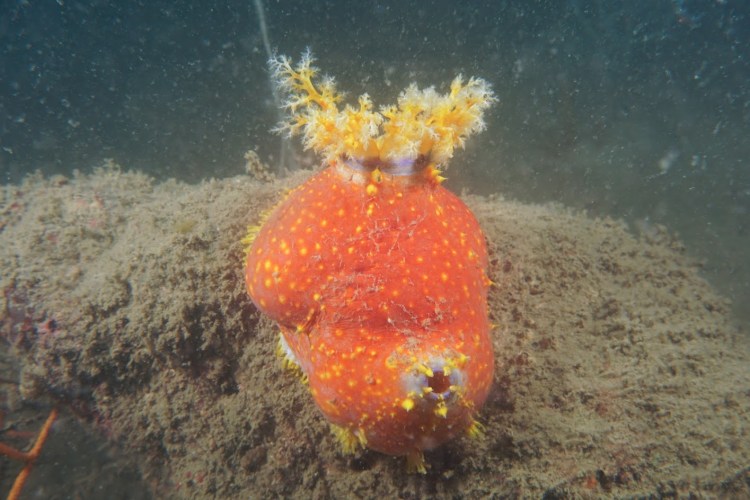
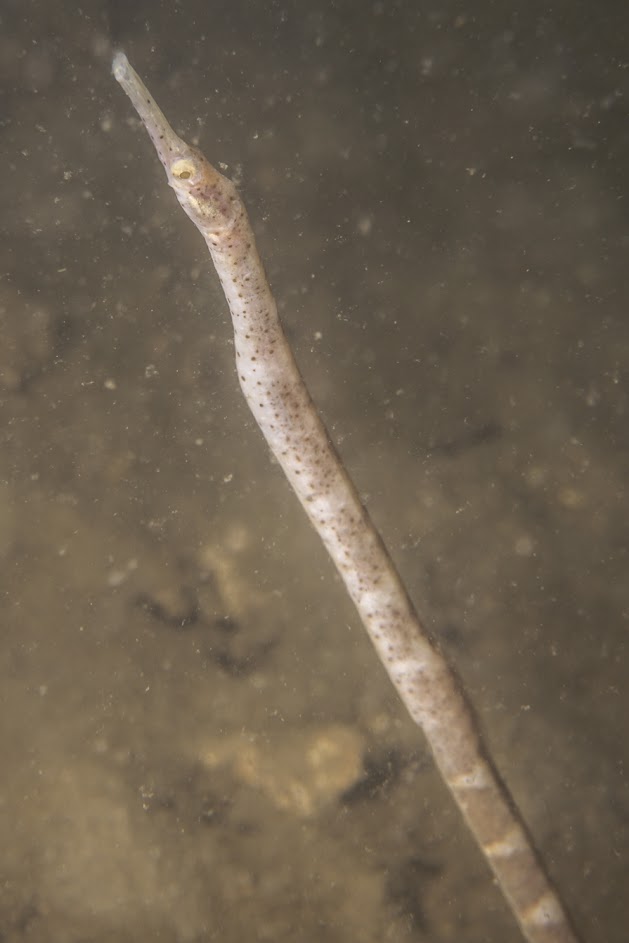
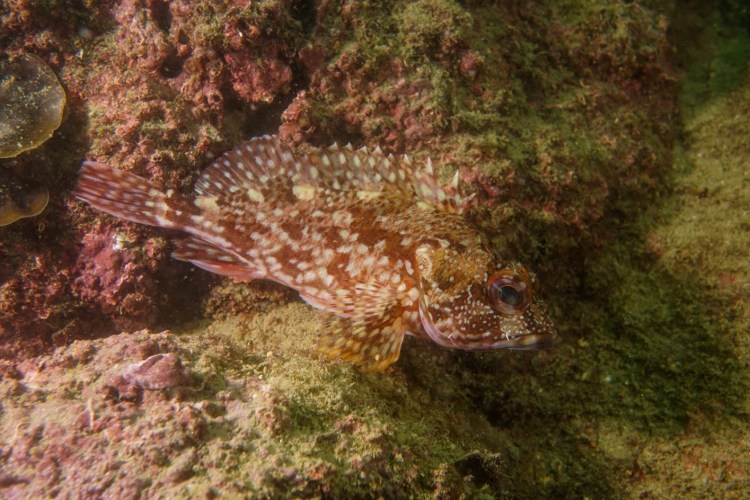
 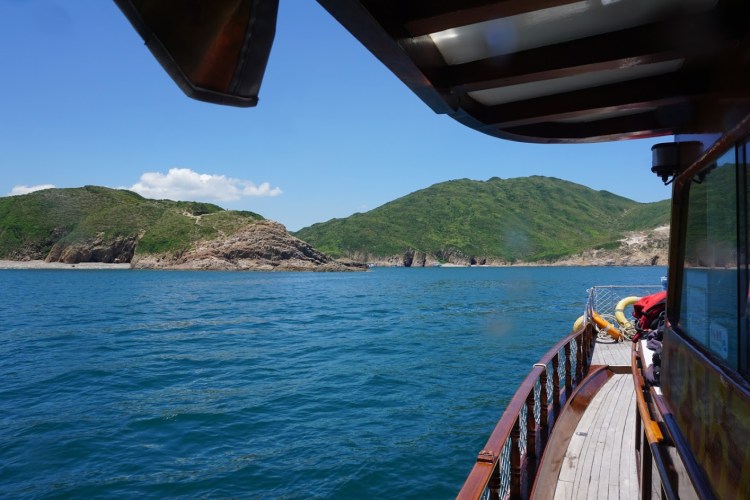 So less than 24 hrs after landing I descended in the warm and murky waters of the Hong Kong Global Geopark, diving of a boat at Basalt Island with diveshop Splash, operating from Sai Kung. My divebuddy was expat Dod, who was so kind to provide some of his photo’s to put on this blog (the one above and the four below; thanks Dod!). The conditions for underwater photography here are about as challenging as they get with the amount of ‘marine snow’; we probably only had two meters of visibility. (I did not attempt to take pictures as I have no strobes and we went down to 18 meters so it was pretty dark anyway.) Large numbers of big, brown anemones hosting clown fish, urchins and sea cucumbers were present. Going a bit deeper, there were lots of black corals around (although they were coloured white) and there were occasional small colonies of one of my favourites, the Sun coral. Large bubble tip anemones, tube anemones, feather stars, a moray eel, pipefish and a lionfish completed this dive, good stuff! As the viz was so bad, we tried the other side of the island the following dive, and we kept it a bit shallower. We saw few fish but a decent amount of coral. Water temperatures dropped from 30+°C to 21°C at the bottom. This was very cold according to all local divers, of course giving me ample opportunity to sneer: 4°C warmer than the warmest it gets in Cornwall! My last dive was in a 9°C sea! All in all a fun and well-organized dive trip. Dod’s photo’s of Sun coral, a Sea apple (a type of sea cucumber), a pipefish (probably a Trachyramphus spp) and a Marbled rockfish Sebasticus marmoratus: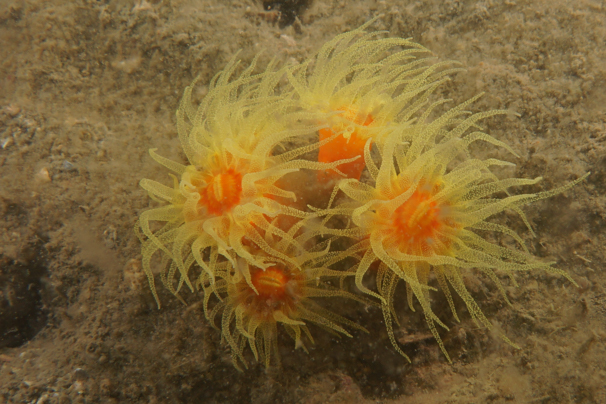
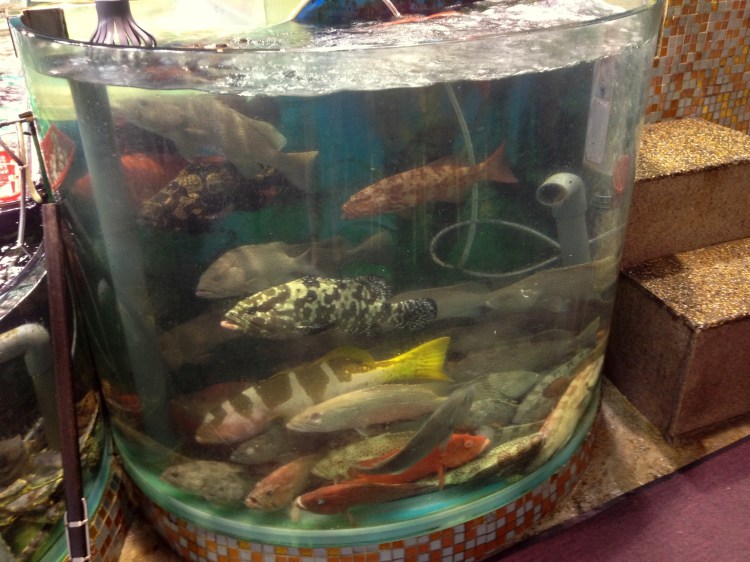
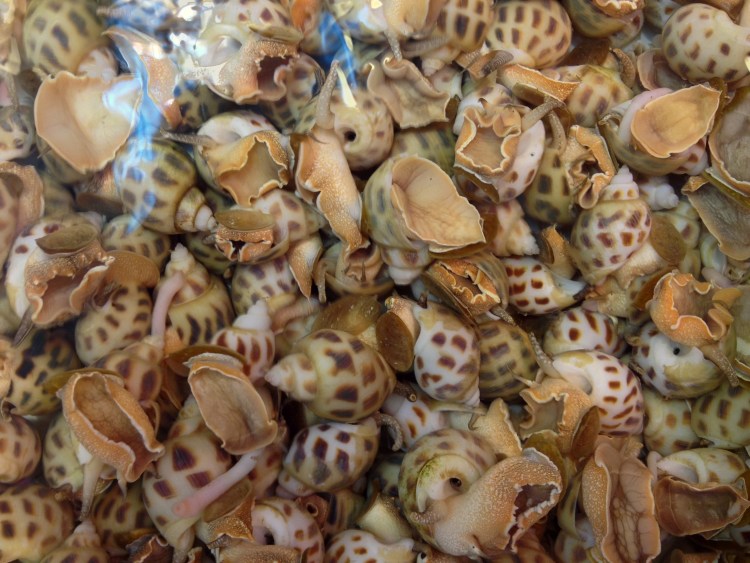
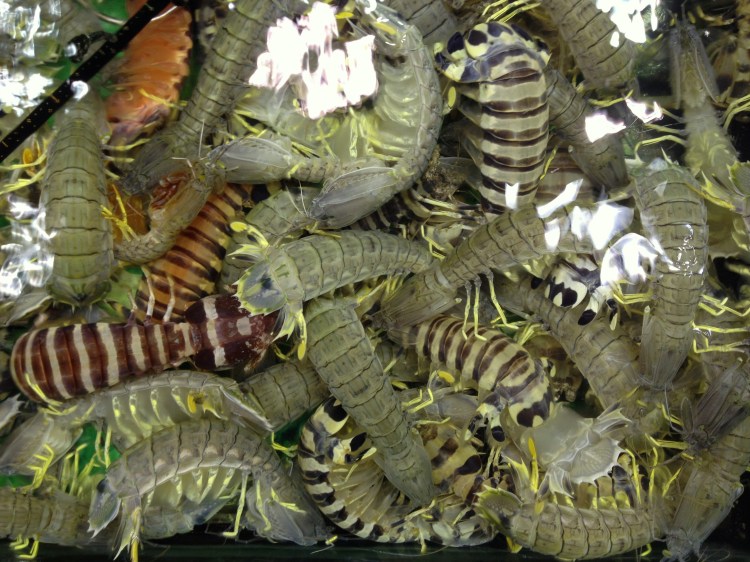
 Back in Sai Kung later in the week I had some more good opportunities to see the local sea life, namely in the display tanks of restaurants. The Chinese definitely lived up to their reputation to being adventurous eaters: I saw Horseshoe crab (not much meat on that!), moray eels, tiny sculpins and the Babylonia snails I only knew from the shell nets sold in seaside tourist shops. Lots of huge and beautifully coloured mantis shrimps, crabs, lobsters, abalones, geoducks, perch and much more. Seafood is also sold from boats along the pier, it was sad to even see cute little filefish cramped in holding tanks in the burning sun. There must be a lot of overfishing going on here.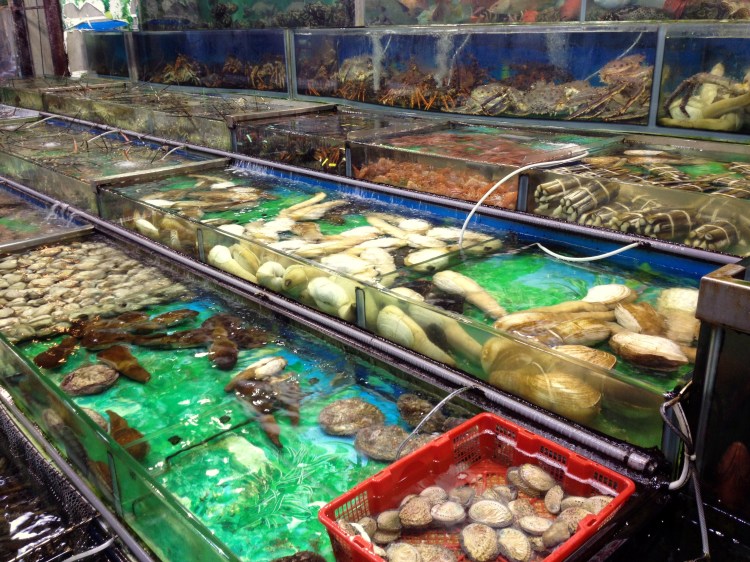
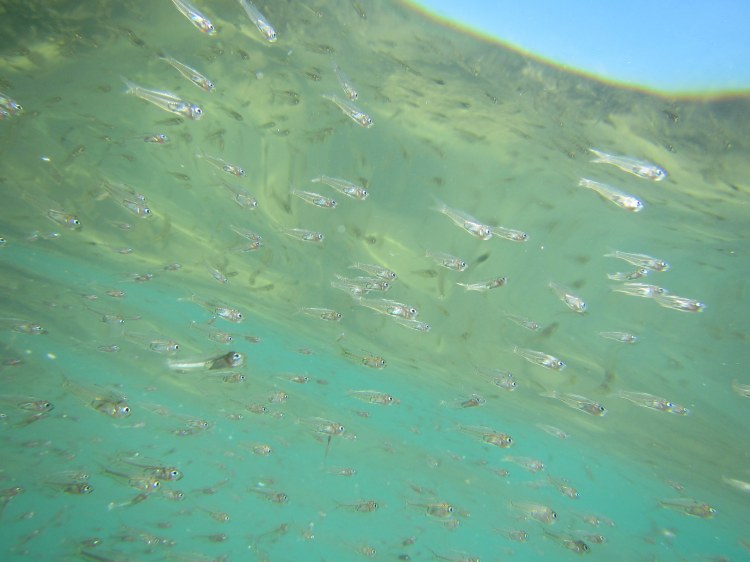
 I went back for half a day to the Sai Kung area later in the week. Small Hoi Ha Wan park (photo at top of post) lies next to the sleepy village of Hoi Ha and has a nice beach and a coastal walking trail. Huge orb spiders sat in their webs and there were loads of pretty butterflies. If you are really lucky you can see pangolins (you have to be very lucky probably, sigh). Clambering over rocks covered with razorsharp clams and large numbers of fleeing, cockroach-sized isopods, I had a little snorkel around. I saw a good diversity of fish but there were quite some jellyfish around also, which was tricky without a wetsuit. Some scattered corals can be seen here, but this area was traditionally used for lime extraction from which the corals are still recovering. Again the visibility was very bad; I managed a single nice shot just below the surface of some fish fry.
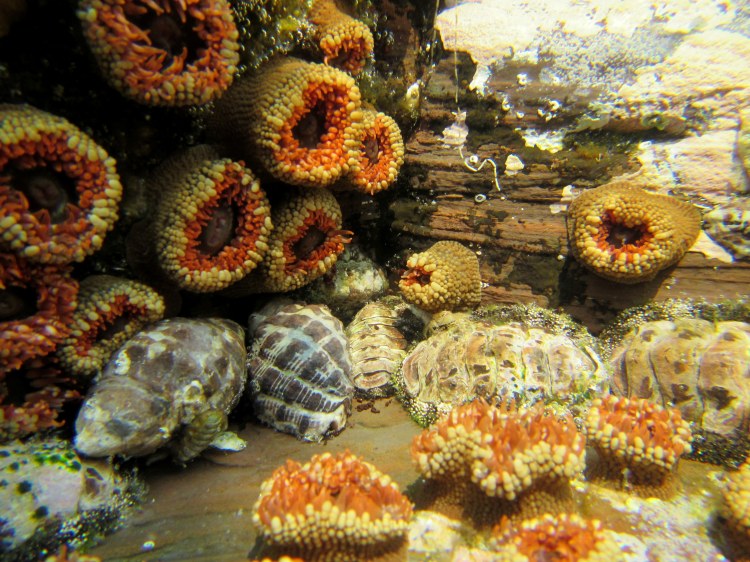
  My last day was spent on the tiny island of Tung Ping Chao, the most easterly point in Hong Kong. Ferries only go in the weekend, and are packed with tourists and ex-villagers (the island is no longer inhabited) packed with supplies to cater for the tourists. I first had a little wander around the island and then checked out the rock pools at Kang Lau Check. Unlike most of Hong Kong, this island consist of sedimentary rock, diagonal layers of which have been eroded by the sea to leave shallow, angular pools. The water in the pools must have been close to 40°C. Unlike Cornwall, but just like in Oregon, there were very large acorn barnacles and clusters of Gooseneck barnacles. The chiton Acanthopleura japonica was very abundant, as were very cute green-red anemones (have not been able to Google them yet). I took some quick shots using the Canon D30; I hope Emilie or Dod at some point can visit and do a better job; some very cool underwater scenery!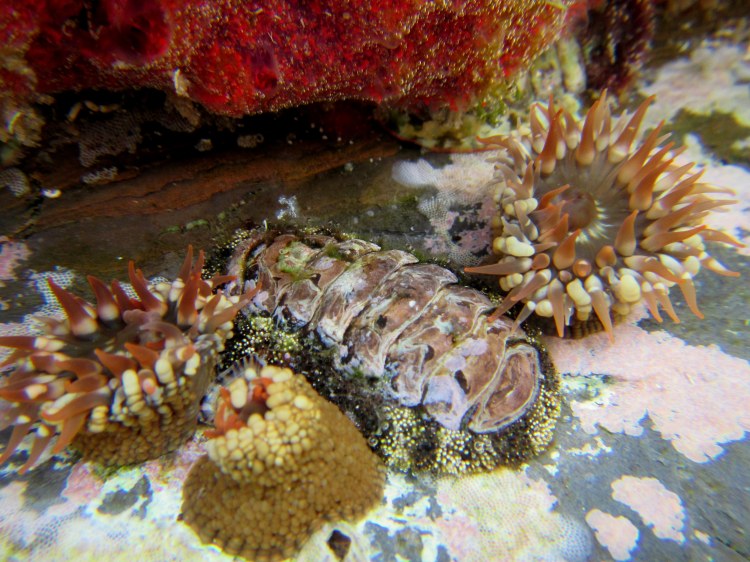
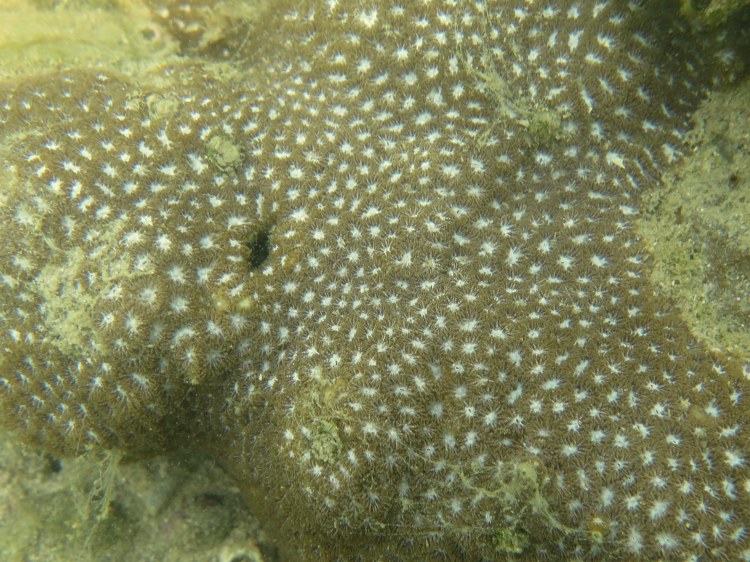
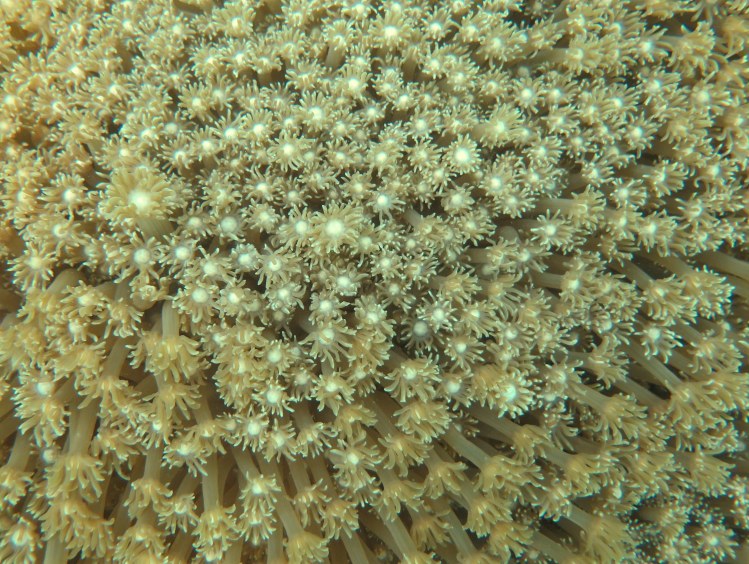
 After a rest, I took my new Canon G16 for a snorkel. The corals here looked very healthy, although unfortunately there was quite some garbage as well. Pondering both the surprising diversity of coral life still present here, and the threats they face, I think it would be cool if some citizen science project could be set up to raise awareness. I am pretty sure many Hong Kong residents do not realize what precious marine life they have close to home. Creating reef enthusiasts will be essential to help conservation efforts. What if coral frags could be propagated in local bays and used to stock native Hong Kong nano tanks to be set up in schools as well as restore damaged reefs? Anyway, thinking about those types of projects is my form of escapism! Due to problems with my mask, not having super viz or strobes and being lazy (using the automatic setting only), I just snapped random pictures. I was pleased to see that the image quality was still quite good! Below some shots of different corals: Acropora, Favia, Goniopora, Pavona, Platygyra and two genera I could not identify to give an impression of the diversity in shapes.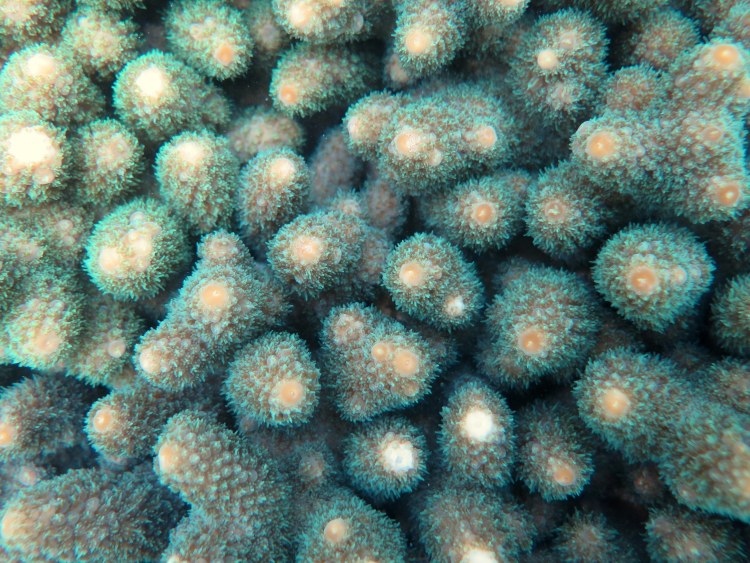
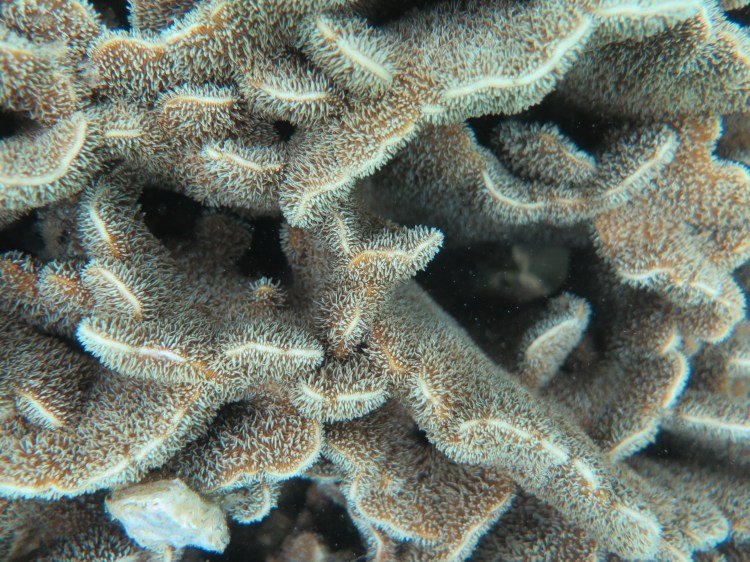
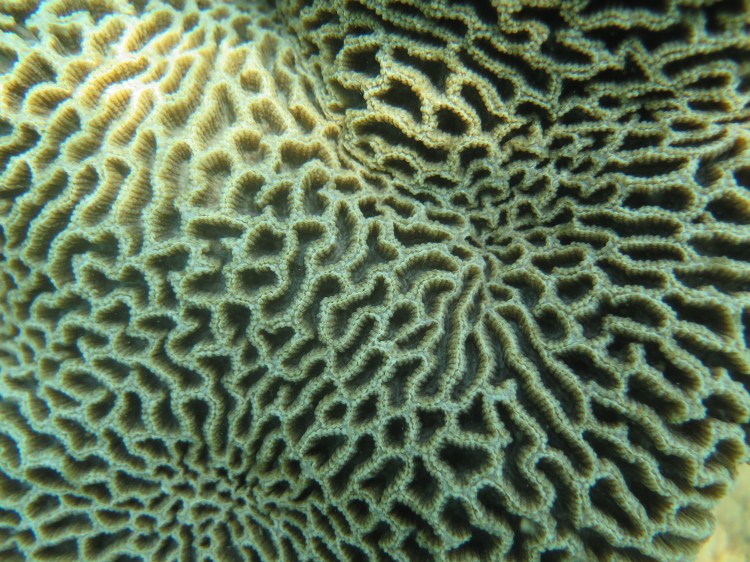
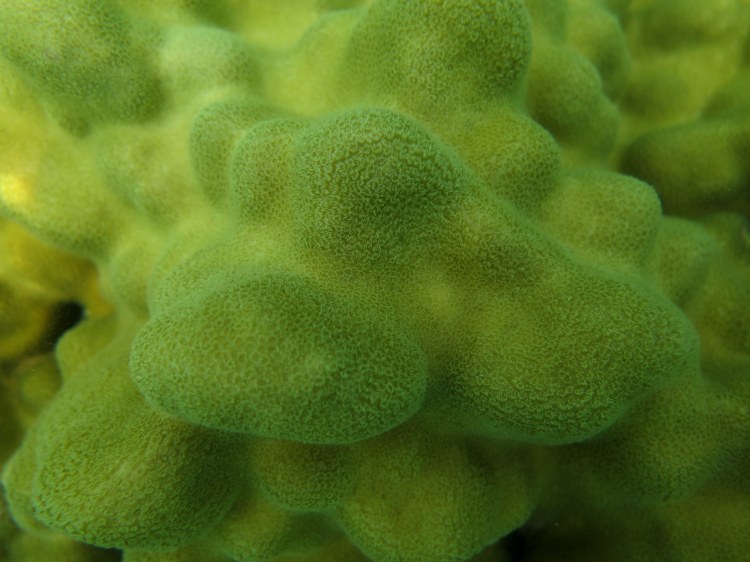
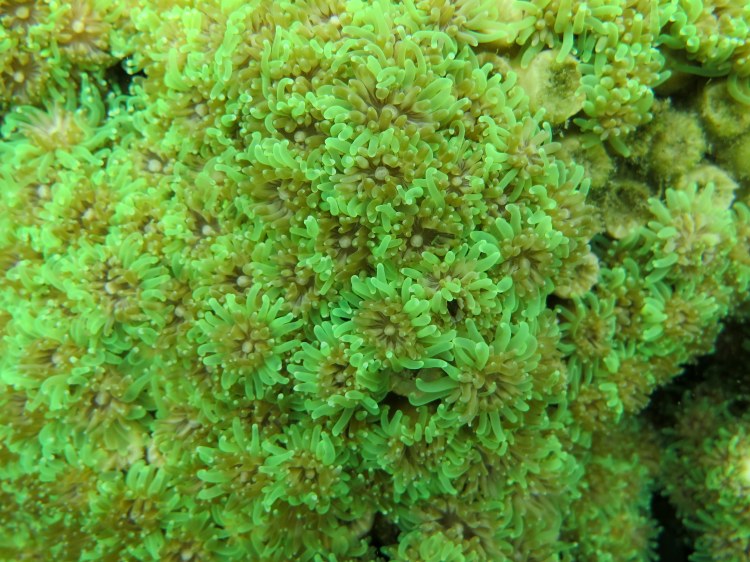
Category Archives: snorkeling
Facelina auriculata
Last weekend I went for a snorkel of Silver Steps at Pendennis Point in Falmouth. Visibility was bad because of the plankton bloom, but this also meant that I could admire the many small jellies floating about. Very hard to get a good shot of these though; might be worthwhile to collect some in a beaker and photograph them in my cuvet back on land next time. My eye was drawn to a giant Barrel jellyfish struggling against the rocks, but then I noticed something a lot cooler: the beautiful nudibranch Facelina auriculata. I was so eager to get in to the water that I had forgotten to put my weight belt on so it was a struggle to dive down and hold still for a macroshot, but this one is relatively sharp (if you want to see beautiful pictures of native nudibranchs I recommend joining the NE Atlantic Nudibranch facebook group). Also spotted the large and beautiful flatworm Prostheceraeus vittatus but did not manage to get a shot, will go back this weekend to try to find them both again!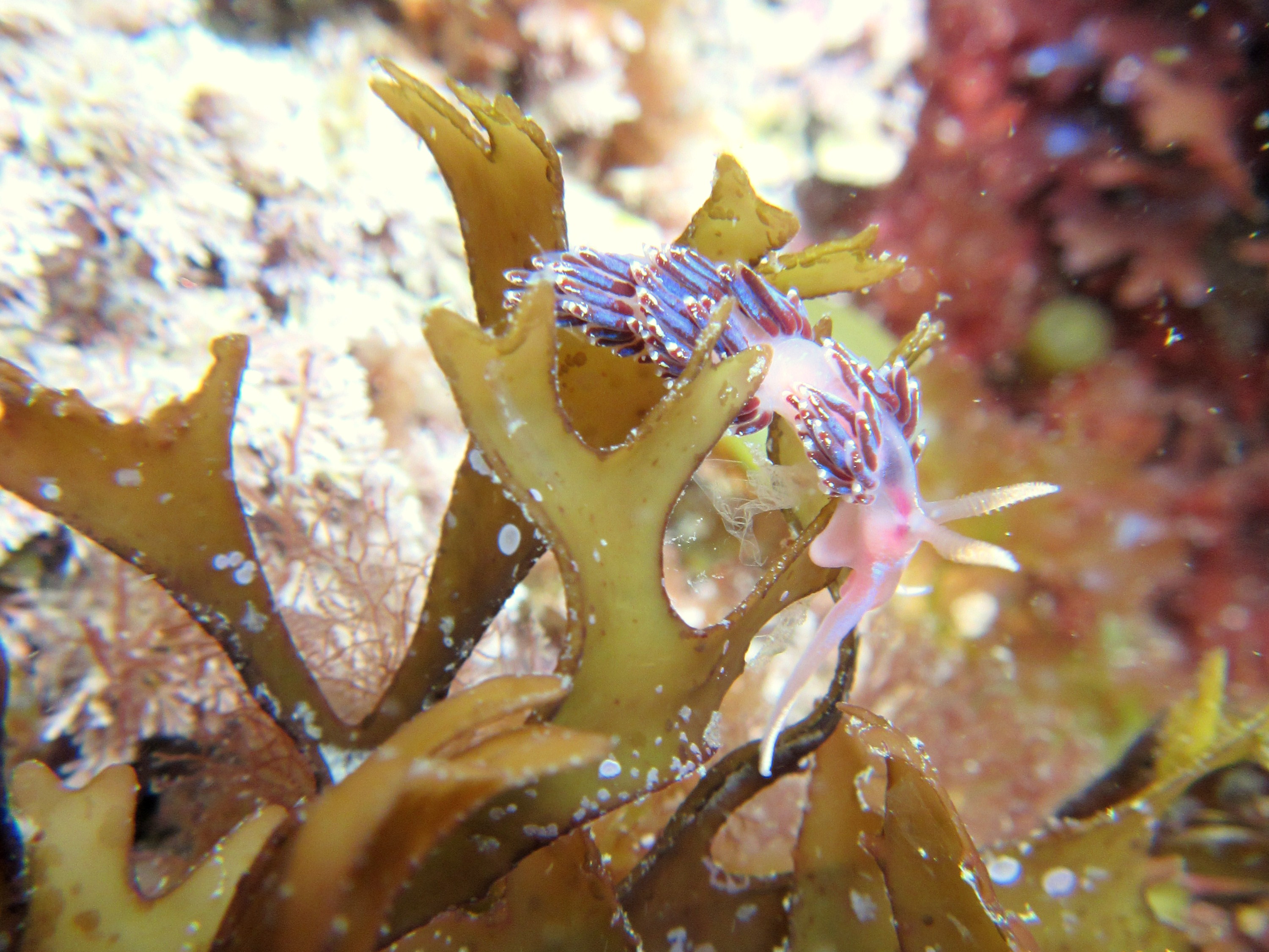
More Jellies
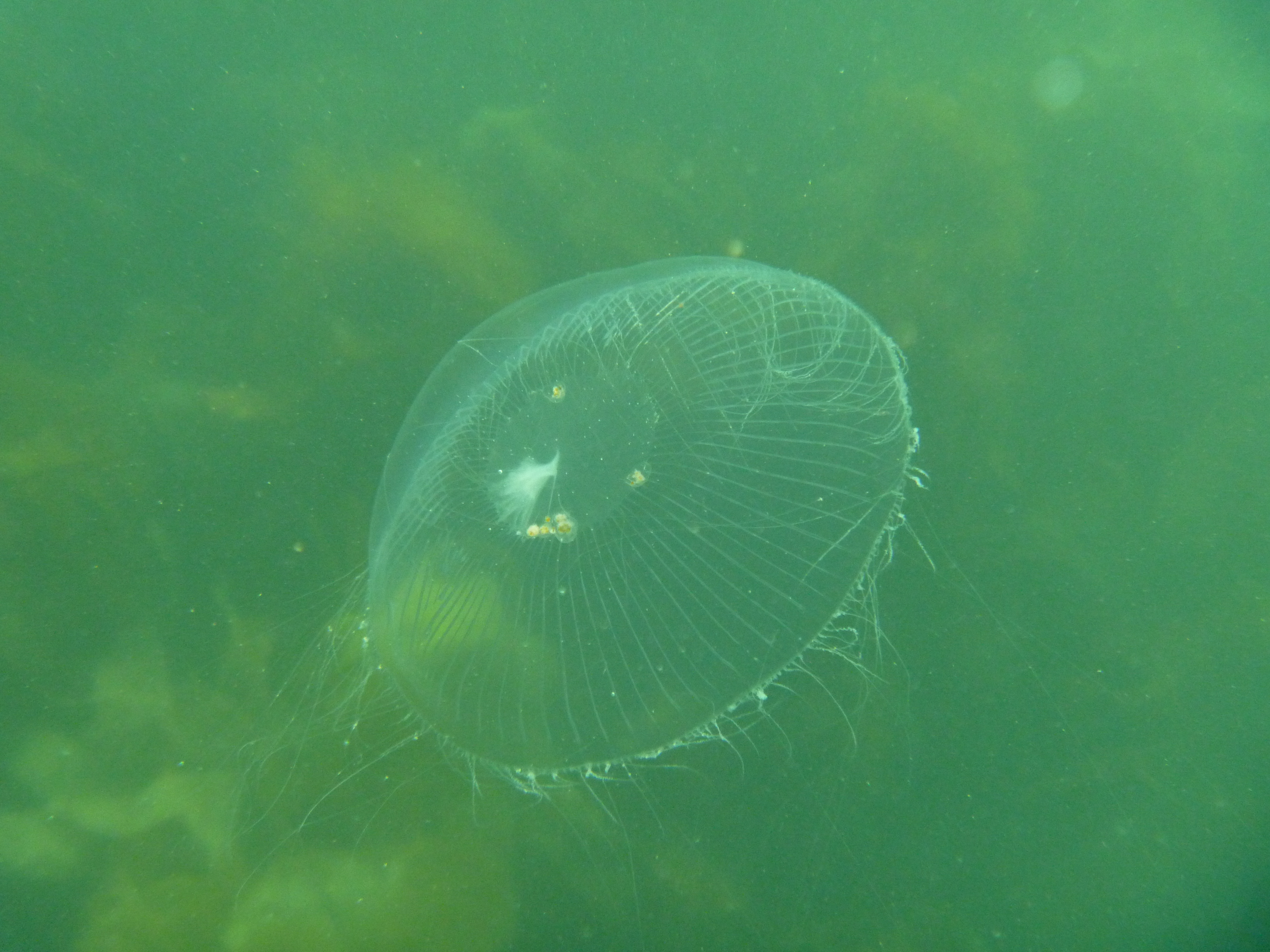
A second, long snorkel session at Gylly Beach yesterday. Loads of Sand eels, no cuttlefish but there were a couple of beautiful Compass jellyfish Chrysaora hysoscella around, with tentacles up to a meter long (first pic). Smaller and less visible was Aequorea forskalea or A. vitrina (second pic)*. A close relative of this species gave molecular biology ‘green fluorescent protein‘ (gfp). 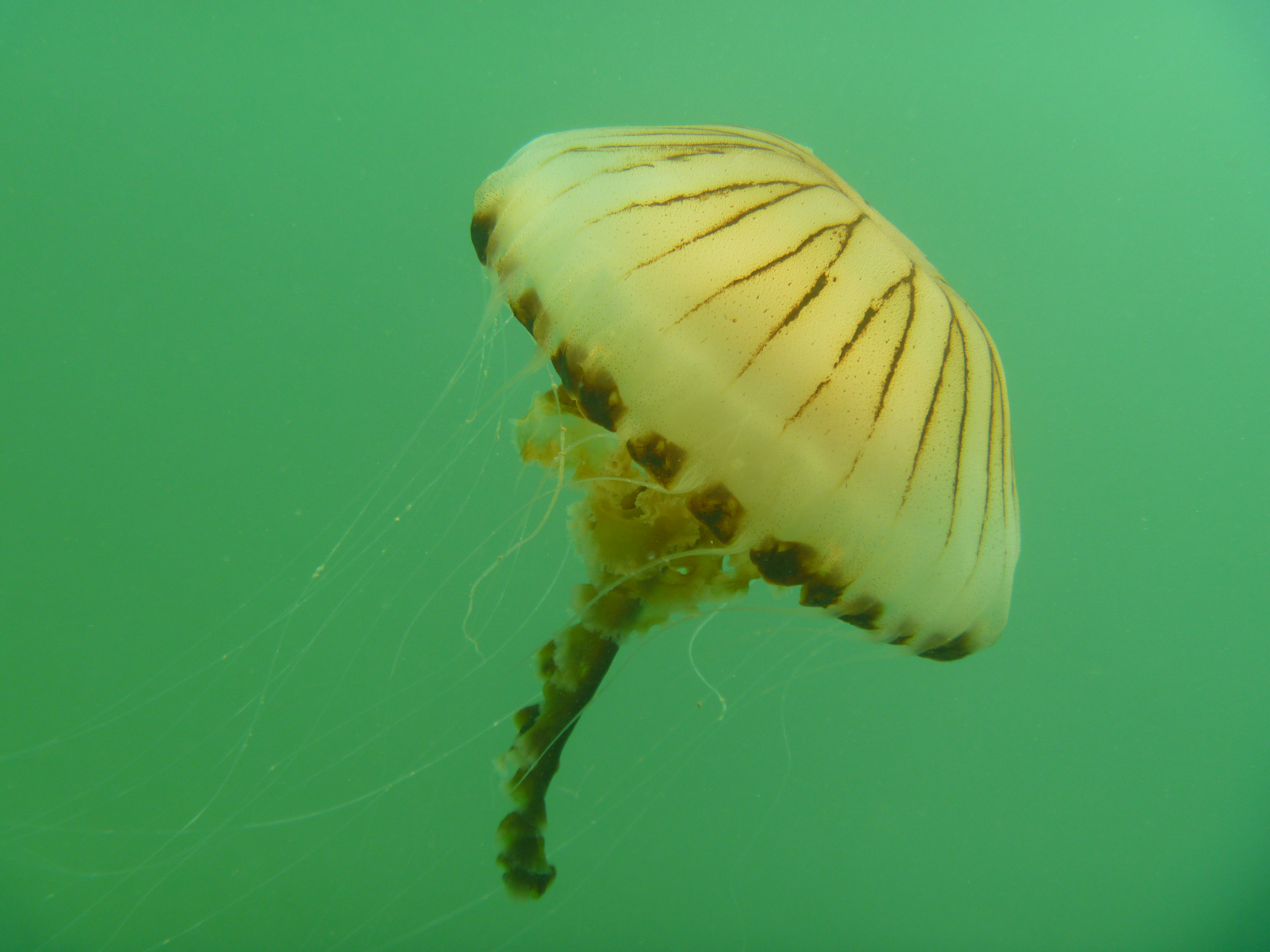
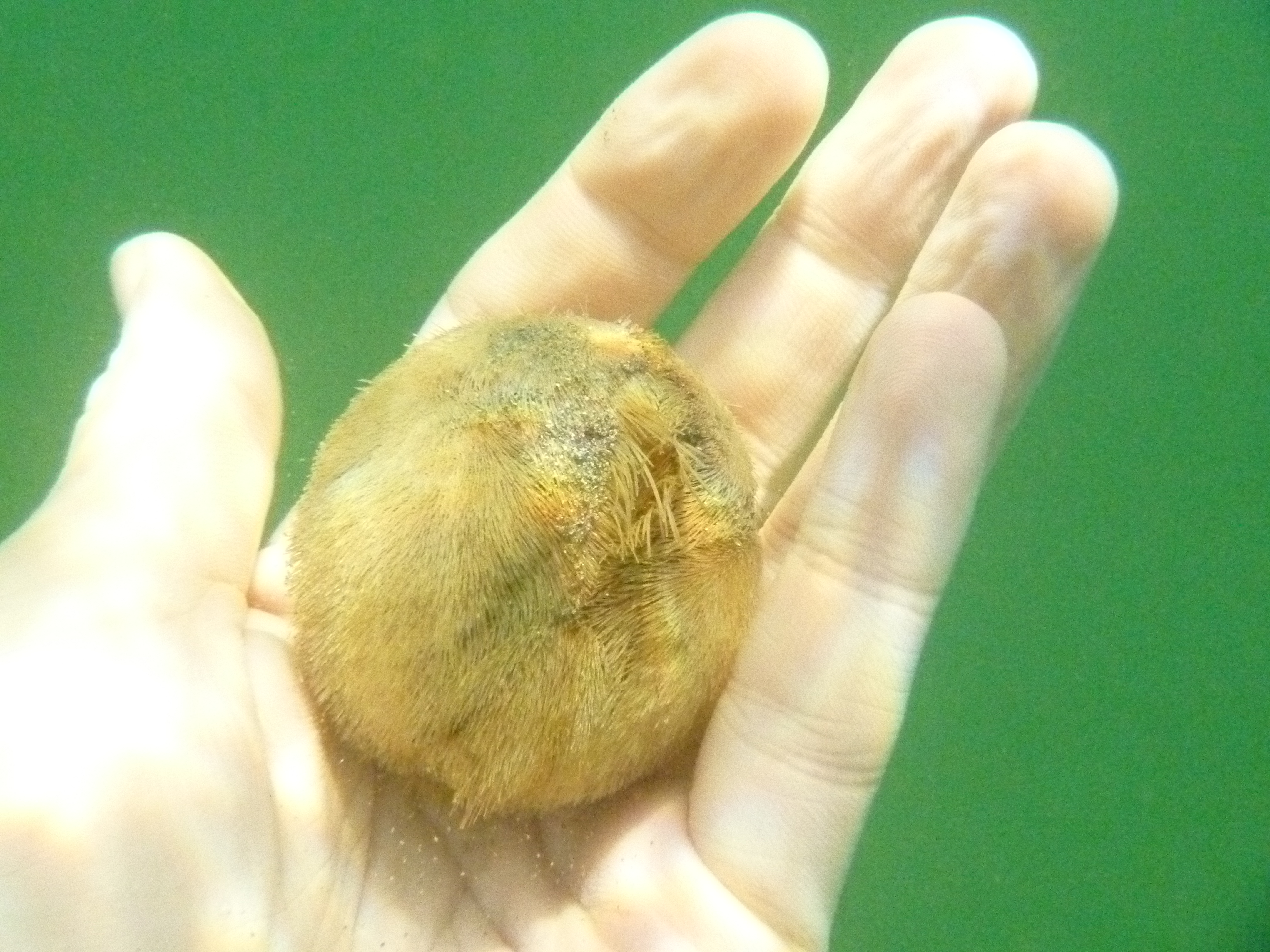
 This time we swam out a bit further, over the sandy bottom which seems quite lifeless compared to the rocky kelp forest. However, the fauna is very different here so it was definitely worth it. I found my first Sea potato Echinocardium cordatum (about to be eaten by a Spider crab). Near the buoys, at around nine meters depth or so there was (sparse) seagrass. Back on the beach I noticed that my lumix camera was flooded. I was somehow convinced that it could go up to ten meters deep but actually the sticker on it quite clearly stated that it was waterproof only up until three meters….Ah well, I will have to switch back to my Canon Powershot with waterproof case then.
 *= From the facebook group NE Atlantic Cnidaria: “A. forskalea : up to ca 120 marginal tentacles, usually fewer than the radial canals but ranging from half to twice as many; radial canals 60-80; max diameter ca 175mm” and for A. vitrina: “60-100 marginal tentacles, three or more times the number of radial canals; radial canals 60-100; max diameter ca 100-170mm”.
two great encounters
Another snorkeling post. Last weekend off Gylly Beach and without a wet suit (sea water temperature close to 20C now!). Plenty of fish about, with my first snorkel sightings of Sea bass Dicentrachus labrax and small groups of Red mullet Mullus surmeletus. Much to my surpise I also spotted a Cuttlefish Sepia officinalis half hiding between dead seaweed drifting in the shallows. It was not particularly scared and stayed put while I swam around it but after a while it let out a squirt of ink and moved on. Of course this was just when I did not bring my lumix camera, so the next day I went back and luckily it was in exactly the same spot: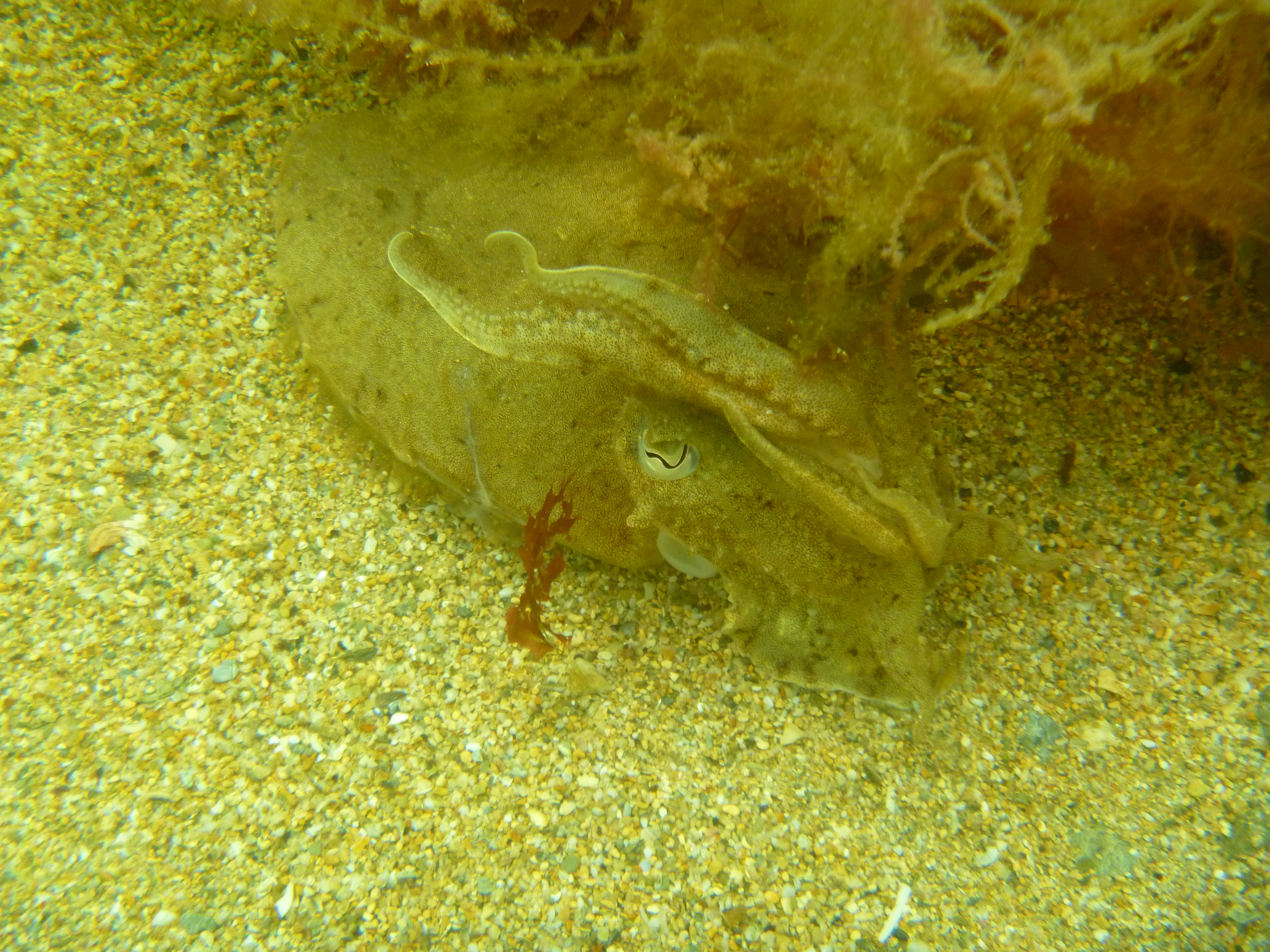 It did not end there. I next spotted a beautiful Blue jellyfish Cyanea lamarckii gently pulsating through the water column. Inbetween the tentacles three tiny fish were hiding, most probably juvenile Horse mackerel Trachurus trachurus: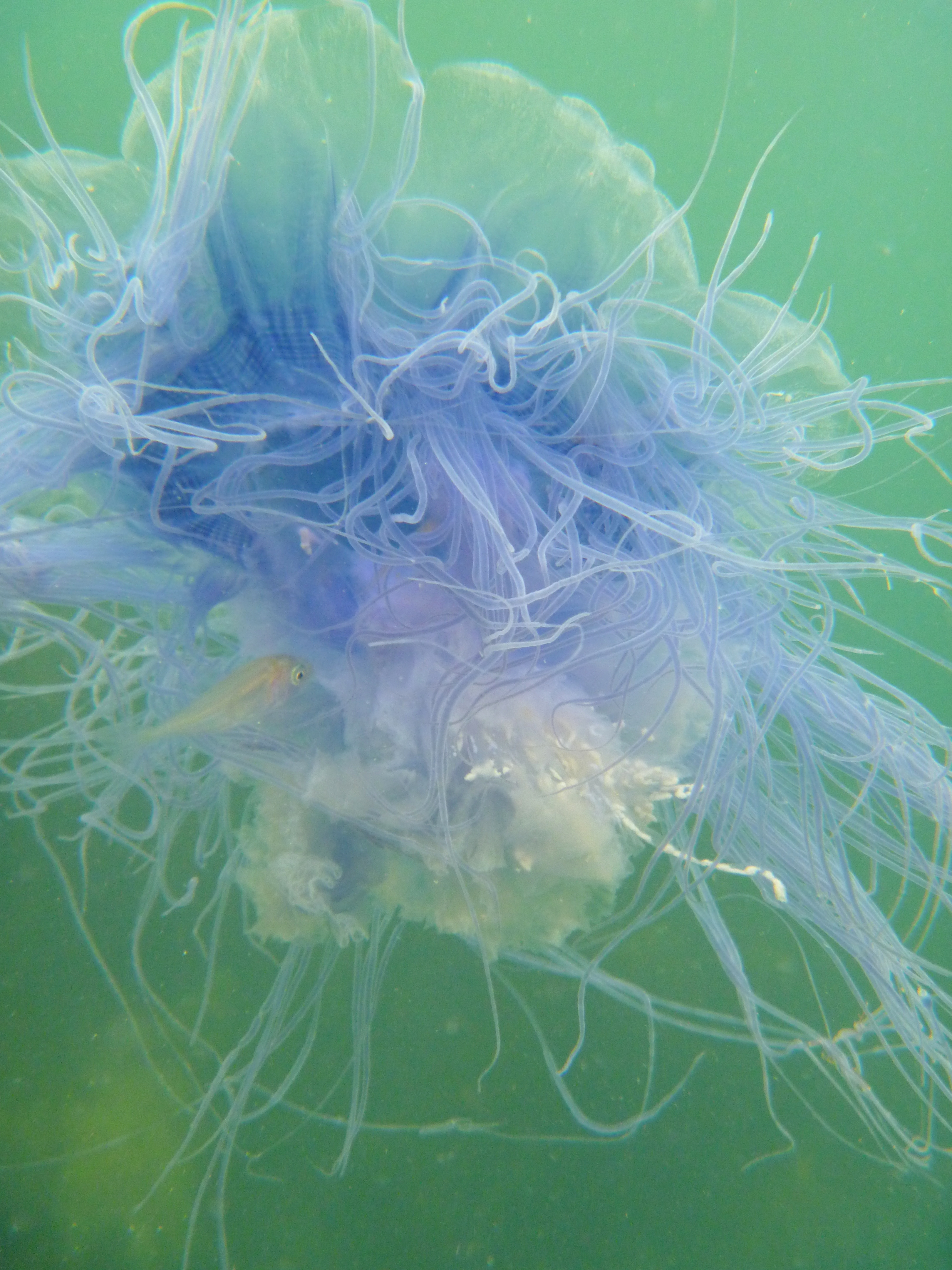
Snorkelling at Silver Steps Part I
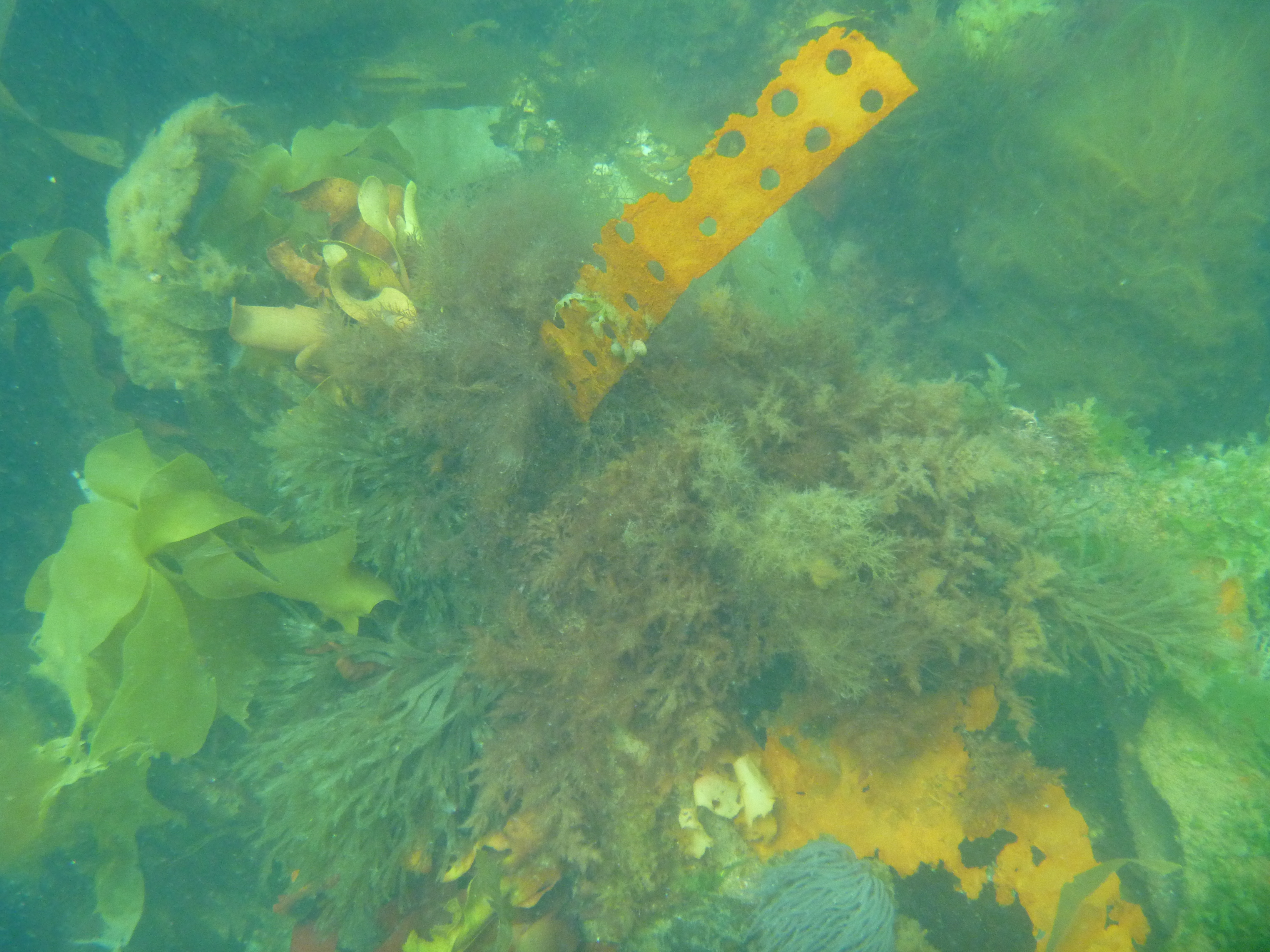
High time for a snorkel, and few better places in the area than ‘Silver Steps’, between Castle Beach and Pendennis Point in Falmouth. I took my little Lumix camera (goes up to 10 meters deep, no optical zoom) with me to take some sub-standard pics (all other photos on the blog are taken with my iPhone). This site is a mix of rocks covered in kelp and gravel and even the remains of two U-Boats (they are no longer recognisable as such though, see here for more specifics on these and other wrecks off Falmouth). There is always something to see: schools of Smelt chased by Sand eels, hovering Two-spotted gobies, Corkwing and Ballan wrasse, Spiny starfish and loads of seaweeds. In fact, there was so much to see that I have divided the pictures over two posts. First a photo of the site and some of the U-Boat wreckage: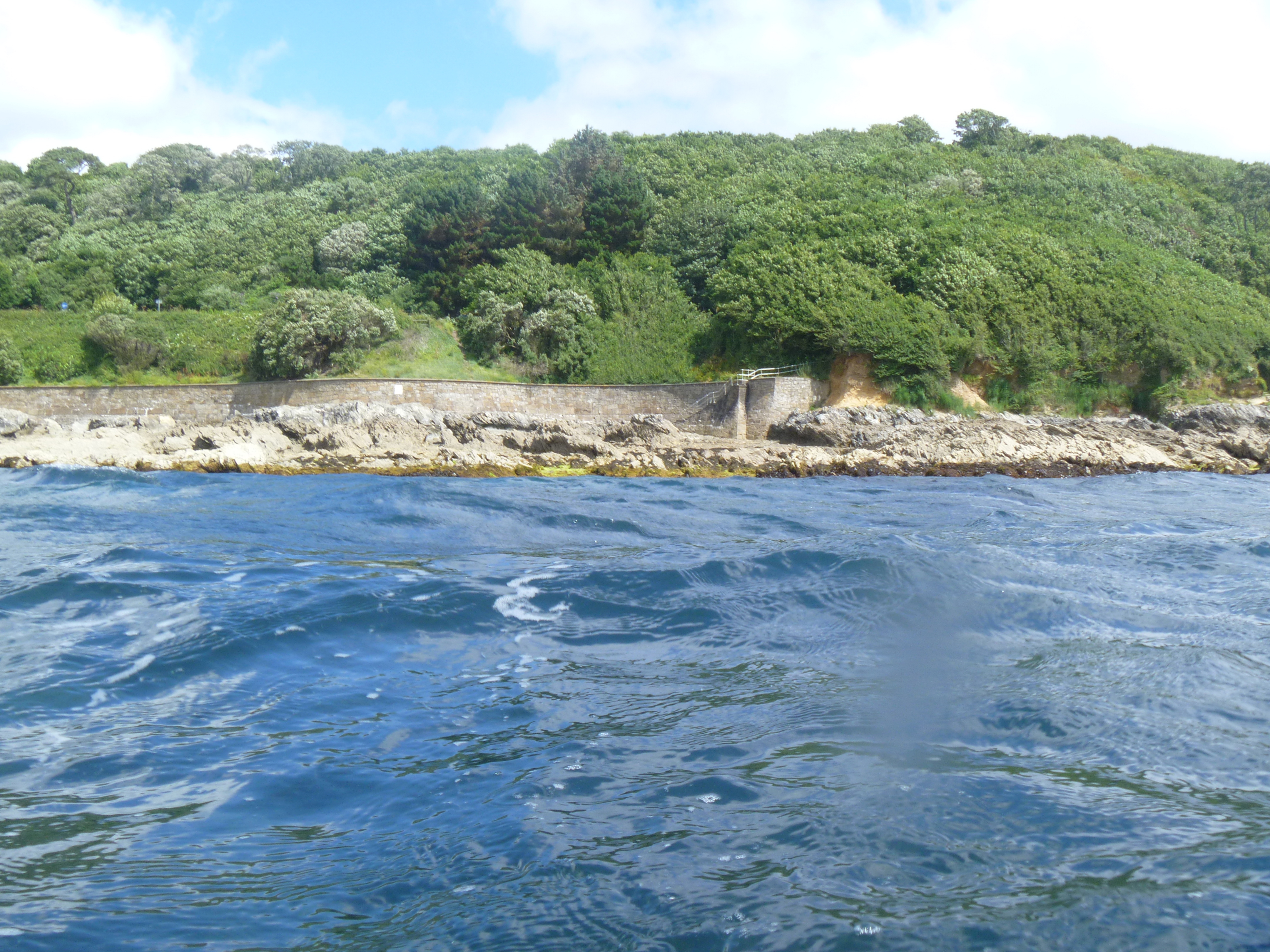
 We were in for a nice surprise: a good-sized John Dory Zeus faber at around seven meters depth. I have posted a very nice picture from my first and only dive in Cornwall courtesy of Charlotte Sams, but here a short, jittery video as well:
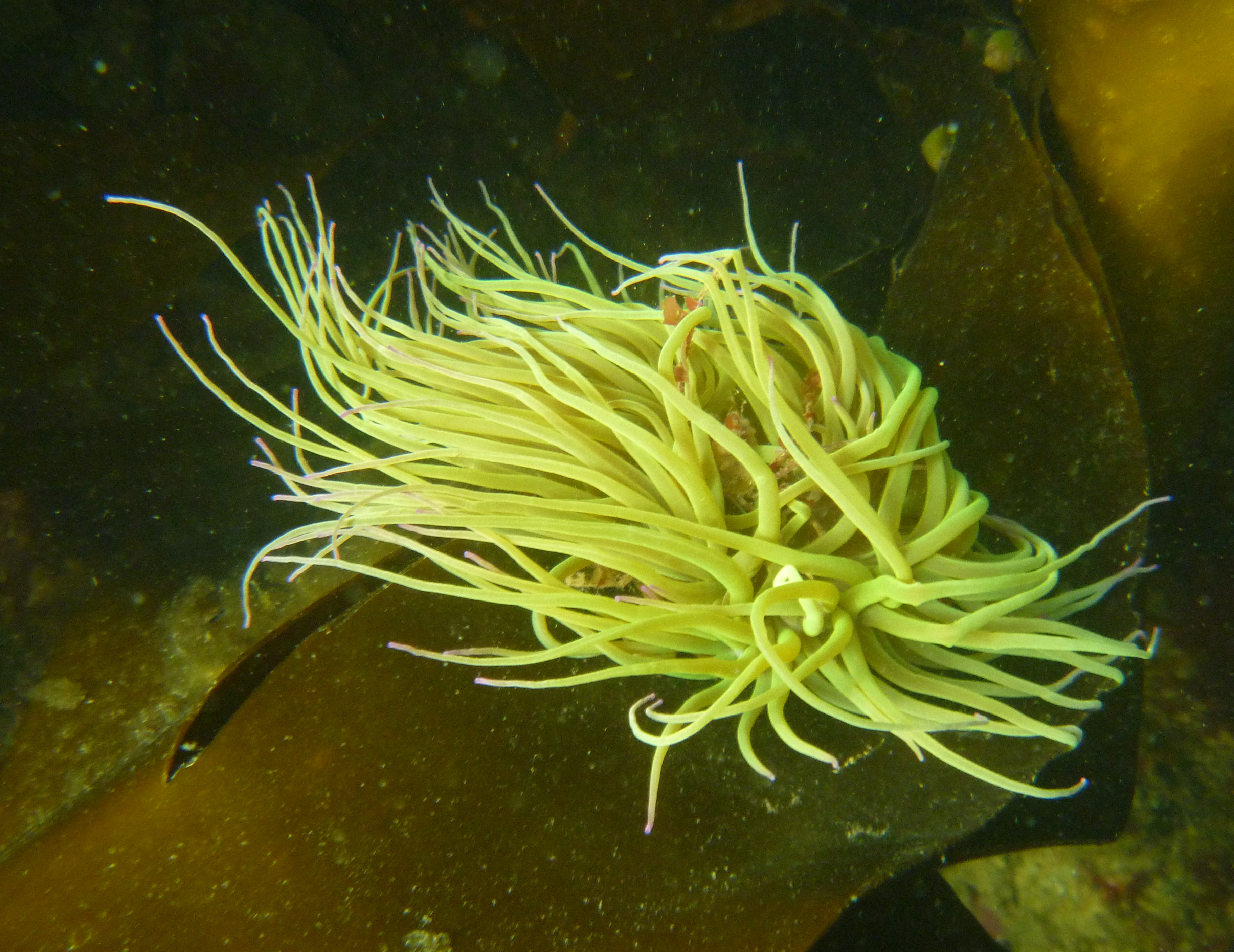
Anyway, a perhaps even nicer find were Leopard-spotted gobies Thorogobius ephippiatus. Some sources make it seem like this is a rare species only ever encountered by divers, but it is actually not uncommon and we saw them at two meters down (the tide was low though). It is a shy species that lives under ledges, burying between the rock and the gravel. The picture is crap but also proof I am not lying. The next picture is of a Tompot blenny Parablennius gattorugine peeking from a crack in the rocks. Large snakelocks anemones are everywhere on the kelp, and although a month ago I saw none, many of them again housed commensal Leach’s spider crabs Inachus phalangium. (These anemones and crabs do well in the aquarium btw, see here.) It would be interesting to know if these crabs arrive from deeper waters or just grow up really fast.
Cornish Coral
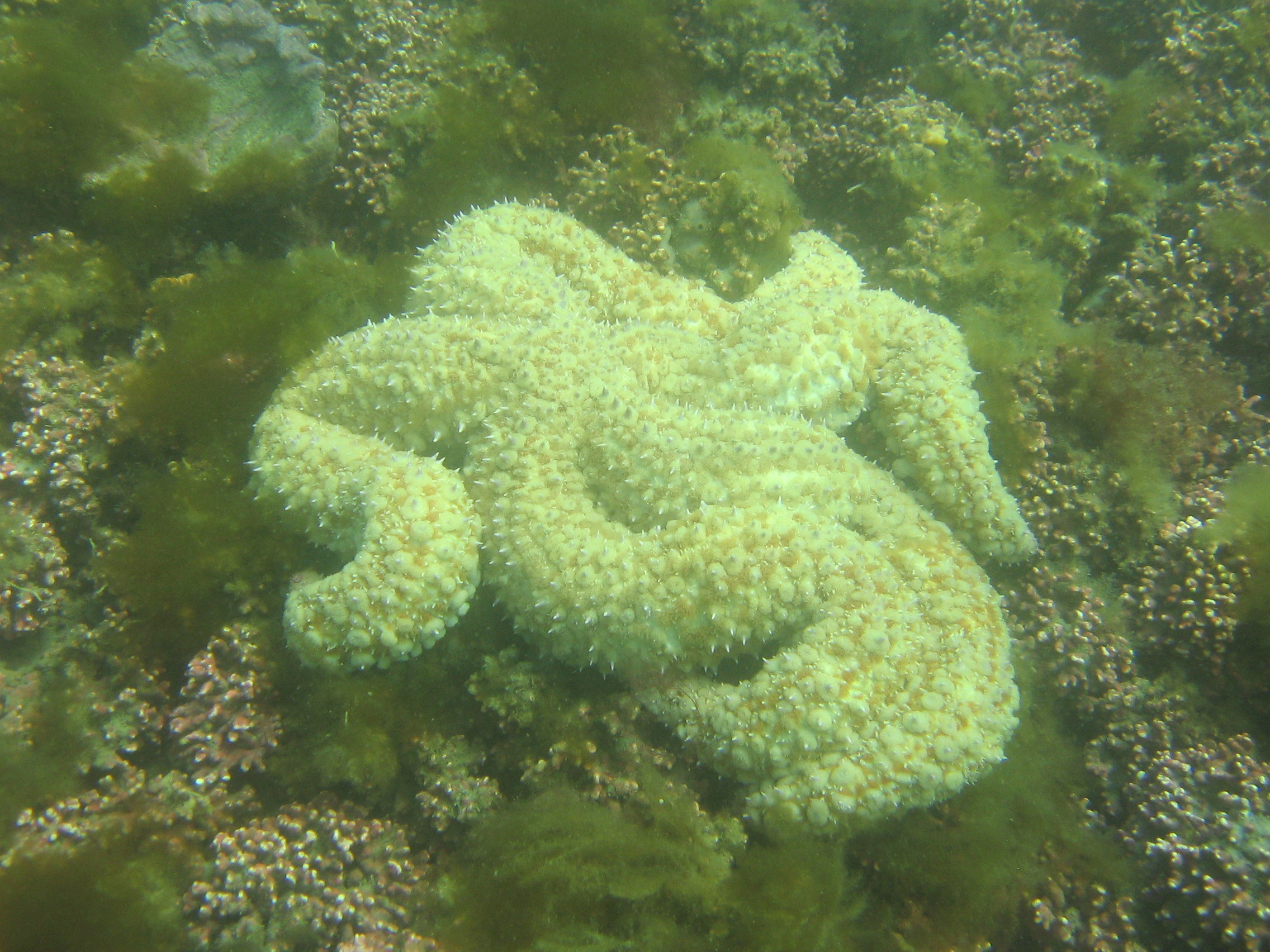
A couple of weeks back I went for a boat trip and snorkel over Maerl beds with friends on the other side of the Fal Estuary, just north of St. Mawes. I did not post about it at the time, as my photographs were quite crap and I reckoned I could go back to try and come home with something better. However, there hasn’t been any time for that, nor will there be in the near future, and as it was such a cool experience I reckoned it would be nice to write a little post about it for now anyway. The beach was fringed with sea grass, but the Maerl beds started very near the coast, at around two meters depth at low tide. Maerl is something special; it must have taken early biologists a while to figure out whether it was mineral, animal or plant. It is actually a calcareous alga that (very slowly) grows in fist-sized nodules or thalli. The Fal and Helford estuaries are one of the few places in the country where it occurs, and the Maerl beds here are under threat of dredging. Although Falmouth has the third deepest natural harbour in the world, big cruise ships cannot land close to the town centre which makes it unattractive for ships to stop. Falmouth would be a very pretty last port of call sailing west and cruise ships are of course good for business, hence the dredging plans. I will save the debate on economy versus conservation for a future post, as it will require a lot more text. I was able to take some pictures of the Maerl with my old Canon Powershot in plastic housing before the new batteries decided to quit on me prematurely: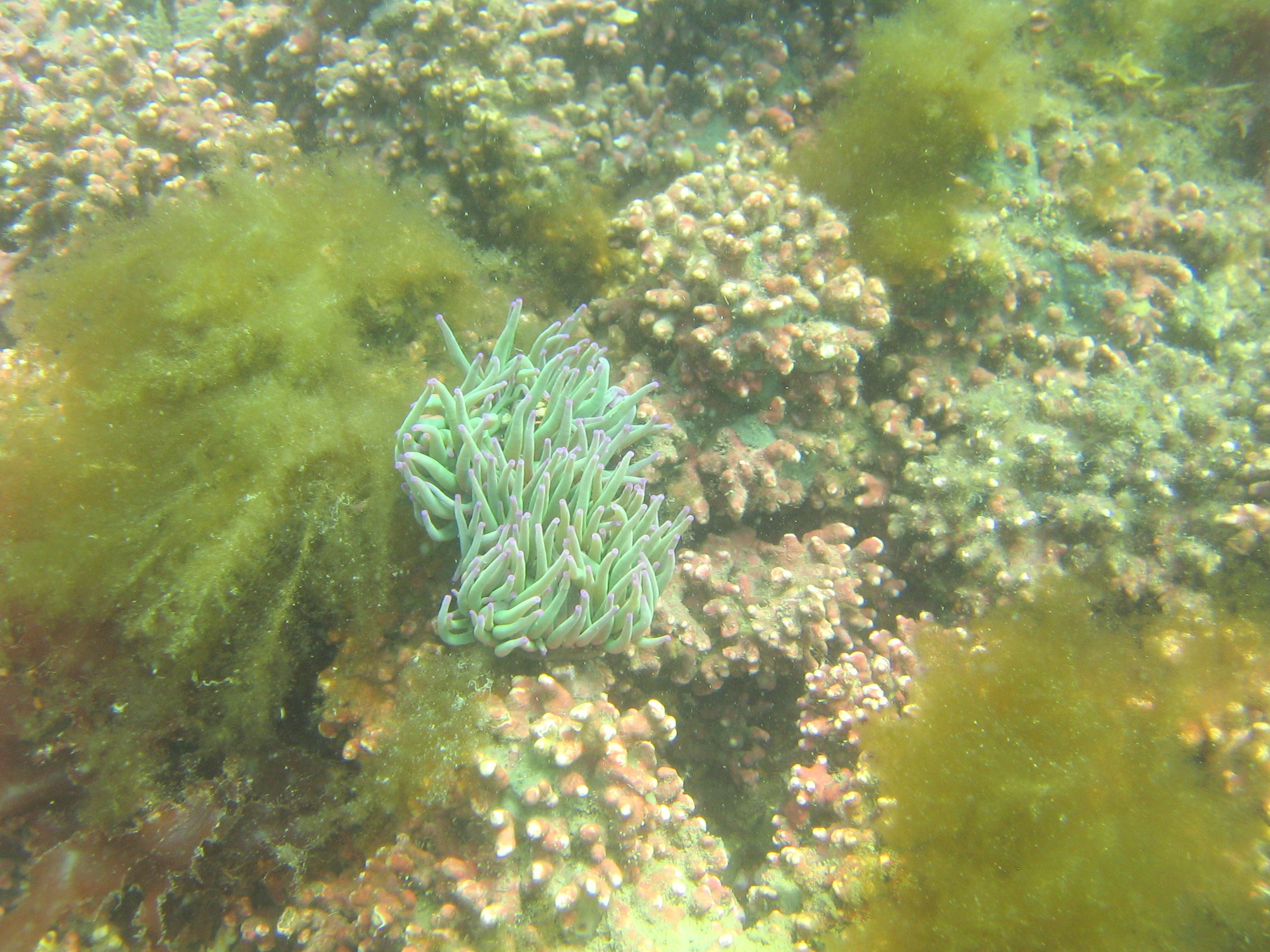 As you can see the Maerl really looks more like a coral than a seaweed (and dead pieces of Maerl form a type of coral sand, see here and here). It provides an ideal structured habitat for all kinds of organisms to live in and on (for instance fine seaweeds and snakelocks anemones). Besides various fish, crabs and sponges and small things darting to safety in general, we saw a big hermit crab in a Buccinum undatum shell with the large anemone Calliactis parasitica on top. Very cool, and apparently not very commonly encountered (this was of course after my batteries had run out). What was striking as well, were the very large (one of them measured half a meter across), very fat and very pale Spiny starfish Marthasterias glacialis:
 Maerl with a sponge growing through it (or possibly the other way around):
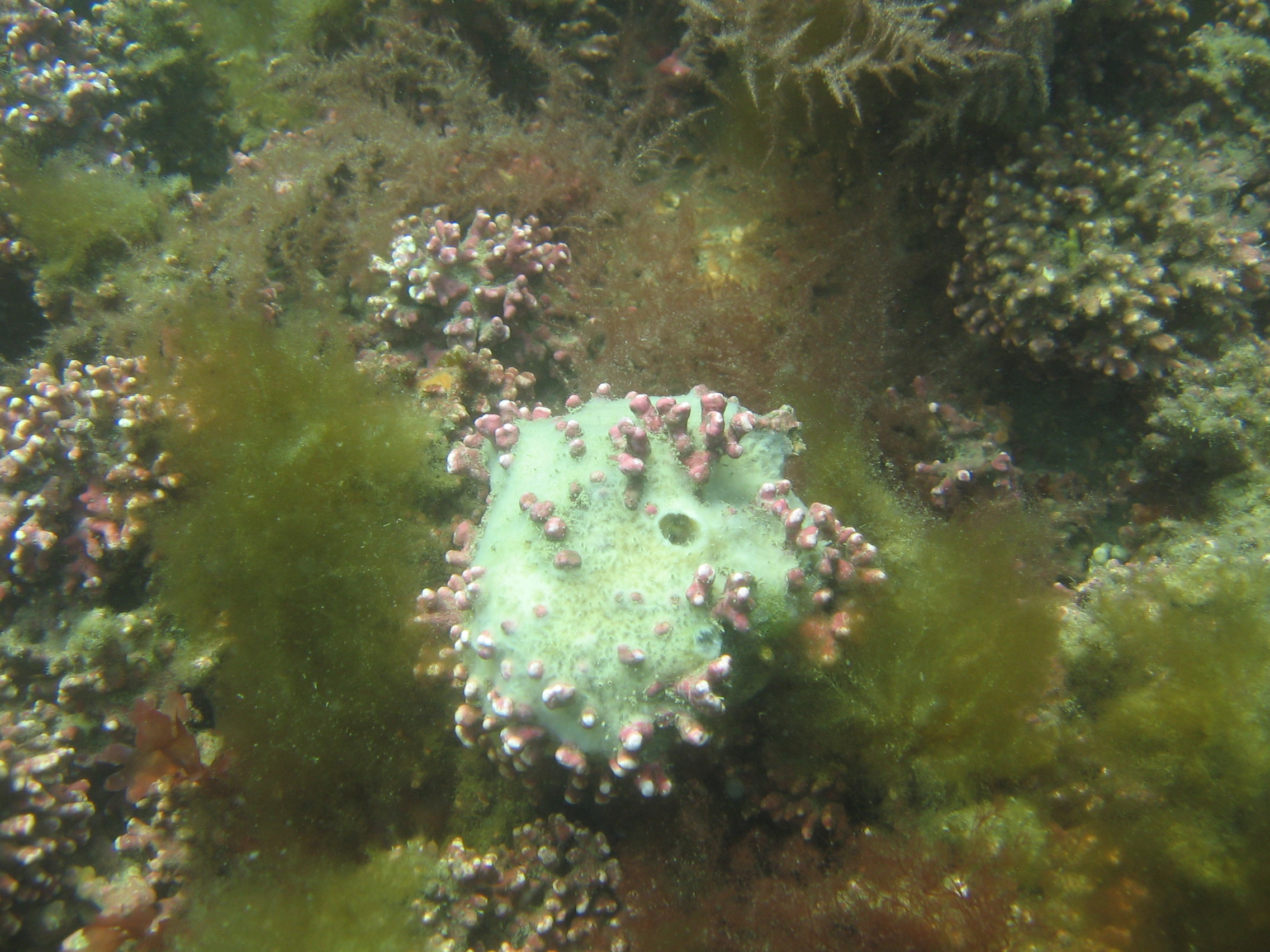 Maerl is protected, so not an option for the aquarium, although I am sure it would make for a fantastic looking display (moreover potentially a very stable display as Maerl is not seasonal but grows for centuries). Hopefully more and better pictures later this year!
snorkeling at pendennis point
The sun was shining this weekend and the sea water is currently at its warmest so we went out for a bit of snorkeling off Pendennis Point in Falmouth. My experience with the iPhone waterproof case was not that good, so I took my Panasonic Lumix (DMC-FT10) along (which is not too great either!). The seaweeds are dying off mostly; the kelp is covered by bryozoans and hydroids to the point that they are completely fuzzy:
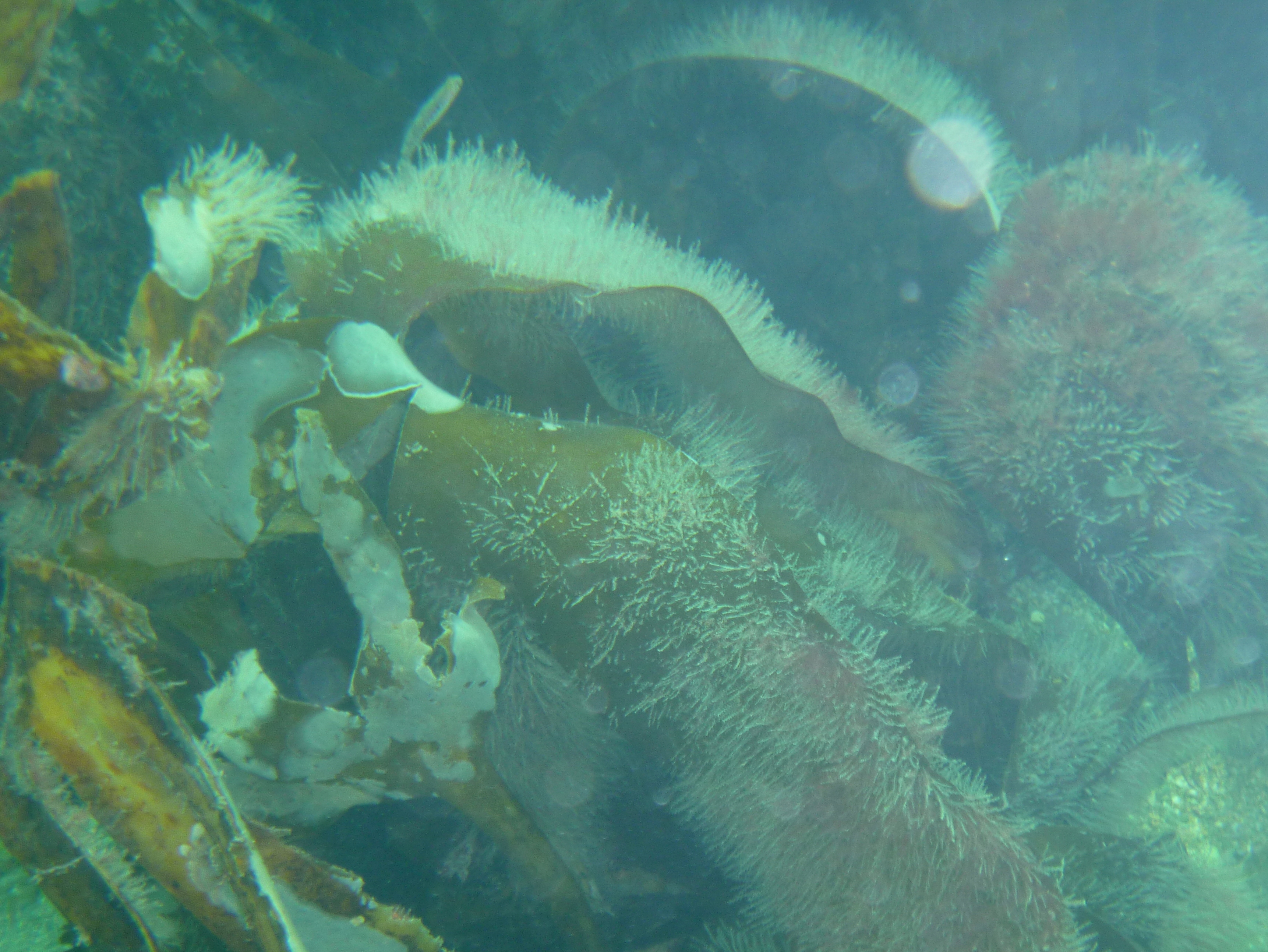
I mentioned in the previous post that the Spiny starfish Marthasterias glacialis was common in rock pools; bigger ones can be found when snorkeling:
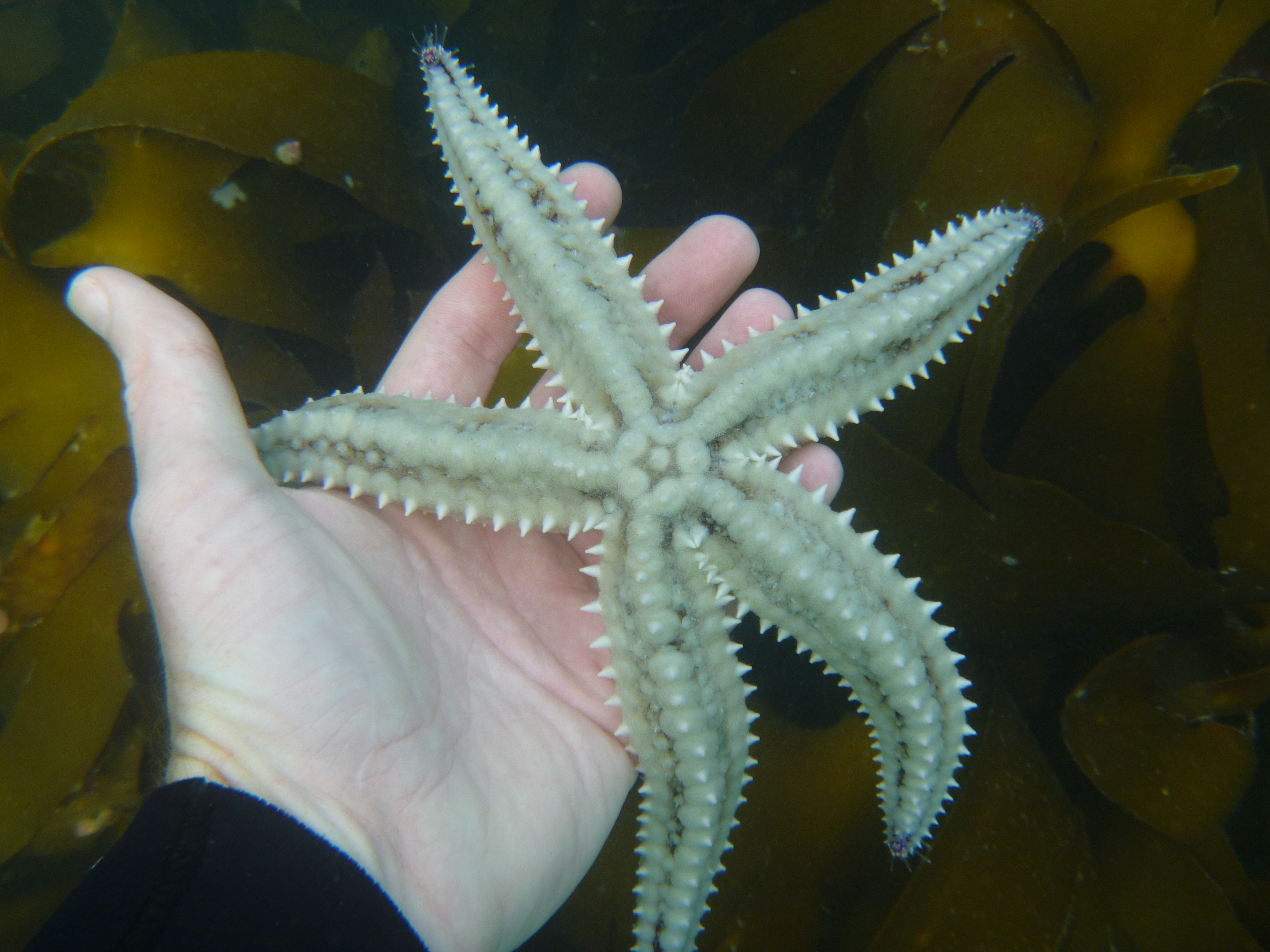
Big Snakelocks anemones Anemonia viridis were everywhere and perhaps half of them had a little Leach’s spider crab Inachus phalangium associated with them. Wikipedia tells me that these crabs eat the anemones’ leftover food and also their mucus:
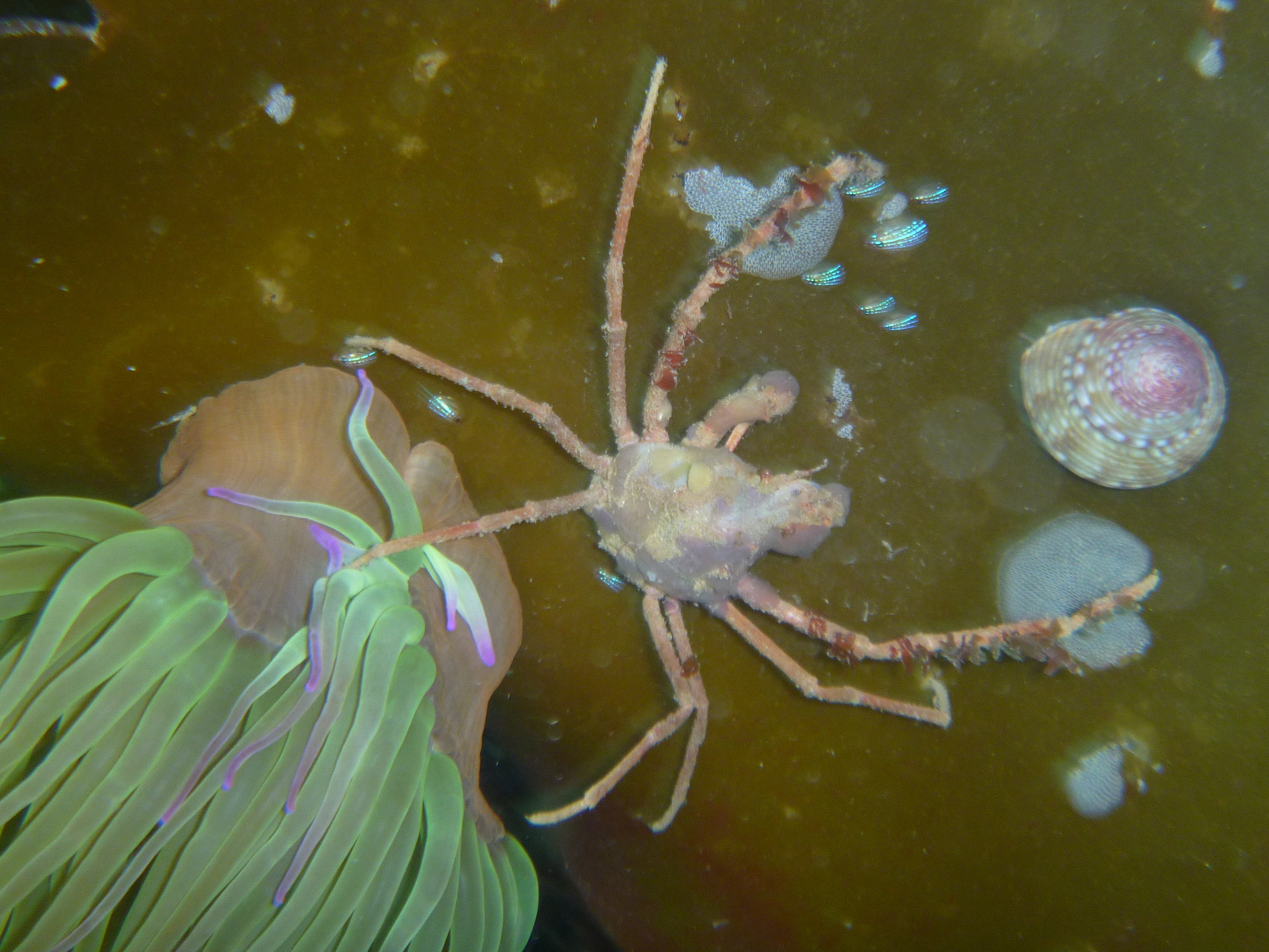
This hour of snorkeling gave me some inspiration for a new aquarium set-up: less seaweeds (specifically less dying seaweeds clogging up the filter and releasing nutrients) and more rocks. On top of these a couple of big snakelocks with spider crabs and some Two-spotted gobies Gobiusculus flavescens. The latter are very common and pretty. I will have to catch them underwater with a net though, which will probably be difficult…
Two starfish videos
I have started a youtube ‘An Bollenessor’ account to be able to embed some of my short iPhone videos here*. First my favourite the Cushion star Asterina gibbosa. My aquarium is more or less empty at the moment, but I still have five of these around. A short movie made with my olloclip macrolens showing how these little starfish move about using their tube feet:
I went out snorkeling yesterday in the mouth of the Helford river (in the rain). A very beautiful spot, I’ll post some pictures of it when I am back and it is sunny. It was high tide and the visibility was bad so I had to dive five meters or so to have a closer look at the Seagrass. I did not see that much but I did spot a Sand star Astropecten irregularis for the very first time. A very beautiful starfish with purple tips and very long tube feet. I took it home and placed it in the aquarium, after which it did what it does best: digging itself in:
*= I use Microsoft Moviemaker to upload files, so had to use my Microsoft account in addition to my Google account, a bit of a hassle. Anyway, it should be easier next time now everything has been set up. For the next videos I will make sure to clean the glass. I probably also should buy a gorillapod to keep my phone still.
Prussia Cove
We went to check out Prussia Cove (named after ‘the king of Prussia’ John Carter who used it as his smuggling base in the 18th century) this weekend for some snorkeling action:
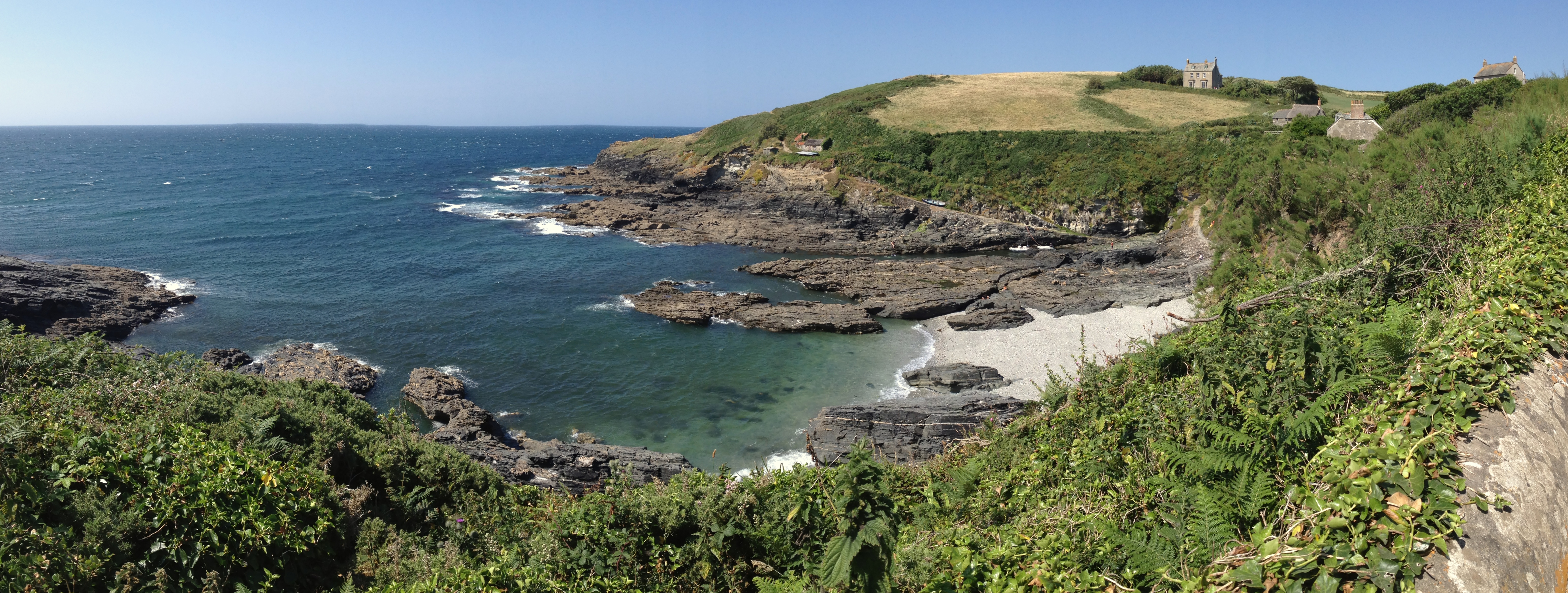
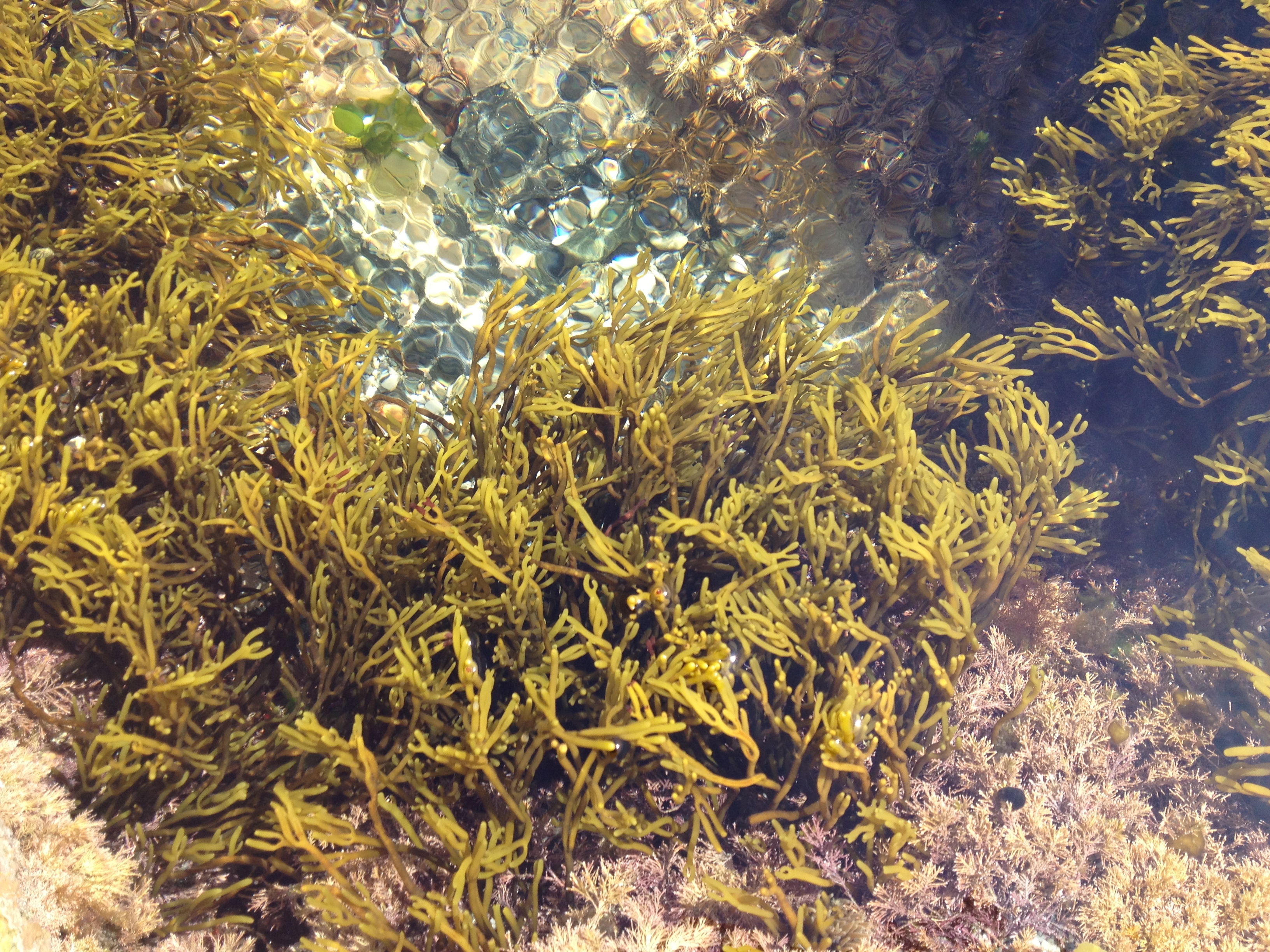
The weather was great but there was quite a lot of wind and so the water was choppy and the visibility really bad. We saw hardly any fish. The seaweeds consisted mainly of the common Thong weed Himanthalia elongata and Bushy berry wrack Cystoseira baccata. There were not many rock pools. The only interesting find there was the pretty Brown tuning fork weed Bifurcaria bifurcata:
taking my iPhone underwater
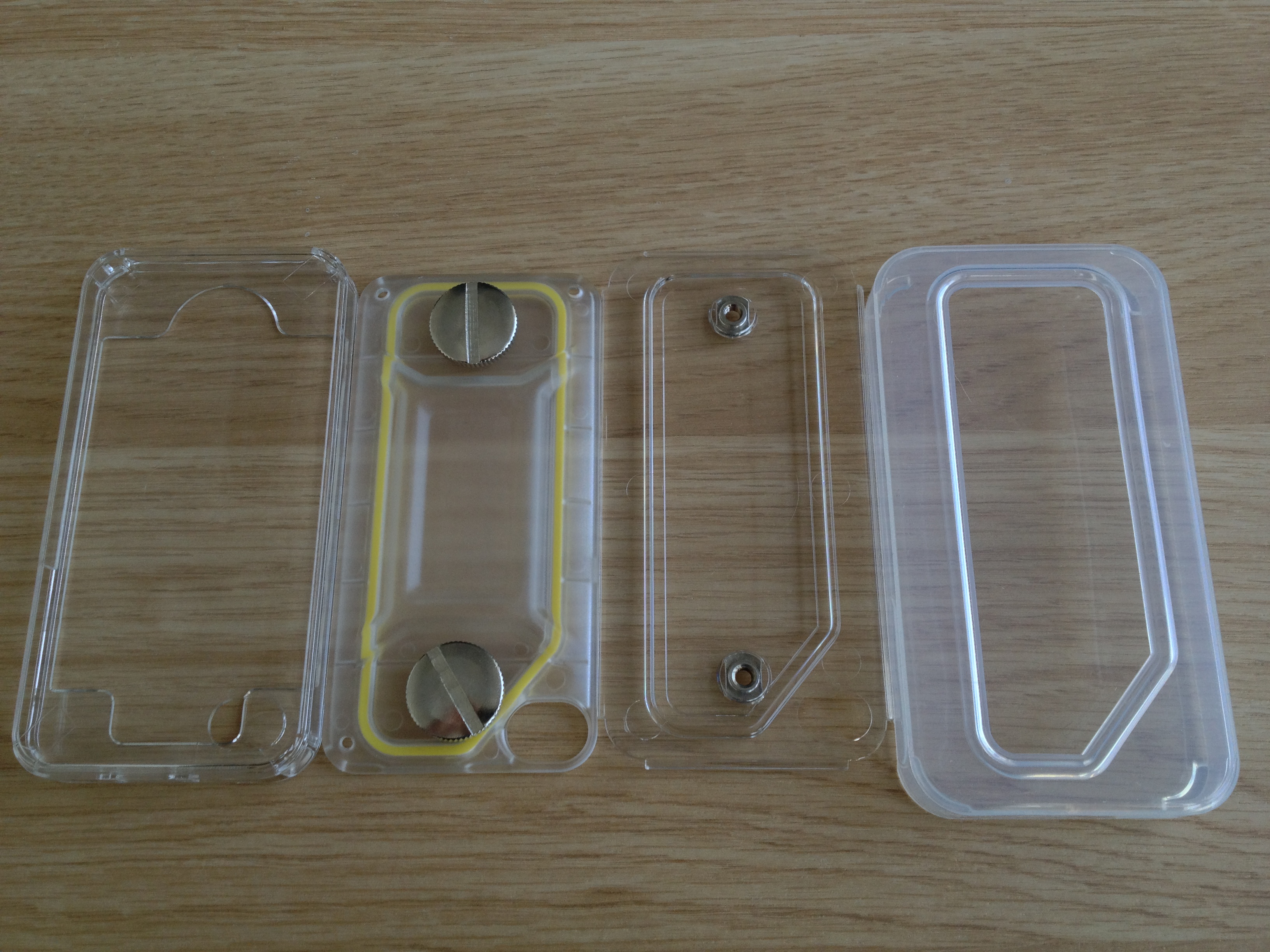
Two weeks ago I went snorkeling with colleague Chris (his hands can be seen in a picture in the previous post) as we figured making a pact would speed up the process of getting in the water. Spring has been so-so and sticking your head beneath the surface was a bit painful but in the end we stayed in for 45 minutes or so. Unfortunately the visibility was very bad. The sea was almost like a soup: you could feel the algae streaming down your face. However, lots of small jellyfish could be seen and occasionally a wrasse darting off. In slightly deeper water, the seaweeds were dominated by Oarweed or Tangle Laminaria digitata. Seaweed diversity seemed much higher in the shallows and the bright light green of the Sea lettuce, the pink of the Harpoon weed and the blue of the Bushy rainbow wrack looked quite amazing. Last week I went back by myself during a lunch break with the audacious plan of taking some underwater pictures with my iPhone. There are quite a lot of (cheap) underwater housings for iPhones nowadays of which I had bought one recently (the ‘amphibian waterproof case’). I tried it out holding it under a tap with distilled water (if it would leak there would not be any damaging salts at least) and that seemed to work. I later saw a patch of moisture but this was minimal condensation that did not seem to any harm. The case:
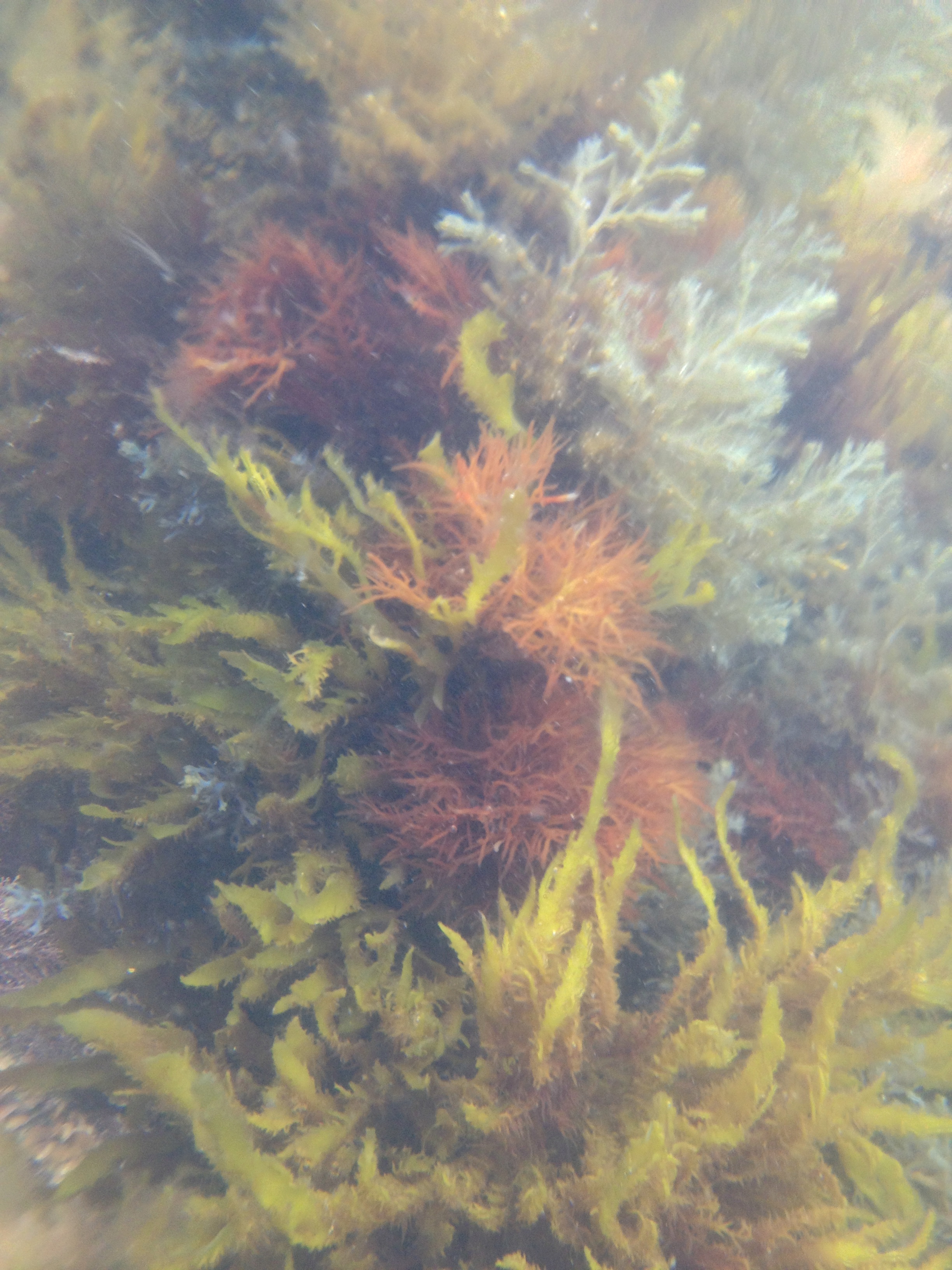
 The water seemed quite a bit less cold the second time around and the visibility was slightly better as well. However, Castle beach is exposed and the wave action results in a lot of debris (such as pieces of dead seaweed). Also, it seemed that some of the seaweeds were already ‘over the hill’; the Harpoon weed often seemed discolored for instance and not that pretty anymore. I have noticed the proliferation and die back of some seaweeds before and it makes sense that there is some seasonal succession (I will keep tabs on the growth of the different species month-by-month in an excel spreadsheet). It should have come as no surprise that my plan of taking crisp, brightly colored underwater pictures with my iPhone in a flimsy case turned out to result in blurry, out of focus and badly composed shots, but it was still a bit disappointing. Some of the least crap ones:
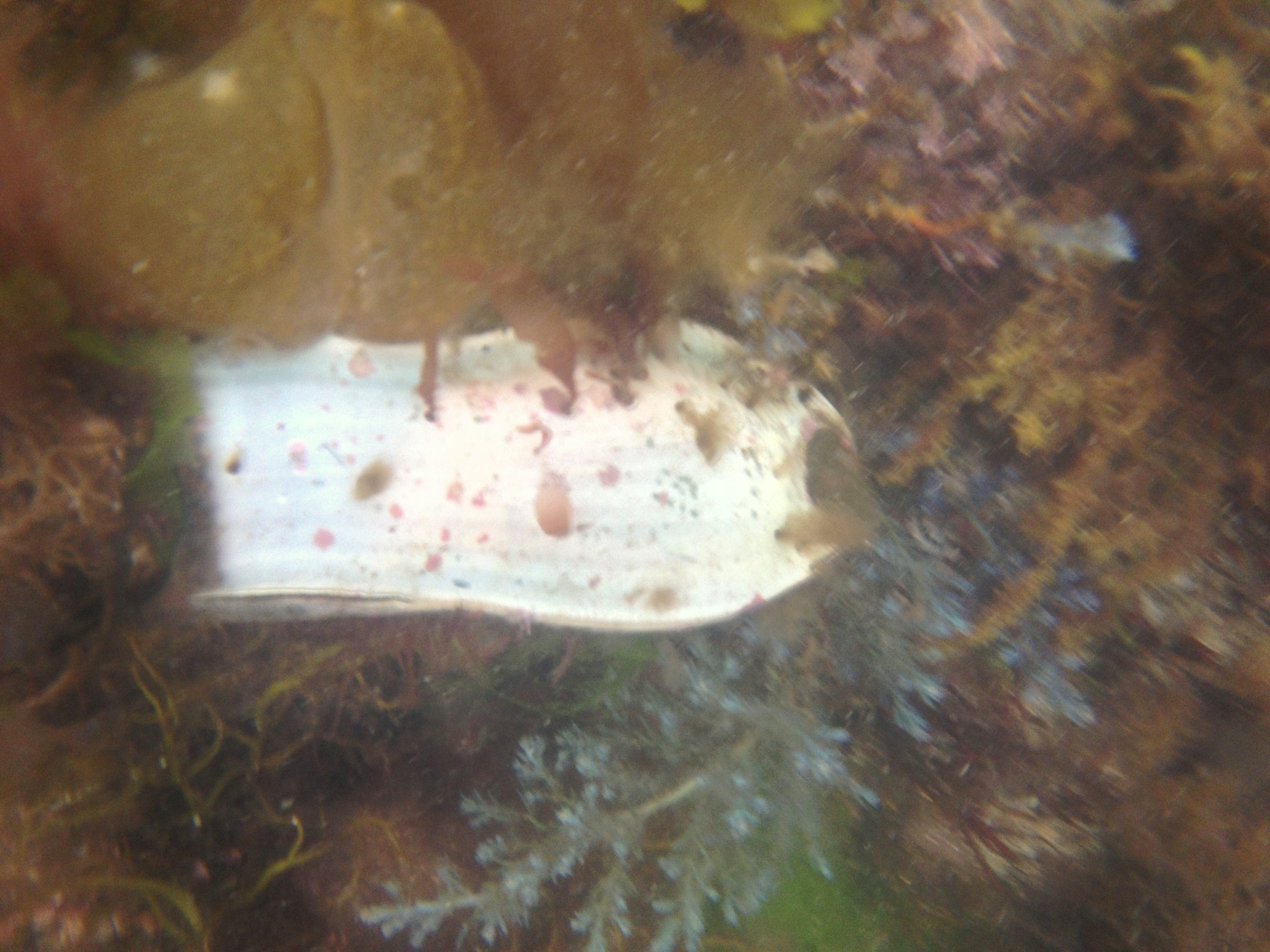
It was quite neat to sea mermaids purses (ray or shark egg cases): bright white and fat (i.e. alive) instead of the black and empty wrinkled ones you find on the beach. I have no idea what species they are but they seemed relatively common and I only found them attached to my favorite, the Bushy rainbow wrack Cystoseira tamariscifolia. *edit, most probably eggs of the Nursehound (or Bull huss) Scyliorhinus stellaris.* I also tried some quick shots in the rock pools as the water is more clear there, but the pictures did not turn out to be too great in there either:
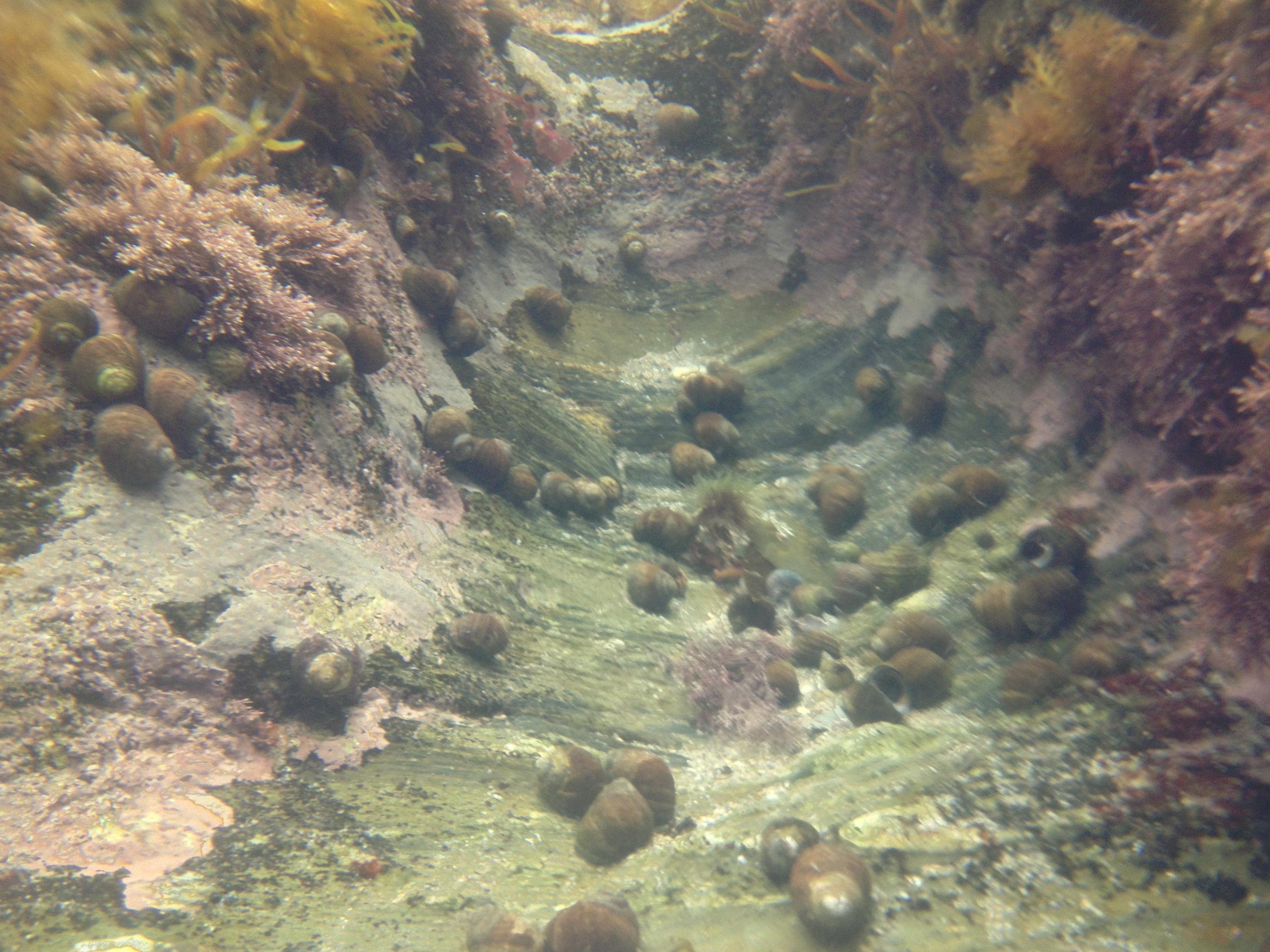 Although quite cheap and -knock on wood- safe, the iPhone case is not a substitute for a real underwater camera. All pictures turned out quite hazy (although this was certainly also due to the bad water conditions). At times it is hard to operate the touch pad and there isn’t a cord to attach it to your wrist which makes the experience a bit less relaxed. I have a Panasonic Lumix that can go 10 meters deep and an old Canon Powershot with an underwater housing which seem to do better (although neither of them in turn can be compared to a SLR in an underwater housing). I will try to explicitly compare some shots with these cameras soon. Next time I go snorkeling I will also try a less exposed spot where visibility will hopefully be better.
 An Bollenessor