Some Silver Steps Molluscs

After posting about the fish and crustaceans of my local dive site Silver Steps in Falmouth, it is time to give molluscs some love! The photos in this post were all taken at 5-10 meter depth at a gravelly bottom this year. Above (and at the end) the Turban Topshell (Gibbula magus) which is common subtidally. However, this was the first time I noticed that they have pretty sky-blue eyes! It is one of my challenges to take a pic of it with both eyes in the frame next year. Below, another favourite species of mine: the Pheasant Shell (Tricolia picta, previously P. pullus). This was a large individual (close to a centimetre?) with a candy cane striped pattern that I’d never seen before.
Next up a juvenile European Stingwinkle (Ocenebra erinaceus) on top of a Saddle Oyster and the Common Keyhole Limpet (Diodora graeca). The latter might be called ‘common’ but I do not see it very often. Going from the Gastropods to the Bivalves: a King Scallop (Pecten maximus) with its many eyes. Moving to yet another Mollusc Class: meet the Cephalopod Common Cuttlefish (Sepia officinalis). This was a very large individual covered in many small white lesions, probably near the end of its life. It was fine in my presence and let me take some photos. It is sometimes strange to think that these intelligent creatures are more closely related to a clam than to a fish! Some bonus photos at the end.

Seagrass Macro

Polycera quadrilineata

I had a couple of good snorkels at the end of summer in the seagrass beds off my local beach in Flushing. The water at the end of summer is warm enough to go without wetsuit – I just had a weightbelt to let me sink down on the sand at low tide, no fins needed. I managed to do what I normally find very difficult: spot nudibranchs! Mainly one of the more common species, Polycera quadrilineata, but that was fine by me, as they are very beautiful, especially the black colour morph pictured above. I spotted one other species, the egg-eating Favorinus branchialis (with its own eggs also visible). Not great photos, but in my defense they are very small!

Shelled molluscs are easier to find. Below 1) the ubiquitous Grey Topshell Steromphala cinerarea, 2) the Grooved Topshell Jujubinus striatus and 3) the tiny Rissoa membranacea (faecal pellets on show, even within the shell). The latter two species are strongly associated with seagrass.

Some assorted macro photos below and at the end a view at a very low tide of the Flushing seagrass site this October.

life on a chain

The rain has been hammering down and I am in accute underwater withdrawal… Just a bit of the ole bloggin then! These are some pictures from April, when the phytoplankton had not kicked in and the water was still quite blue. Out of curiousity I swam out to the marker buoys off Castle Beach in Falmouth to see if there was anything interesting growing on them. There was! Lots of mussels, including on the chain going down to the bottom (10ish meters deep). I took my fisheye lens and after much adjusting of strobes (holding the housing sideways for portrait mode, and also up, meaning that the lower strobe needed to be pulled back) I got the nice shot above. Mussels are not a favourite of underwaterphotographers (this is an understatement!) but they are beautiful upclose, the white mantle contrasting with the blueish black shell.

A few days later I returned with my probe lens, as i thought this would offer an original perspective. It was a tricky thing to do as this lens lets in very little light. The difference between foreground and background seems slightly off as well! These photos show that the mussels were crawling with the tubedwelling amphipod Jassa marmorata, a prominent fouling species. I planned to return to try again a few days later, but the chains had been replaced by ‘fresh’ ones, bad luck! I will go back to have a look at them as soon as the weather allows it.

P.S. there are two older posts tagged with ‘buoys‘.

Porthkerris

A few weeks back I drove to one of the UKs more well-known divesites, Porthkerris, about 50 minutes away, for two dives. I had only been there once before, also for two dives (not worth going all the way for just the one) when I did my PADI Advanced Open Water (I just realised that I forgot to blog about that at the time…). The pebbly shore here leads to the Drawna Rocks and it is one of the few places in Cornwall that a shoredive can get you a bit deeper than 10 meters (maybe 18 at a high tide). This allows me to see some critters that are not present at my usual haunt Silver Steps in Falmouth. One example is the North Sea Tube Anemone (Synarachnactis lloydii) above. The black pebbles are quite striking, and also a very different background then what I am used to. For the first dive I took my macro lens, as it was quite choppy, and my expectations of the viz were low (which turned out to be correct!). I practiced a bit on the Jewel Anemones (Corynactis viridis) which come in a range of beautiful colours: orange, yellow, pink, white and green. I also took a shot of a Devonshire Cupcoral (Caryophyllia smithii) which is a solitary hard coral and some detail of a boring sponge (Cliona celata), including Rissoa parva snails I later noticed (they are everywhere in the rockpools too).
For the second dive I took my weird probe lens to bother some of the Spiny Lobsters (Palinurus elegans). Finally, a Cottonspinner (Holothuria forskali), what a beaut!

Back to Silver Steps

With the camera housing back, I have been in the water again lately, taking quite a few photos. I am lagging behind with posting quite a bit (this will allow me to post when I cannot get in the water later in the year) but should occasionally maintain the blog over summer, so here is! My local haunt Silver Steps provided during two dives with the macro lens. Above a Twin Fan Worm (Bispira volutacornis). These are quite shy (i.e. they retract into their parchment-like tube when their composite eyes detect a curious diver) but also are attached to cluttered rock walls. To blur this unappealing background, I used a very shallow depth of field (f 2.8); this also has the advantage of letting a lot of light in so ISO can be decreased to 100 – sorry non-photographers!). Below a collage of other ‘usual suspects’ (names under the photos) but ALSO I SPOTTED AN OCTOPUS! Crouched in a crevice and with only a macro lens I could not do it justice but it was still a very nice encounter.

Periwinkles

Long time no post – the idea was to spend time taking photos during spring and summer and enjoy the underwater world vicariously by blogging in autumn and winter. However, something terrible happened on my only dive of 2025: my underwater housing sprung a leak! The housing was not flooded to an extent that it damaged my camera but it needed to be repaired before I could get back underwater. Unfortunately there is only one place that can do that, backscatter all the way in California, and even more unfortunately, U.S. customs decided to keep my package on a shelf for over a month. I have never seen an octopus in my decade of diving but of course people reported eight or so per dive last month so I was feeling very sorry for myself!* Anyway, I have been confined to the shoreline so far. To cope with that, I bought a weird chinese macro-wide angle lens to play with which I will post about later. I also used my ‘normal’ 60mm macro lens (sometimes with a Raynox lens attached to the front for extra magnification) and took some time to focus on periwinkles.

At the top and below a Flat Periwinkle (Littorina obtusata or maybe L. fabialis – distinguishing is very hard as it requires investigating differences in penis shape!). As you can see the locations are not always glamorous, but if you zoom in you can still find beauty!

Flat periwinkles tend to be most active above-water, followed by the smaller Rough Periwinkle (Littorina saxatilis – below) with the Common Periwinkle (Littorina littorea – below that) only occasionally moving about.

Finally, a tiny species the Small Periwinkle (Littorina Melharaphe neritoides). Probably overlooked by most, as it is tiny (up to 8mm, usually smaller) and hidden between barnacles (or even nestled in empty barnacle cases) high on the shore.

* and no, I could not bring myself to go diving without a camera…

A Gray Seaslug

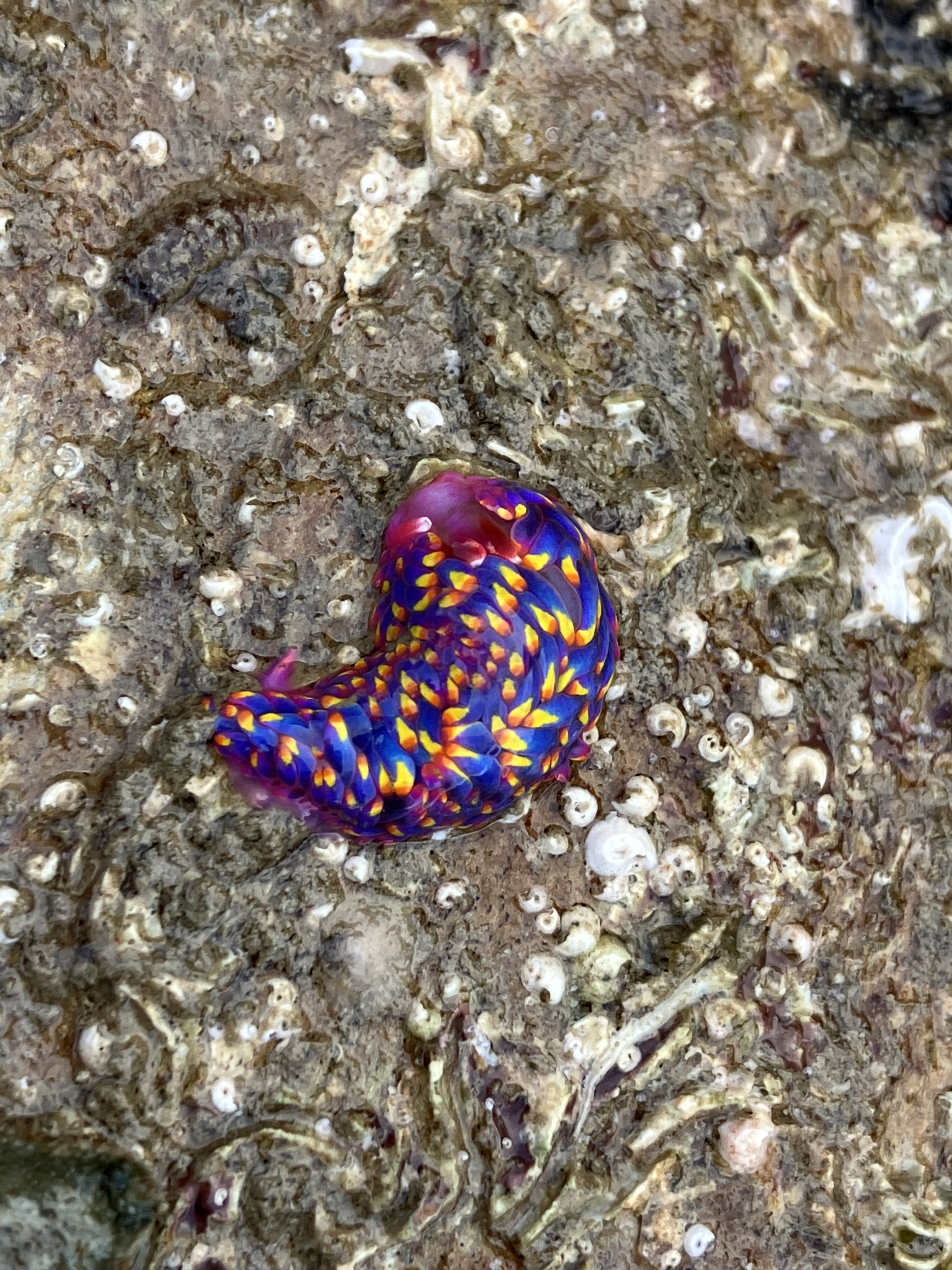
There have been a few finds lately at my local spot in Falmouth (and in other places in Cornwall) of the fantastically coloured Rainbow Slug Babakina anadoni. I have tried in vain so far to find it, but I did manage to find another species of Seaslug last Friday: Aeolidia filomenae. It is the opposite of the Rainbow Slug; large, not small, drab, not extravagant, and common instead of rare. More of an understated beauty I guess, and still a nice find! This species feeds on anemones (mainly Beadlet Anemones but also Snakelocks Anemones) rather than the Candelabrum hydroids the Rainbow Slug prefers. I am not very good at spottting nudibranchs so the plan is to keep looking this spring and find more species!

Rockpools from the top

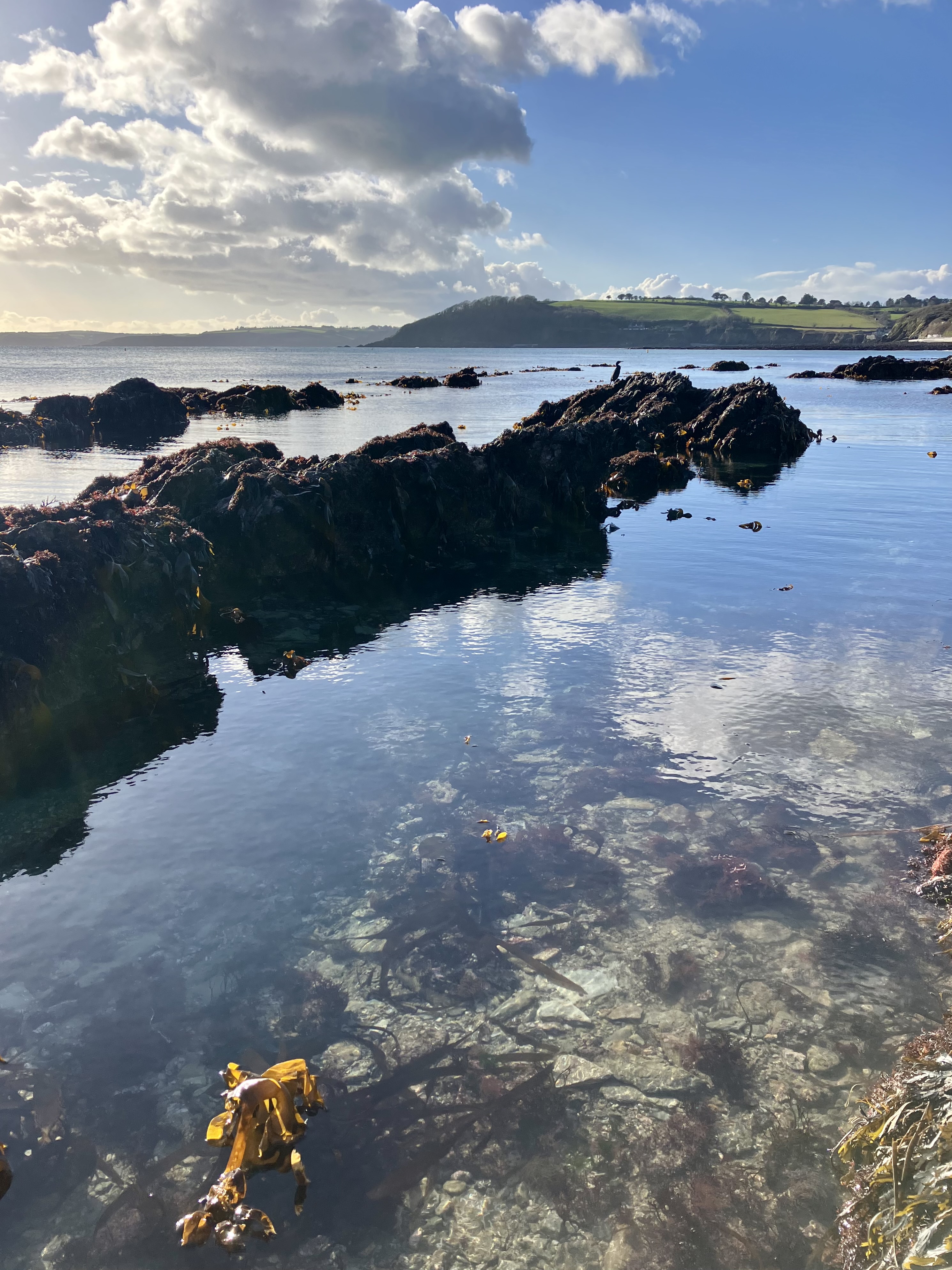
I tried my hand today at taking photos of rock pools above water – tricky! I used my Leica wide angle lens with a polarizing filter and a handheld strobe in a diffuser. It was fun playing around, although felt my back after an hour or so trying! It is difficult to keep the reflection of the flash out of the shot. The tide was not low so these are small, mid-shore pools dominated by coralline algae and some (fine) red seaweeds. Beadlet and snakelocks anemones, limpets, periwinkles, thick- and purple topshells are the most common animals. Some sunshine and blue sky – let’s see when I can try my hand at underwater photos again!

P.S. two extra pics taken a day later (without flash) near Bream Cove featuring an anemone-eating Aeolidia nudibranch.

beachcombing after storm Darragh

Storm Darragh raged over the UK last weekend – which by itself was not great, apart from the fact that there was a chance interesting stuff had washed up on the beach! As the winds came from the North, we drove to the long beach at Perranporth on the north coast to have a look. It was nice to get sandblasted for a bit and admire the furious crashing waves and icy blue-grey sea. Find of the day was a dead Grey Triggerfish (Balistes capriscus), a generally more southern species that is increasingly observed in the UK. Some other finds in the gallery below (shot with an iPhone; which is actually a lot easier than changing a wide angle for a macro lens on a wet, sandy beach!). Among the finds, Goose Barnacles, a Small-Spotted Catshark eggcase, an unidentified blob and a cuttlefishbone of the Pink Cuttlefish (Rhombosepion orbignyanum).

A Late October Snorkel

I have a lot more pics from this year to put on the blog but those have to wait, as I want to post some photos from last Saturday first, when there was little wind, a low tide and some sun! The viz was not great as expected, so I brought the macrolens and went in search for some small critters. No special finds, but I was very happy with my shots of a common little mollusc the European Cowrie (Trivia monacha). Most people will be familiar with this species as beach finds of empty shells, but not know how it looks like when it is alive, when its mantle covers most of the shell, it shows its striped tail at the back and a siphon and cute little eyes at the front. I used a shallow depth of field (f/4) to get rid of the ugly cluttered background, which worked well if I may say so myself (I need to try this technique more often!).

Many other critters were found too and I took shots of a selection. First, a Sea Spider, all legs and crawling away. A tiny mat of colonial tunicate that looked like a persian rug on drugs. A quick shot of the ubiquitous (if you know where to look – on kelp fronds) blue-rayed Limpets and a stalked jellyfish. Finally, I spent a lot of time taking shallow-depth-of-field AND slow shutter-speed photos of a scorpion spider crab in a snakelocks anemone to get some sort of ‘artistic’ shot. It did not really work, but it was fun nonetheless and I will have a go at it again. After almost 2,5 hours in the water I stumbled back to the car to get changed – an afternoon well-spent!