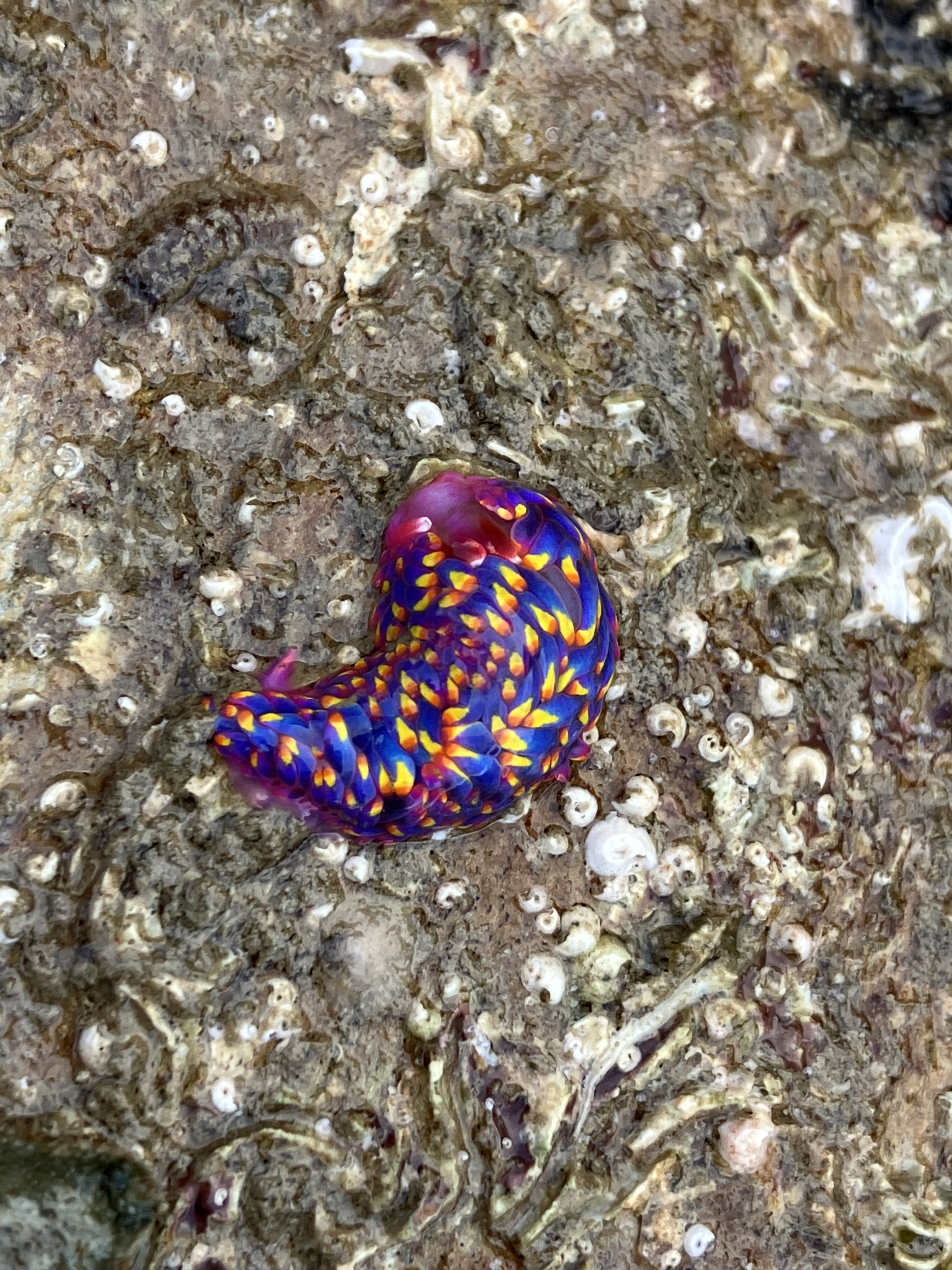
There have been a few finds lately at my local spot in Falmouth (and in other places in Cornwall) of the fantastically coloured Rainbow Slug Babakina anadoni. I have tried in vain so far to find it, but I did manage to find another species of Seaslug last Friday: Aeolidia filomenae. It is the opposite of the Rainbow Slug; large, not small, drab, not extravagant, and common instead of rare. More of an understated beauty I guess, and still a nice find! This species feeds on anemones (mainly Beadlet Anemones but also Snakelocks Anemones) rather than the Candelabrum hydroids the Rainbow Slug prefers. I am not very good at spottting nudibranchs so the plan is to keep looking this spring and find more species!


Easterlies (bad viz) and low tides meant some macro photography in the rockpools this Saturday. The water is getting chillier but staying in for two hours is still possible. I returned to a subject I tried my hand at before: the tube feet of a Green Sea Urchin (Psammechinus miliaris). The 60mm macro + cmc-1 wetlens plus some cheeky cropping gets me close, although I always want to get even closer! I was happier with the results than the previous times, so I posted it on instagram (@an_bollenessor). Below a more zoomed out view of the underside of the urchin, yours truly in the water, a common brittlestar, a small brittlestar, a pheasant shell, a tiny nermertean worm which might be this (thanks David Fenwick!) and a detail of a redspeckled anemone.


Many other critters were found too and I took shots of a selection. First, a Sea Spider, all legs and crawling away. A tiny mat of colonial tunicate that looked like a persian rug on drugs. A quick shot of the ubiquitous (if you know where to look – on kelp fronds) blue-rayed Limpets and a stalked jellyfish. Finally, I spent a lot of time taking shallow-depth-of-field AND slow shutter-speed photos of a scorpion spider crab in a snakelocks anemone to get some sort of ‘artistic’ shot. It did not really work, but it was fun nonetheless and I will have a go at it again. After almost 2,5 hours in the water I stumbled back to the car to get changed – an afternoon well-spent!


The Pheasant Shell is one of my favourite little critters in the rockpools in Falmouth. It is a bit weird to refer to these organisms as ‘shells’ actually, as they are living things and the nonliving shell is ofcourse only a part of them. The confusion extends to its scientific name: this species was previously known as Tricolia pullus, but has recently been split into a Southern European T. pullus species and a Northern European T. picta species. Perhaps the dust needs to still settle on that one.

I have taken these photos, on different occasions, with the mzuiko 60mm macrolens and the nauticam cmc-1 wetlens. The extra magnification the latter lens (screwed onto the housing) offers is great; although somehow I always want to get even CLOSER! I have not nailed the Pheasant Shell shot either. Reflecting on these pics I think I need to use a shallower depth of field to get rid of cluttered backgrounds. Next time.


The calcified operculum (the little door to close the shell) is clearly visible in the first photo above, as are the tentacles. On the second photo above you can even see that the left ‘neck lobe’ is more deeply digitated (fingerlike) than the right one. For more detailed (studio)shots of this and other molluscs please see Morddyn’s flickr account. I will post more macroshots of other mollusc species soon!

Last Friday I had a really enjoyable rockpool/snorkeling trip with my rockpool buddy David Fenwick (see his website aphotomarine for all your marine ID questions). Dave suggested we go far west, down to Sennen Cove where he knew about some interesting mini sea caves with jewel anemones and other things to explore. That is what we did, see the photo below!
Jewel anemones were indeed found in this spot….the water was too shallow to take a good photo though. I therefore jumped in the water where at first I got a bit seasick of all the waving Furbelows kelp. The water was noticeably colder than on the South Coast too. I discovered a nice deep gully with a whole variety of sea anemones growing on the vertical rock face. Orange, purple and green Jewel Anemones (Corynactis viridis) were common from 6 meters deep (at low tide). Very tricky for this middle-aged man to take good photos on one breath though! I was stumped by one white anemone but as Dave pointed out it looked like a Dahlia Anemone (Urticina felina) (and multiple ‘normally’ coloured individuals lived nearby so that makes sense). Finally a Sandalled Anemone (Actinothoe sphyrodeta) (my photos of the White-striped Anemone Anthothoe albocincta were unfortunately out of focus).


We had a blast and David found a Nemertean worm which might be new to the UK, or even new to science! It will find its way to aphotomarine eventually I am sure (check for ribbon worms here). I certainly like to go back snorkeling here some (windstill, swell-less) time.
When the viz is bad, I take my macrolens (sometimes with the Nauticam CMC-1 wetlens for a bit of extra magnification) out to the pools. Sometimes I stick to the surface of rocks and seaweeds (to look for stalked jellyfish for instance), but other times I turn over rocks under water to see what hides beneath. Quite a lot! There are larger animals, such as Topknots and different types of crabs (and Worm pipefish as pictured here) but mainly they are quite small (around a centimetre or even less). See the selection below (Tricolia, Bittium and Limacia were not from under rocks but I had to make the grid fit!).


I cheekily ordered a larger dome port last week (8 inch instead of 4 inch), which should suffer less chromatic aberration (unsharp corners), but also make it easier to compose splitshots (or ‘over-under’ shots) where the top half is above water and the bottom half below water. I played around with this type of shot a bit before with the small dome (e.g. see here and here) but it should be much easier with a larger dome. Anyway, the weather was such that I did not immediately have a go at it, but this Tuesday I figured I could give it a try at Fistral Beach in Newquay, which has some good rockpools that are not directly connected to the sea at low tide and might be still enough. It was bloody hard to get a decent shot in the deeper rockpools I tried first, as the difference in ambient light above and below water really necessitates the use of strobes to result in an even exposure, As I struggle with strobe lighting for normal shots, this was a bit too much to ask. My fallback was the ‘cave of dreams’ a rather grandiose name for a small overhang containing scarlet and gold cup corals (Balanophyllia regia) and Yellow hedgehog sponges (Polymastia boletiformis) (amongst other sponge species). (Check out THIS OLD POST on the cave of dreams with some decent pics I took with my old Canon Powershot camera.) Crouching down, I could barely fit under the overhang. The picture above looks like it is a substantial scene, but I could only submerge my domeport halfway! Using strobes would have been too finicky and probably result in quite unnatural light, so I bumped the ISO to 400, lowered the shutterspeed to 1/30 and used a 6.3 F-stop to get sufficient exposure using my micro four thirds Olympus camera. I needed to go down to a shutterspeed of 1/25 and a 5 F-stop for the close-up shot below. Here is to more experimenting this spring/summer!

P.S. the sponges have been going strong for a good while, see these pics from 2014/2015!


A while ago I played around with taking pics of the underside of a buoy, which was fun, and so i wanted to practice this some more. My mistake the first time (see here) was to use a fast shutterspeed (the buoy was bobbing about after all) which made the water look unnaturally dark. I tried again this weekend and it went a bit better, although I already know I can improve things. This time I thought it would be nice to put some names to the amazing fouling biodiversity (I did this before for some seaweed images, see here). Crustaceans (tube-dwelling Jassa), Sponges, Bryozoans, Seaweeds but especially a lot of Tunicates (seasquirts; both solitary and colonial species). David Fenwick (of AphotoMarine fame) had a quick look to help with some IDs; there is a more there but this was not meant to be exhaustive. I have underlined species that are invasive. Anyway, I am sure I will post more of these types of images: the buoys are always there and these organisms do not swim off when you try to take a photo!